Back to Blog

BlockSec arbeitet mit OKX Explorer zusammen, um die Einhaltung von On-Chain-Daten zu stärken

November 18, 2024

Das führende Blockchain-Sicherheitsunternehmen BlockSec ist eine strategische Partnerschaft mit OKX Explorer, einem der weltweit führenden Blockchain-Explorer, eingegangen. Diese Zusammenarbeit konzentriert sich auf die Interoperabilität von Blockchain-Daten, Produktintegration und API-Erweiterungen. Durch die Nutzung der gemeinsamen Stärken wollen BlockSec und OKX Explorer den Nutzern verbesserte Tools für die Blockchain-Analyse zur Verfügung stellen und so ein sichereres und transparenteres Ökosystem fördern.

Über BlockSec

BlockSec ist ein umfassender Anbieter von Web3-Sicherheitsdienstleistungen. Das Unternehmen hat es sich zur Aufgabe gemacht, die Sicherheit und Benutzerfreundlichkeit der aufstrebenden Web3-Welt zu verbessern, um deren Masseneinführung zu erleichtern. Zu diesem Zweck bietet BlockSec Sicherheitsaudits für Smart Contracts und EVM-Ketten, die Phalcon-Plattform für die Entwicklung von Sicherheit und die proaktive Abwehr von Bedrohungen, die MetaSleuth-Plattform für die Verfolgung und Untersuchung von Fonds und die MetaSuites-Erweiterung für Web3-Bauer, die effizient in der Kryptowelt surfen.

Für weitere Informationen über BlockSec besuchen Sie bitte https://blocksec.com/.

Über OKX Explorer

OKX Explorer ist eine führende Blockchain-Suchmaschine und Web3-Analyseplattform, die eine umfassende Abdeckung von über 55 öffentlichen Chains bietet, darunter BTC- und EVM-L1- und L2-Chains sowie heterogene Chains wie Tron und Solana. Es bietet umfassende Onchain-Daten, Entwickler-Tools, robuste OpenAPI und Explorer-as-a-Service-Lösungen.

Für weitere Informationen über OKX Explorer besuchen Sie bitte https://www.okx.com/web3/explorer.
Sign up for the latest updates
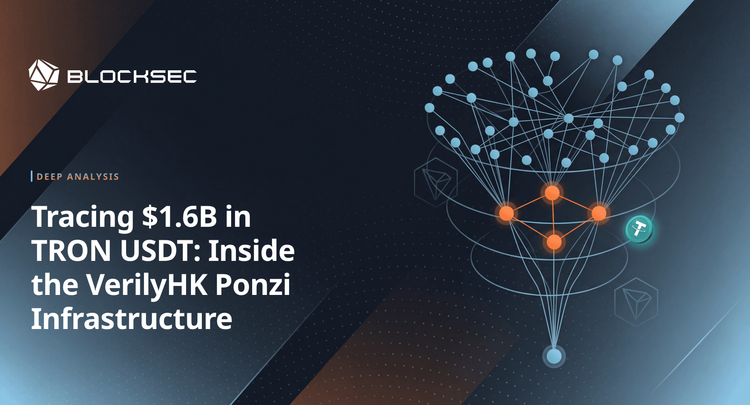
Tracing $1.6B in TRON USDT: Inside the VerilyHK Ponzi Infrastructure
Case Studies

Tracing $1.6B in TRON USDT: Inside the VerilyHK Ponzi Infrastructure

An on-chain investigation into VerilyHK, a fraudulent platform that moved $1.6B in TRON USDT through a multi-layered fund-routing infrastructure of rotating wallets, paired payout channels, and exchange exit funnels, with traced connections to the FinCEN-sanctioned Huione Group.

Weekly Web3 Security Incident Roundup | Mar 30 – Apr 5, 2026
Security Insights

Weekly Web3 Security Incident Roundup | Mar 30 – Apr 5, 2026

This BlockSec weekly security report covers nine DeFi attack incidents detected between March 30 and April 5, 2026, across Solana, BNB Chain, Arbitrum, and Polygon, with total estimated losses of approximately $287M. The week was dominated by the $285.3M Drift Protocol exploit on Solana, where attackers combined multisig signer social engineering with Solana's durable nonce mechanism to bypass a zero-timelock 2-of-5 Security Council, alongside notable incidents including a $950K flash loan TWAP manipulation against the LML staking protocol, a $359K Silo Finance vault inflation via an external `wstUSR` market donation exploiting a depegged-asset oracle and `totalAssets()` accounting flaw, and an EIP-7702 delegated-code access control failure. The report provides detailed vulnerability analysis and attack transaction breakdowns for each incident, covering flawed business logic, access control, price manipulation, phishing, and misconfiguration attack types.

Drift Protocol Incident: Multisig Governance Compromise via Durable Nonce Exploitation
Security Insights

Drift Protocol Incident: Multisig Governance Compromise via Durable Nonce Exploitation

On April 1, 2026 (UTC), Drift Protocol on Solana suffered a $285.3M loss after an attacker exploited Solana's durable nonce mechanism to delay the execution of phished multisig approvals, ultimately transferring administrative control of the protocol's 2-of-5 Squads governance with zero timelock. With full admin privileges, the attacker created a malicious collateral market (CVT), inflated its oracle price, relaxed withdrawal protections, and drained USDC, JLP, SOL, cbBTC, and other assets through 31 rapid withdrawals in approximately 12 minutes. This incident highlights how durable nonce-based delayed execution can decouple signer intent from on-chain execution, bypassing the temporal assumptions that multisig security implicitly relies on.