The previous article, From Incidents to Regulation: Why Crypto Institutions Need Blockchain Penetration Testing, set out why blockchain penetration testing is necessary. This article turns to what it is, examining the definitions and boundaries of blockchain penetration testing in more detail.
No widely accepted formal definition of blockchain penetration testing exists, and many proposed ones tangle it with other mitigations, so labels like audit, scan, and bug bounty are sometimes included as part of penetration testing even though each serves a different objective. That makes it harder to know what a given engagement actually validated. Our starting point, drawn from practice in both academia and industry, is deliberately simple: blockchain penetration testing is, as the name suggests, penetration testing—a discipline defined for decades—applied to the web3 ecosystem, carried out as an adversarial, whole-system assessment against a running web3 environment. Start from that familiar discipline, then ask what web3 adds to the threat model and to the judgment required of testers.
Blockchain penetration testing is an adversarial, hands-on assessment of a running system, conducted within an agreed environment and rules of engagement, to validate exploitable paths and control chains. It complements code-level security audits and can also be commissioned independently [1].
It seeks paths rather than isolated weaknesses and operates under explicit authorization, scope, access assumptions, and safety constraints. This article answers three questions: what blockchain penetration testing is, what it can validate—especially beyond the evidence an audit usually provides—and how an institution can begin at a high level.
Blockchain Penetration Testing
Find the path in — across contracts, nodes, APIs, and cloud
What web3 adds: the money-handling threat model
Web3 retains the traditional penetration-testing surfaces: cloud infrastructure, websites, APIs, identities, privileged access, vendors, and operational tooling. Rather than replacing that threat model with a blockchain-only one, it extends it into systems where the same footholds can lead directly into actions that authorize, account for, or move value.
Three characteristics shape that extension.
-
First, digital assets are directly transferable. An attacker who reaches the right transaction or withdrawal path may be able to move value without passing through the same reversal and reconciliation mechanisms used in traditional payments.
-
Second, signing is often a money-moving action. A cryptographically valid signature proves that a key authorized a payload; by itself, it does not prove that an operator saw the correct destination, understood the transaction, or followed the intended approval policy.
-
Third, when an institution deploys its own contracts—increasingly common as products add richer on-chain functionality—those contracts are publicly callable and composable. External users and other contracts can invoke them in sequences that the institution does not control. Security therefore depends not only on each component, but also on how identities, applications, policies, signing systems, accounting logic, and contracts interact.
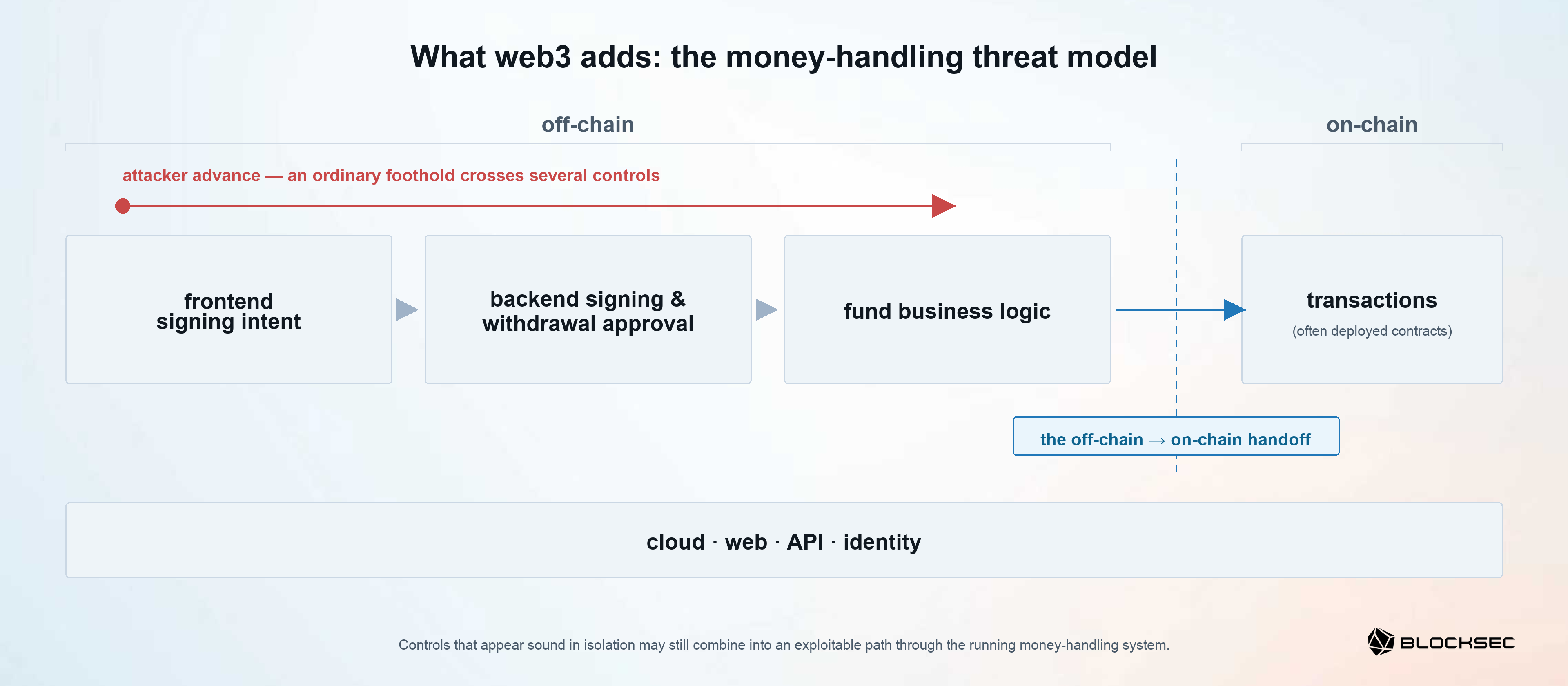
We model the resulting exposure as a money-handling chain—the off-chain signing intent, approval, and fund-logic controls that lead into on-chain transactions (and, increasingly, the institution's own deployed contracts)—alongside the cloud, web, API, and identity layers that support those steps [1]. An attacker may begin with an ordinary foothold and advance across several controls: manipulate what is presented for signing, reach a privileged workflow, exploit an authorization gap, or cause fund logic to accept an unintended state transition.
The defining composition gap is the handoff between off-chain and on-chain: whether identity, interface, approval, signing, and fund-logic controls preserve the intended action when it becomes an on-chain transaction. Not every attack traverses the whole chain. The point is that the assurance target is cross-layer: controls that appear sound in isolation may still combine into an exploitable path through the running money-handling system.
What blockchain penetration testing does
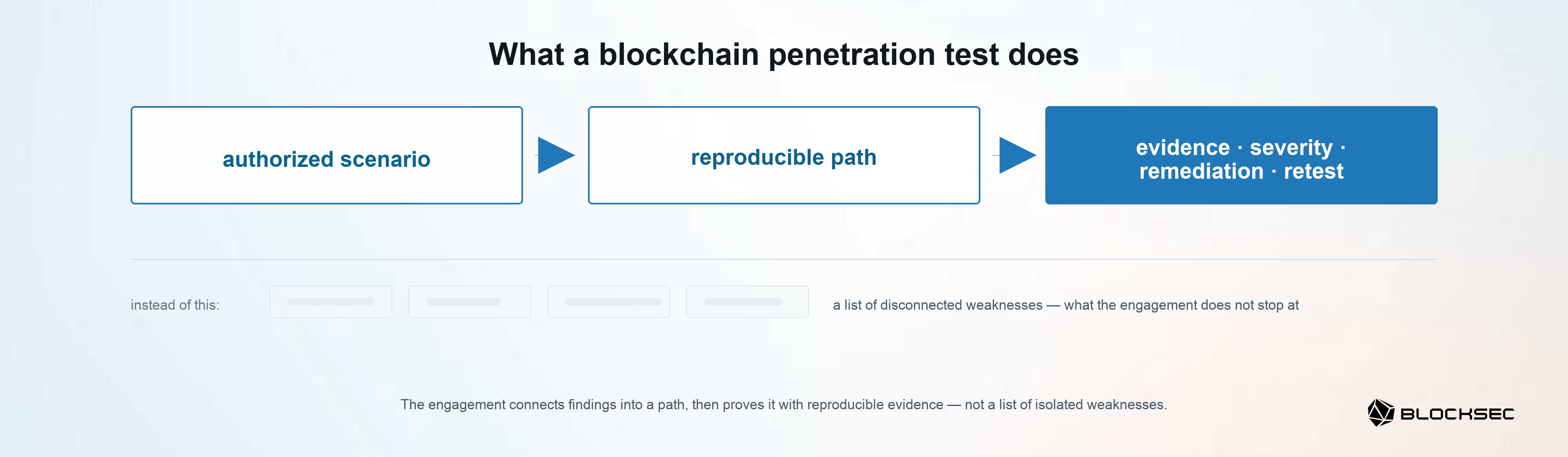
Blockchain penetration testing turns that composition gap into evidence. Within the authorized scope and agreed rules, testers translate cross-layer assumptions into attack scenarios, exercise those scenarios against the running environment, and determine whether they produce a reproducible path and concrete impact. The output connects the path to supporting evidence, severity, remediation guidance, and retesting of agreed fixes—rather than stopping at a list of disconnected weaknesses.
Its differentiator is specialist web3 security judgment, not a unique toolbox. Testers must interpret custody, transaction intent, approval policy, withdrawal flows, fund accounting, and on-chain transaction behavior (including deployed contracts) while connecting evidence from conventional cloud, web, API, identity, and privileged-access surfaces. Tools may support discovery or validation, but expert judgment establishes whether the observed conditions form a credible money-moving path.
The assessment is methodical, evidence-led, and point-in-time. Its conclusions apply to the systems, versions, configurations, access assumptions, and conditions tested. Potential paths are examined; confirmed exploitable paths are documented with reproducible evidence.
Please note that systematic work across the agreed surface cannot guarantee that every weakness or attack path will be discovered, and a responsible engagement does not guarantee that testers will achieve a breach.
Within an institutional web3 environment, that scenario-to-evidence process runs across five connected capabilities—the testable surfaces of the same money-handling chain. They span the infrastructure that supports the chain, its three off-chain controls, and the on-chain transactions it hands off to; they are connected because a single path can cross several of them:
-
Production environment and automation operations: testers validate whether access, deployment, secrets, or operational controls can be chained toward a money-handling action, producing evidence that links the operational foothold to its reachable impact.
-
Web and dApp frontends, authorization, and signing intent: testers validate whether the transaction presented to a user or operator can diverge from the action ultimately authorized, recording the manipulated flow and resulting signed or submitted behavior.
-
Signing, approval, and withdrawal authorization chains: testers validate whether identities, roles, policy checks, or approval steps can be bypassed or combined, documenting the sequence and the unauthorized action it enables.
-
Fund business logic: testers validate whether balances, limits, reconciliation, withdrawal rules, or state transitions accept unintended conditions, capturing a reproducible business-impact path rather than only a technical defect.
-
On-chain transactions and deployed contracts: testers validate how the institution's on-chain interactions behave under adversarial runtime conditions; where the institution has deployed its own contracts, they exercise those contracts' runtime behavior and preserve transaction-level evidence of the observed outcome. Code-level assurance remains the role of the matching Code Audit.
Part 4: Web3 Attack Surfaces: A Penetration Testing Overview maps these surfaces and their connections without changing the core objective: establish whether conditions across the agreed running environment chain into reproducible impact.
Where it fits alongside other assurance
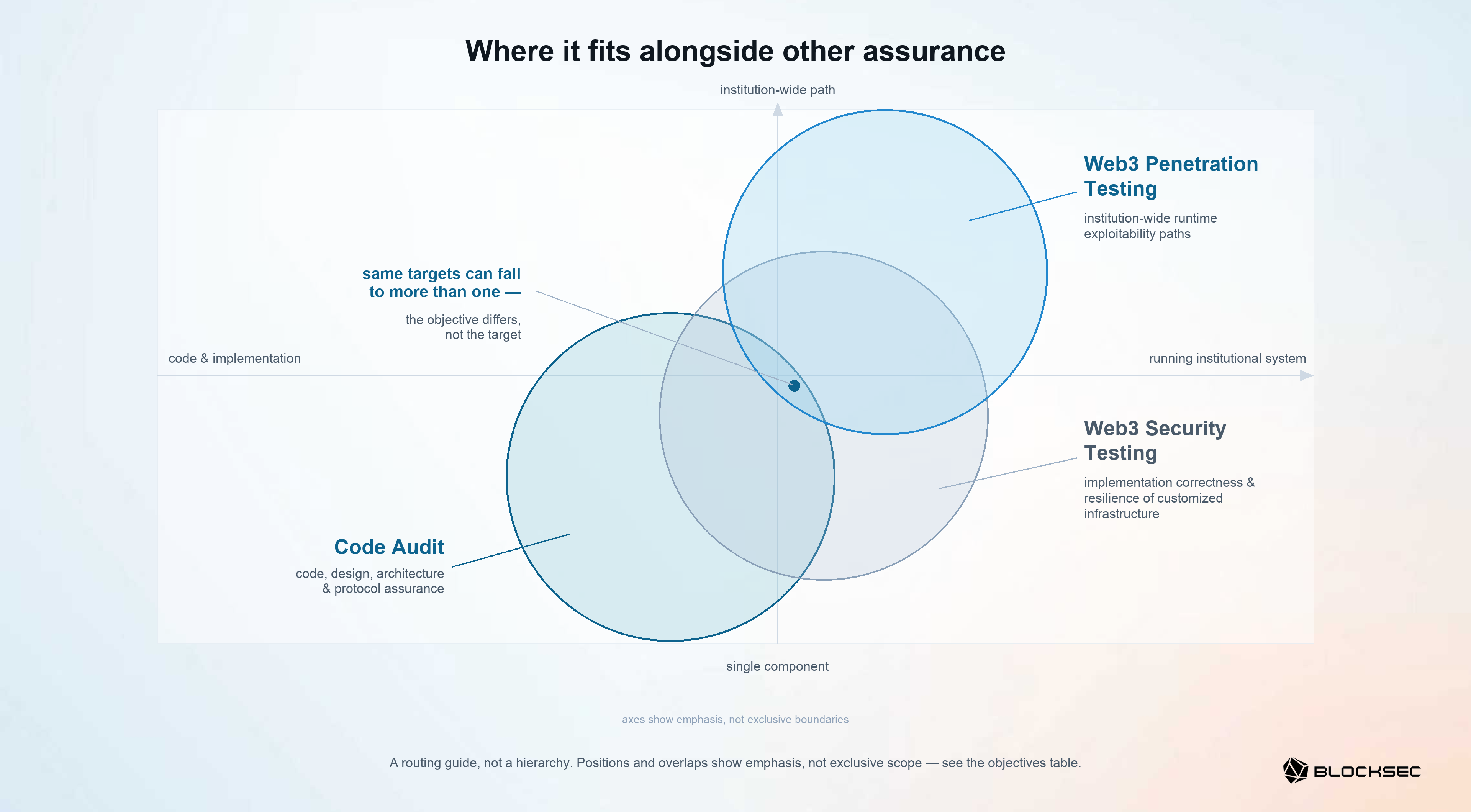
The clearest comparison is by assurance objective: the decision the work is intended to support and the evidence it is expected to produce. As shown in the figure below, methods can overlap, disciplines can collaborate, and no useful boundary depends on pretending that one team is exclusively static while another is exclusively dynamic. The same target—a deployed contract, a cloud or RPC surface, a signing system—can fall to more than one of these disciplines; what differs is the assurance objective each one emphasizes, not an exclusive claim on the system.
Penetration testing and code-level audit
A Code Audit—the named form of code-level audit—primarily builds assurance in code (also including the design, architecture, and protocol assumptions). It combines expert review with detection tooling, may include dynamic techniques, and produces a signed report against the agreed audit scope. For contracts, chains, bridges, rollups, wallets, or other implementations, the audit asks whether the design and code satisfy their intended security properties.
Penetration testing primarily establishes whether real conditions across an agreed, running institutional environment can be chained into reproducible impact. It follows the interaction among deployed applications, identities, configurations, workflows, business logic, signing systems, and contract calls, then records the evidence needed to reproduce and remediate the path.
This is a difference in objective and evidence, not a capability prohibition. Auditors may execute tests, fuzz components, and investigate runtime behavior; penetration testers may review configurations, application logic, and implementation details to understand a path. The methods may overlap and the teams may work together. The services are complementary, not substitutes: audit alone typically does not provide this institution-wide runtime exploitability evidence, while penetration testing does not replace code-level assurance in the implementation and protocol properties covered by an audit.
A contract's adversarial behavior in a live institutional path can therefore fall within penetration testing, while assurance about the contract code itself routes to the matching Code Audit.
Best Security Auditor for Web3
Validate design, code, and business logic before launch
Scanning, bug bounties, and specialized testing
Vulnerability scanning provides automated breadth across known signatures, exposed services, missing patches, and common configuration issues. It supports repeatable visibility and can contribute to reconnaissance, while penetration testing adds expert-led depth and determines whether conditions can be chained into a meaningful path.
A bug bounty invites independent researchers to report eligible findings under published rules. Its continuous, crowdsourced model can surface long-tail issues, while a penetration-testing engagement assigns a team to methodically examine an agreed environment and deliver consolidated evidence, severity, remediation guidance, and retesting. The two models are complementary and neither guarantees complete discovery.
For example, BlockSec's Blockchain Security Testing is a sibling program, not a parent or subset of penetration testing. It uses specialized engines—including differential testing, fuzzing, private deployment, large-scale RPC denial-of-service testing, and node or cluster infrastructure testing—to validate the implementation correctness and resilience of customized infrastructure [2]. Blockchain penetration testing centers on institution-level, cross-layer paths through the running money-handling system. Application hosting and application CI/CD route to the penetration-testing surface; node and cluster infrastructure and large-scale RPC resilience route to Blockchain Security Testing. An architecture may need both.
Nearby objectives also require precise routing. Contract code-level assurance routes to the matching Code Audit. Cryptographic correctness of key-custody implementations, including MPC, TSS, and TEE designs, routes to Wallet Security Audit. Payment-side agentic systems route to Agentic Payment Security [1]. Penetration testing may still examine the surrounding signing workflow, operational agents, or application path when it forms part of the agreed institutional scope.
| Assurance objective | Matching approach |
|---|---|
| Validate whether exploitable paths cross a running institution's applications, identities, approval controls, fund logic, and on-chain transactions (including deployed contracts) | Blockchain Penetration Testing |
| Assess code, design, architecture, or protocol assumptions | Code Audit |
| Assess cryptographic correctness in an MPC, TSS, TEE, or key-custody implementation | Wallet Security Audit |
| Validate implementation correctness and resilience of customized node, cluster, EVM, database, MPT, or large-scale RPC infrastructure | Blockchain Security Testing |
| Maintain broad, automated visibility into known signatures and configuration issues | Vulnerability Scanning |
| Invite continuous, incentive-driven research across a published eligible surface | Bug Bounty |
| Assess payment-side agentic systems and their security assumptions | Agentic Payment Security |
This is a routing guide, not a sequence. A single system may create multiple assurance objectives and therefore justify a coordinated set of assessments; the labels are not mutually exclusive.
Depending on the jurisdiction and institution class, testing may be a regulatory requirement or a supervisory expectation, and some regimes require an independent third party; Part 1 explains those distinctions [3]. Regulatory applicability should be confirmed with counsel.
How to get started
Prior to the decision, we may begin with the following three questions: Which systems are moving funds? What assurance evidence already exists? Which control chain has not yet been adversarially validated? The answers identify the assurance gap without prematurely choosing a service by name.
A scoping conversation can then align the target, access assumptions, safeguards, and expected deliverables. Part 3: Rules of Engagement and Production Safety for Institutional Blockchain Penetration Testing covers the authorization, safety, and coordination needed to operationalize the engagement [4].
When you are ready to act on this, scope your assurance gap with BlockSec to align the target, evidence, and safeguards before testing begins.
Continue through the attack-surface guides:
Also in this series, publishing soon:
- Part 5: Authorization and Signing Security: Web, dApps, and Mobile
- Part 6: Cloud and CI/CD Security: Automated Operations Attack Surfaces
- Part 7: Treasury Control-Plane Security: Signing and Withdrawal Approvals
- Part 8: Exchange Ledger Security: Theft Paths and Data-Plane Logic
The Blockchain Penetration Testing pillar page provides the engagement-level view.
References
Numbered in order of first appearance.
- BlockSec, Blockchain Penetration Testing.
- BlockSec, [Blockchain Security Testing], publishing soon.
- BlockSec, From Incidents to Regulation: Why Crypto Institutions Need Blockchain Penetration Testing.
- BlockSec, Rules of Engagement and Production Safety for Institutional Blockchain Penetration Testing.