If you're reading this, the money is already gone, or you just found out.
You're not alone, and the scale isn't personal. The FBI's Internet Crime Complaint Center recorded $5.8 billion in cryptocurrency investment fraud losses in 2024, rising to $7.2 billion in 2025. Pig butchering, the slow-build romance-into-investment scam that landed you here, accounts for the largest slice of that number. The DOJ estimates the pig butchering industry defrauds Americans of $9 to $10 billion per year.
Every guide will tell you to report the loss and hope. This one is more specific. Recovery from a pig butchering scam, when it's even possible, has two prerequisites: you need a formal report to law enforcement, and you need enough on-chain evidence for them to act. Both matter. Neither alone is enough. What follows walks both: the calm actions of the first hour, what a fund-flow report actually is and how it unlocks a CEX freeze, when pig butchering recovery is realistic, and how to spot the secondary "recovery service" scam that finds most victims next.
Pig butchering scam recovery in one paragraph. First hour: (1) stop all further transfers — do not send a "verification fee" or "unlock deposit." (2) File with FBI IC3 within 24 hours; for losses above $100K your case may reach the Recovery Asset Team, which in 2024 processed 3,020 cases and froze $561M — a 66% success rate on filed cases. (3) Preserve every wallet address, transaction hash, and platform screenshot. (4) Trace the money before it enters a mixer or off-ramp — Trace AI does this across the chains it supports. The IC3 freeze window closes fast once funds move off a compliant venue; the deep steps for each of the four above are below.
What to do in the first hour
The first hour after a pig butchering scam is about preserving what you still have: evidence, and the option to act. Every step below should take less than five minutes. Do them in order.
Step 1: Stop replying, but do not tell them you know
The instinct is to confront the person who scammed you, to send one last message, to threaten police, to demand your money back. Do not.
The moment the scammer knows you know, they close accounts, delete conversations, and rotate wallets. Every message they send you afterward is potential evidence: a name, a location detail, a link to the fake trading platform, another wallet address. Silent screenshots are worth more than any confrontation.
If they message you, do not respond. Do not block them yet. Read, screenshot, let it sit.
Step 2: Screenshot everything, before the fake platform vanishes
Fake pig butchering trading platforms come down within days once the scammer knows they're burned. Screenshot:
- The full conversation history, start to now. Most messaging platforms let you export a full log; do that too.
- Every screen of the fake trading platform: balances, "trade history," "withdrawal pending," any tax or fee notice, every subpage.
- The scammer's profile: photo, username, phone number, any linked social accounts.
- Any documents they sent you, such as fake exchange KYC, fake customer service transcripts, fake tax notices, fake court letters.
Save these in a single folder with a timestamp in the name. Do not edit them.
Step 3: Copy every transaction hash and destination address to a plain text file
This is the single most important thing you will save in this first hour. Open a text file, and paste, one per line:
- Every transaction hash (from your own wallet, from your exchange withdrawal history)
- Every destination address you sent to
- The date and time of each transfer
- Which chain each transfer was on (Ethereum, Tron, BSC, Solana, etc.)
- The amount and token
If you sent through a centralized exchange, log into it now and screenshot the withdrawal history page. Exchange records disappear behind account holds and closures faster than you'd expect.
This plain text file is the seed of your fund-flow report. Law enforcement can't do anything on a pig butchering case without it.
Step 4: If you're still logged into the fake platform, capture every screen
Do not click "withdraw." You're being farmed for one more deposit. Do not close the tab. Instead, screenshot every subpage. If there's a "customer support" chat, save the transcript. Take a full-page screenshot of the homepage.
Then close the tab and do not log back in.
That plain-text file of transaction hashes and addresses is what a tracing tool like Trace AI needs to produce your fund-flow report, which is the artifact you will attach to a law-enforcement complaint in the next section. For deeper analyst follow-up on complex cases, MetaSleuth is the same team's professional-analyst tool. What each one is for gets more detail below; for now you have what they need as input.
What to do in the first 24 hours
By hour 24, the money you sent is almost certainly no longer at the address you sent it to. What matters now is opening the parallel tracks that make pig butchering recovery possible at all: bank, filing, and the receiving exchange.
Call your bank about any wire transfers
If any part of the money left your bank as a wire, ACH, or debit card purchase (not crypto, but fiat), call your bank now, not tomorrow. Most banks have a 24-to-72-hour window during which they can attempt a reversal. Wire reversals rarely succeed against overseas accounts, but they do sometimes work against U.S. accounts if the funds haven't been swept.
Ask specifically for the fraud desk. Have the transaction date, amount, and destination bank name ready. Say: "I was defrauded in a cryptocurrency investment scam. I need to file a fraud claim and request a reversal."
Open a case with the FBI IC3 (US) or your national equivalent
Go to complaint.ic3.gov and file. It's free, takes about 30 minutes, and generates the case number that unlocks everything downstream. Without a case number, no exchange will freeze funds for you, and no other agency will treat your complaint as active.
Include, at minimum: the amount lost, transaction hashes, destination addresses, chain names, the scammer's contact info, and a short chronological narrative. Upload your screenshots. If you have the plain-text hash list from Step 3, paste it into the narrative field.
For losses above $100,000, your case may be routed to the IC3 Recovery Asset Team (RAT), the group that runs the Financial Fraud Kill Chain freeze process. In 2024 the RAT processed 3,020 fraud cases totaling $848 million in attempted losses and froze $561 million, a 66% success rate. Speed matters: the RAT window closes fast once funds are moved off a compliant venue.
The single artifact that turns your complaint into an actionable case, both for the RAT and for the receiving exchange, is a fund-flow report showing where the money went. Two BlockSec tools produce this artifact, and it's worth being clear about what fits when. Trace AI is the fast path: paste a wallet address or a transaction hash, and it returns a fund-flow report in hours. It's designed for exactly this handoff to law enforcement or CEX compliance in the first 72 hours. For deeper investigation, such as complex mixer paths, multi-victim aggregation, or custom analyst pivots, MetaSleuth is the professional-analyst tool built by the same team. Later sections walk through what the report actually contains and when each tool fits.
If you're outside the US, file with your national equivalent: Action Fraud in the UK, your national cybercrime unit in the EU, plus Europol EC3 for cross-border coordination. A section further down has jurisdiction-by-jurisdiction links.
Notify the destination exchange if you can identify it
If any destination address is one of the major CEX deposit addresses (Binance, Coinbase, Kraken, OKX, Bybit, HTX, etc.), you can usually identify this by pasting the address into a block explorer. Most CEX addresses are labeled. Notify that exchange's compliance address (usually compliance@ or abuse@; check their support page) with your case number and the deposit address. They won't discuss specific accounts with you, but the report enters their compliance queue.
The 72-hour window (why time-to-trace matters)
Investigators talk about the 72-hour window for a reason. It's roughly the time between a victim's transfer and the funds becoming unreachable to normal enforcement.
Pig butchering laundering has a consistent shape. Your money leaves your wallet or exchange and arrives at what the scammer calls a "corporate wallet," which is actually a fresh operator address. Within hours, it moves to a second wallet, then splits across three or four more. From there, it enters one of three exits: a cross-chain bridge (usually to Tron or a low-fee network for USDT), a mixer, or a series of intermediary exchanges in jurisdictions with weak compliance.
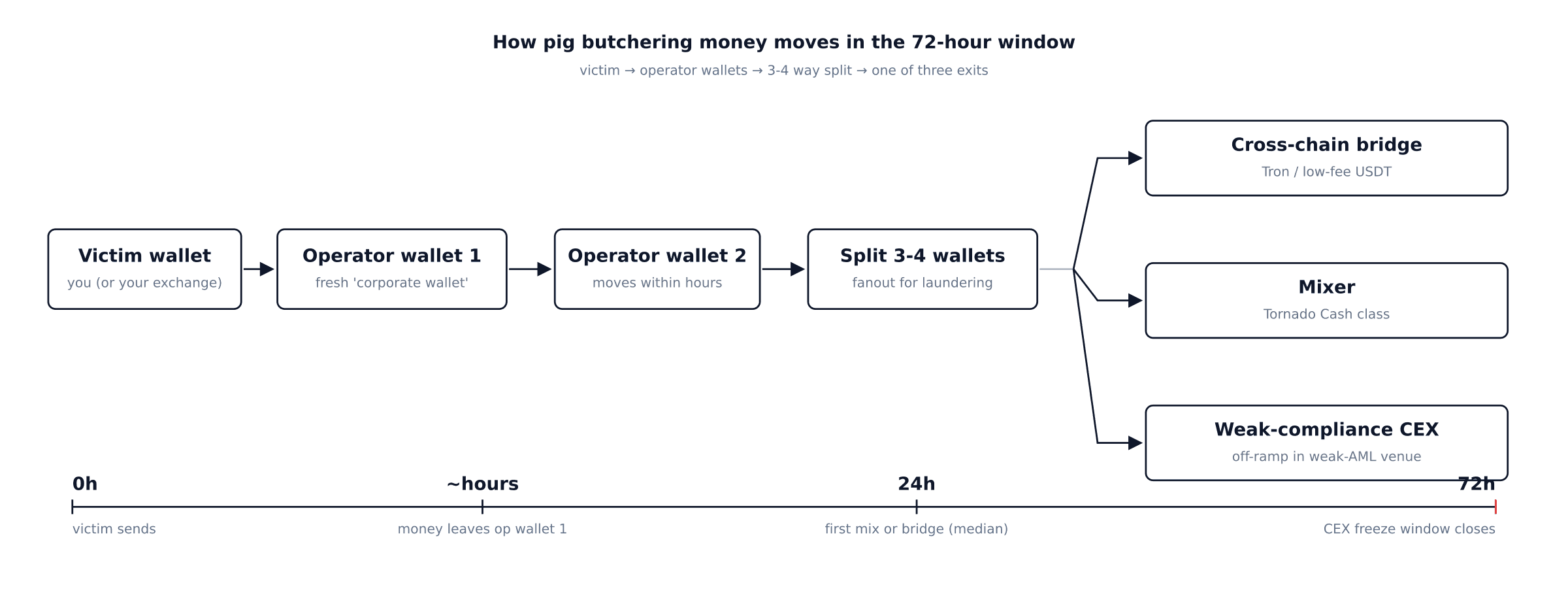
Median time from victim send to first mixing or bridging step is under 24 hours; by 72 hours the funds have typically moved past any single-exchange freeze.
The median time from victim deposit to first mixing or bridging step, based on public pig butchering cases, is under 24 hours. By 72 hours, most funds have made at least three hops and touched at least two chains.
Why does that time matter?
Because a CEX freeze, the only actually enforceable form of intervention short of a DOJ seizure, requires the funds to still be at that CEX's deposit address when the compliance team receives the request. Once the funds are moved out, they're one hop further away, and the request has to start over against a new exchange, in a new jurisdiction, sometimes on a new chain.
The 72-hour window is not magic. Recovery beyond it is possible; it's just harder and slower. But the first three days are when your report plus your fund-flow evidence has the highest chance of reaching an intact target.
That's why the next section matters more than any other in this guide. Understanding what tracing actually produces is what lets you produce it, or ask someone to produce it, before the window closes.
How the tracing actually works (and why law enforcement needs it)
This is the section most pig butchering recovery guides skip. It's also the one that most decides whether you'll get anywhere.
What "tracing" actually produces: a fund-flow report
When investigators talk about tracing stolen crypto, they mean producing a specific artifact: a fund-flow report. It's a visualization plus a written narrative that shows, in order, how the money moved:
- Where it started (your wallet or your exchange withdrawal)
- Every intermediate address it touched
- Every chain it crossed, via bridge or wrapping
- Where it currently sits, or where it exited into fiat
This is not a bank statement. It's not a table of transactions. It's a directed graph, with each hop annotated, each address labeled (exchange? mixer? bridge? unknown?), each timestamp recorded, each transfer amount tied to its source.
Why does the artifact matter? Because a fund-flow report is what compliance teams at exchanges act on. It's what DOJ investigators attach to seizure warrants. It's what your case number gets compared against. Without one, "my crypto was stolen" is a complaint. With one, it's a case.
What investigators actually map (plain-English mechanic)
The trace itself is a walk. You start at the send transaction, a specific transaction hash on a specific chain. You look at the destination address, and you list every subsequent transaction from that address. Each one has a new destination. For each new destination, you repeat.
If a destination is a known exchange deposit address, you've hit an exit: funds became someone's exchange balance. If it's a known bridge contract, you flag it and pick the walk up on the destination chain. If it's a mixer contract, such as Tornado Cash on Ethereum, the trace becomes statistical rather than deterministic. You can talk about probabilities across the mixer's output batch, but you can't point to a specific coin.
Most pig butchering traces are not intellectually complicated: five to fifteen hops, one to two bridges, one exit at an exchange in an under-regulated jurisdiction. The math is not the hard part. The hard part is doing it fast, at the level of specificity a compliance team will act on.
The Li/Zhang case: what a real fund-flow report looks like
BlockSec's research team documented a real case that illustrates the shape. Two operators, Daren Li and Yicheng Zhang, were indicted in May 2024 by a federal grand jury in the Central District of California. Their pipeline moved more than $73 million through Deltec Bank in the Bahamas, converted it to USDT, and distributed it across wallets that eventually received over $341 million from pig butchering investment schemes.
The fund-flow report on that case was court-admissible. It named the deposit addresses, the transaction hashes, and the timing correlations that tied the Bahamas accounts to specific victim funds. That report was the basis for a criminal case. It's not hypothetical work. It's the level of specificity that pig butchering recovery actually requires.
Why some 1-hop-from-CEX traces still get missed
Even when funds are visibly one hop from a compliant exchange, some freeze requests fail. BlockSec's team found a common reason: the compliance queue at a large CEX processes requests in first-in-first-out order, and pig butchering cases without a proper fund-flow report often get triaged below higher-value institutional alerts. The report itself is what promotes the case.
This is why the artifact, not just "I saw my money go to Binance," is what unlocks a freeze.
The victim's real problem
Producing a fund-flow report has historically meant one of two things:
- Engaging a paid forensics firm. These exist, they're competent, and their fees start around $5,000 for a basic trace, often much more. Turnaround is usually a week or longer.
- Working with a professional-analyst tool. Tools like MetaSleuth, the industry standard, built by the same BlockSec team, give an analyst everything they need to produce a report themselves. They're powerful. They're also built for analysts, not for a stressed pig butchering victim in the first 72 hours.
Both paths work. Neither meets the time constraint most victims face.
Two tools from the same team, for two different needs
BlockSec builds two products for this problem, and it's worth being clear about what fits when.
Trace AI is the fast path. You put in a wallet address or a transaction hash. It follows the funds across chains and returns a fund-flow report, the artifact you can attach to your IC3 or Action Fraud complaint, or forward to a CEX compliance team. It's designed for the "I need something usable this week" case, not for deep manual investigation.
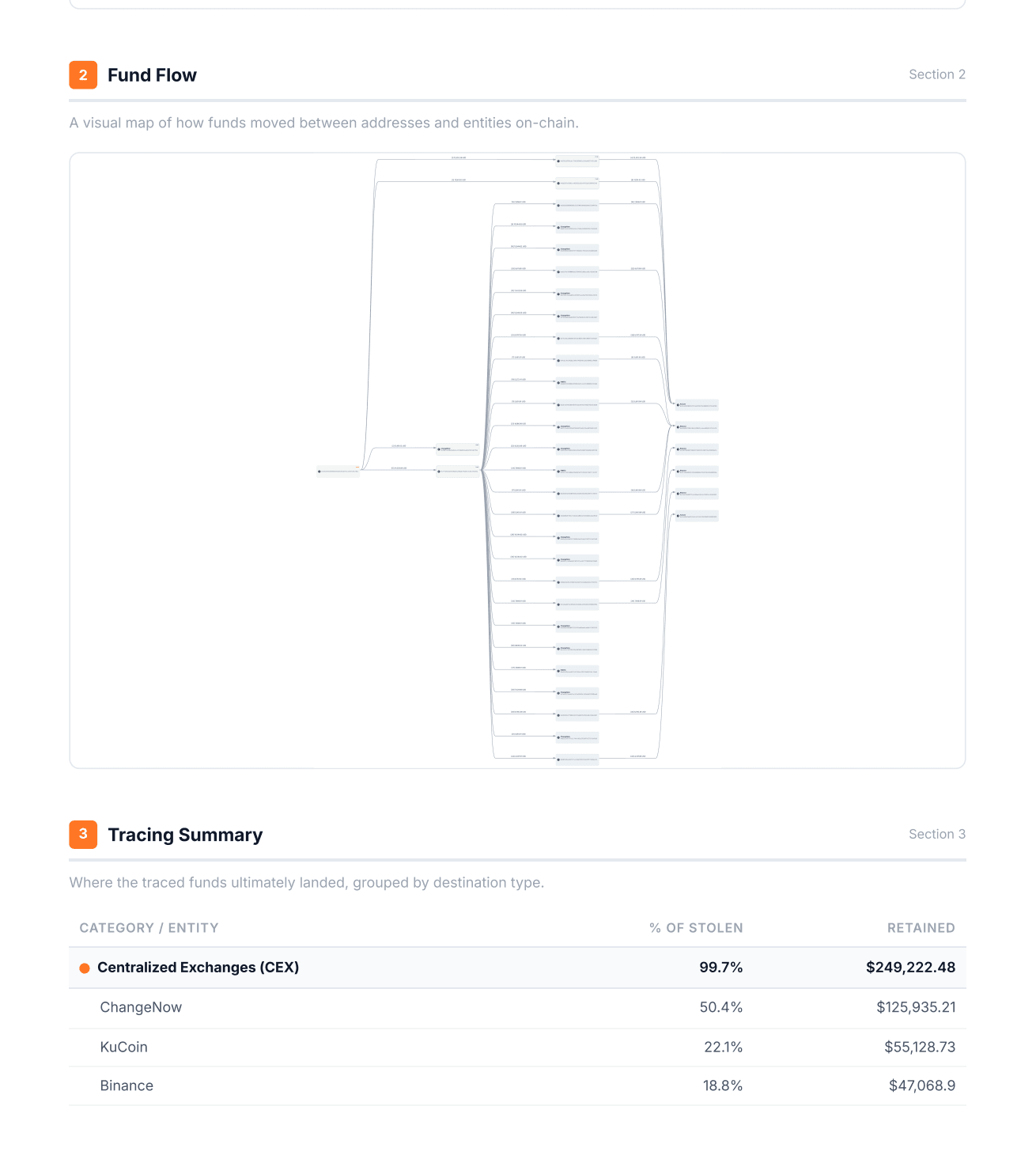
A real Trace AI investigation report, Section 2 (Fund Flow diagram) and Section 3 (Tracing Summary). This is the output — the exact artifact you attach to your law-enforcement filing. Open the full 6-page sample PDF →
MetaSleuth is the professional-analyst tool. If your case is complex, such as mixer pathways, cross-case aggregation, multi-victim clusters, or investigation that needs custom pivots, MetaSleuth is what you (or an analyst you hire) will use to go deeper.
Both feed the same goal. Trace AI for a report to hand over, fast. MetaSleuth or a forensics firm for the follow-up investigation. Neither replaces the other, and both have their place.
If neither fits your situation, a paid forensics firm with a strong pig butchering track record is the alternative. Expect several thousand dollars in fees and a week or more of wait, in exchange for litigation-ready reports.
When can stolen crypto realistically be recovered?
Honest answer first: most pig butchering losses are not recovered.
The FBI's Operation Level Up, which proactively contacts victims of ongoing pig butchering scams, notified 4,323 victims and prevented an estimated $285 million in additional losses in 2024. The DOJ's Scam Center Strike Force has, as of February 2026, seized more than $580 million in cryptocurrency tied to Chinese transnational pig butchering operations. Those are real, meaningful numbers. They are still small compared to the roughly $9 to $10 billion Americans lose to pig butchering scams every year.
Two gates decide whether your case falls in the recoverable slice.
The two gates
Gate 1: a case number from law enforcement. No case number, no exchange freeze, no DOJ interest. IC3 in the U.S., Action Fraud in the U.K., your national cybercrime unit elsewhere. This is the paperwork gate, and it's cheap to pass: 30 minutes online.
Gate 2: a fund-flow report the receiving CEX or investigator can act on. Without this, "my crypto was stolen and went somewhere on Ethereum" is not actionable. Both gates matter, and both are on you (or your investigators) to produce.
The three realistic scenarios
Once both gates are passed, what actually happens depends on where the funds went:
| Scenario | On-chain state | Recovery outlook | Timeline |
|---|---|---|---|
| Best case | Funds still at a compliant CEX (Coinbase, Kraken, Binance, OKX) | Freeze possible; DOJ seizure warrant reclaims the funds | Freeze in days; seizure in months |
| Middle case | Funds through a mixer (Tornado Cash) or in an intermediate wallet | Partial trace via statistical methods; recovery only if operator later withdraws through a compliant venue with your case still active | Months to years |
| Worst case | Funds through Huione Pay, informal peer-to-peer OTC in Cambodia/Myanmar/Philippines, or unlicensed exchanges | Recovery unlikely; legal reach limited | Recovery normally not achieved |
The best-case shape is where the IC3 Recovery Asset Team's 66% freeze success rate lives. The worst-case shape is where most pig butchering money actually ends up. That's why Operation Level Up focuses on prevention rather than recovery: it's much easier to stop the next transfer than to reclaim the last one.
Being honest about this matters. Anyone who tells you your funds are definitely recoverable is either uninformed or lying to you, which is the exact pattern of the recovery scam covered next.
Red flags: "recovery services" that are themselves scams
Pig butchering victims are the primary target of a second scam ecosystem, and the FBI has been explicit about it. IC3's official position (August 2025): "IC3 does not partner with any recovery company." Any recovery service claiming that partnership is lying.
Here's how the pig butchering recovery scam pattern works, and how to identify it before you send anyone more money.
1. Cold contact
Any recovery service that reaches out to you first, through a social-media DM, a comment on a forum or Reddit post, a phone call, a WhatsApp or Telegram message, is running the recovery scam pattern. Original scammers sell victim contact lists to recovery-scam networks. If you've posted about your pig butchering loss anywhere online, you're on those lists.
Legitimate forensic firms do not cold-call victims.
2. Upfront fees
Any variant: "processing fee," "legal fee," "escrow deposit," "network fee to unlock funds," "tax payment on recovered assets." Real forensic firms bill after a written engagement letter, not before contact.
3. False government affiliation
"IC3 partnership," "FBI-approved recovery agent," "authorized by DOJ," "certified by the Treasury Department." All fake. The FBI's July 2026 PSA on IC3 impersonation is explicit: IC3 never contacts victims through social media, and never charges recovery fees. Between December 2023 and February 2025 alone, the FBI received more than 100 reports of IC3 impersonation scams targeting prior pig butchering victims.
Some scams now use AI-generated video calls of "FBI agents." Treat any government-agent claim that comes through a channel other than an official U.S. government website as false.
4. Guaranteed recovery
Guaranteed recovery does not exist. Even the successful IC3 RAT freeze cases required specific conditions no third party can promise. Anyone guaranteeing pig butchering recovery is running the scam.
5. Requests for private keys or seed phrases
No legitimate investigation ever needs your private key or seed phrase. Not the FBI, not a forensics firm, not Trace AI, not MetaSleuth, not a court. This is the hard line, and there is no exception.
6. Named, publicly seized examples
In September 2024, the FBI's San Diego Field Office seized the websites of three companies operating as pig butchering recovery services: MyChargeBack, Payback LTD, and Claim Justice. All three had social-media advertising, testimonials, and claims of tracing capability. All three took upfront fees. None had a track record of recovery.
That's the pattern. Names change; the shape doesn't.
What real forensic help looks like
Written engagement letter before any payment. Explicit statement of scope and limits. Court-admissible reports as the deliverable. References you can independently verify. No percentage-of-recovery promise, and no upfront percentage either. Transparent about the honest cases where recovery isn't realistic.
How to file a formal report
What law enforcement actually needs from you
Whichever jurisdiction you file in, the deliverables are the same. Investigators can't work with narrative alone. Have ready, at minimum:
- Every transaction hash: sends from your wallet, exchange withdrawals to the scammer's addresses, everything you actually paid
- Every wallet address involved: your addresses, the scammer's destination addresses, any intermediate addresses you noticed
- Chain name and timestamp for each transfer: Ethereum, Tron, BSC, Solana, whatever it was, with the date and time
- Screenshots of the fake trading platform, the in-app messages, and the conversation history that led up to the transfers
- The first-contact channel: WhatsApp, Telegram, Bumble, WeChat, LinkedIn, dating apps, whatever platform they used to find you
- Ideally, a fund-flow report or visualization showing where the money moved (see previous section on producing one)
The more of this you provide, the faster your pig butchering case moves. Missing hashes and addresses are the most common reason a case sits.
US: FBI IC3, FTC, local police
- FBI IC3: complaint.ic3.gov. The federal starting point. Takes 30 minutes.
- FTC: reportfraud.ftc.gov. File in parallel. FTC and IC3 do not share data automatically.
- Local police: file at your local station. Ask specifically for a case number and an incident report copy, which is what banks and exchanges will ask for.
UK: Action Fraud
File at actionfraud.police.uk or call 0300 123 2040. Ask for a Crime Reference Number (CRN), which is what UK banks and exchanges need.
EU and elsewhere
File with your national cybercrime unit (Germany: BKA; France: PHAROS; Italy: Postal Police; and so on), and mirror the report to the Europol Cybercrime Centre (EC3) for cross-border coordination.
If you're outside the EU or UK, file with the national police unit that handles cybercrime, and mirror the report to Interpol via your country's National Central Bureau.
Cross-border: what your case number gets you
Your case number is not just for statistics. It's the string that a receiving exchange's compliance team, a foreign law-enforcement contact, or a DOJ attaché will look up. Include it in every follow-up email. Include it when you contact any exchange's compliance address. Include it if you later engage a forensic firm.
Without the number, you're a complaint. With it, you're a case.
Frequently Asked Questions
Can you actually recover money from a pig butchering scam?
Sometimes, but not usually. FBI Operation Level Up notified 4,323 pig butchering victims and prevented $285 million in additional losses in 2024, and the IC3 Recovery Asset Team froze $561 million across fraud cases the same year. Meaningful, but small against the $9 to $10 billion Americans lose to pig butchering annually. Recovery is most realistic when funds still sit at a compliant exchange and law enforcement has an active case number and fund-flow evidence.
How long does crypto tracing take for a pig butchering case?
A basic fund-flow trace across two to three chains, for a normal 5-to-15-hop pig butchering laundering path, can be produced in hours to a day with modern AI-driven tools, and in one to several weeks by a traditional forensics firm. Deep manual investigation into multi-victim aggregation or complex mixer paths takes analysts weeks. Time-to-report is what usually decides pig butchering recovery outcomes.
What is the "72-hour window" and does it really matter?
The 72-hour window refers to the roughly three days between a victim's transfer and the funds passing beyond the reach of ordinary enforcement, usually via mixers, bridges, or off-ramps in weak-compliance jurisdictions. Pig butchering recovery is still possible after 72 hours, but the odds drop sharply because a CEX freeze requires the funds to still be at that exchange's deposit address when the request lands.
Is it worth reporting to the FBI if the loss is small?
Yes. IC3 aggregates reports to identify pig butchering laundering patterns and repeat wallet infrastructure. Your report may connect to a larger case being built. Filing is free, takes about 30 minutes, and generates the case number that banks, exchanges, and any future forensic firm will require. Even if your loss is a few hundred dollars, file.
What is Operation Level Up?
Operation Level Up is an FBI initiative launched in January 2024 that identifies victims of active pig butchering scams, often before the victim knows they've been scammed, and proactively notifies them. By the end of 2024 it had contacted 4,323 victims and prevented $285 million in additional losses. It also refers victims in crisis to FBI victim specialists, including for suicide intervention.
Are crypto recovery services legitimate?
The vast majority are not. FBI IC3 has been explicit that it does not partner with any recovery company, and in September 2024 the FBI's San Diego field office seized the websites of three of them: MyChargeBack, Payback LTD, and Claim Justice. Legitimate forensic firms exist, but they do not cold-contact pig butchering victims and do not charge upfront fees. Any that do are running the recovery scam.
Should I hire a blockchain forensics firm or an attorney first?
Depends on what you need first. If you need a fund-flow report to attach to your IC3 filing quickly, an AI-driven tracing tool like Trace AI can produce one from a wallet address or transaction hash in hours. For deeper investigation, such as mixer analysis, litigation-ready reports, or multi-victim aggregation, a professional forensics firm using MetaSleuth-class tools, or an attorney with crypto experience, is the right next step. Trace AI for a fast report to hand over; MetaSleuth or a firm for the follow-up.
Related reads
- Taint Analysis in Crypto: How Investigators Trace Stolen Funds: the educational primer on how the tracing math actually works
- How the U.S. Traced $110M in Crypto Money Laundering: the Li/Zhang case in full, from BlockSec's investigation team
- Shedding Light on Shadows: Automatically Tracing Illicit Money Flows on EVM-Compatible Blockchains (SIGMETRICS 2026, Best Paper Award Runner-Up): the academic research behind the tracing techniques used in this article
- Trace AI product page: the fund-flow reporting tool referenced above
Trace AI traces stolen crypto across 8 chains and produces a full fund-flow report from a wallet address or transaction hash. See how it works →
About the author

Andy is co-founder of BlockSec and the technical lead behind MetaSleuth and Trace AI. He is also an associate professor at The Chinese University of Hong Kong, where his research focuses on system and blockchain security. Personal homepage: yajin.org.