Executive Summary
Selecting a crypto compliance platform requires mapping operational use cases against actual vendor capabilities. A reliable evaluation framework tests data granularity, workflow efficiency, investigation capacity, API integration readiness, and vendor support via historical cases rather than marketing materials.
Crypto compliance operates as a core business function for exchanges, stablecoin operators, custodians, and payment processors. Analysts rely on wallet screening, transaction monitoring, on-chain analytics, and case management to track fund movements and adapt to shifting illicit typologies.
Vendor landscapes frequently blur under overlapping terminology. System constraints usually surface during live operations: whether the infrastructure correctly flags sanctioned entities, if alert logic is traceable, how defensible the source-of-funds analysis remains during audits, and whether case evidence exports cleanly without manual reformatting. Financial crime teams consistently rank alert precision and explainability above additional dashboard visualizations.
This checklist offers AML analysts and compliance directors a structured approach for procuring a system that aligns with production workloads. It details how combining security intelligence with compliance monitoring reduces friction across detection, investigation, and regulatory reporting.
Core Insights
Procurement should prioritize reliable risk intelligence, analyst throughput, clear audit trails, and infrastructure compatibility over raw feature counts. Vendor assessments yield the best results when run against live scenarios and measurable operational metrics.
Five principles guide a functional evaluation. First, document internal compliance requirements prior to vendor discussions. Second, benchmark asset and protocol coverage against the specific tokens the firm handles. Third, verify that alert algorithms filter out routine noise while retaining verifiable risk indicators. Fourth, review investigation interfaces as formal audit controls rather than just analyst aids. Fifth, assess the vendor's competency in both on-chain security incidents and regulatory reporting frameworks.
This distinction carries weight because digital asset financial crime routinely intersects with technical exploits. Tracing obfuscated flows across cross-chain swaps, compromised key events, bridge protocols, and phishing infrastructure generates transaction patterns that standard rule engines frequently miss. Through 2024, exploits and contract vulnerabilities misdirected assets at scale, with subsequent laundering attempts heavily utilizing mixers and high-risk routing services.
Define the Compliance Problems the Platform Must Solve
A structured evaluation anchors on an explicit operating model. AML teams need to document their decision-making steps, the specific risk vectors they must monitor, and the reporting procedures required. Skipping this phase often leads buyers to over-index on visual analytics while underestimating basic screening and queue management constraints.
Map your core use cases: wallet screening, transaction monitoring, investigations, and reporting
The initial requirement involves mapping system utility across the transaction lifecycle. Wallet screening manages onboarding checks, withdrawal clearance, and scheduled risk reviews. Transaction monitoring tracks volume changes, unusual routing, high-risk entity exposure, and behavioral shifts over a given timeframe. Investigations synthesize these alerts into a documented sequence of events. Reporting translates that sequence into formats ready for external review.
AML departments should clarify user roles for each function. Front-line staff require fast triage interfaces, whereas senior investigators need multi-hop tracing utilities and detailed case annotation features. Compliance directors typically require trend analysis, governance metrics, and packaged evidence files for regulatory exams. Teams operating with mapped workflows process on-chain alerts faster than those relying on ad hoc analyst methods.
Identify the assets, chains, and risk scenarios your team handles most often
Protocol coverage requires alignment with the firm's specific business lines. Stablecoin operators need visibility into minting behaviors, redemption flows, and smart contract interactions. Centralized exchanges typically focus on deposit screening, withdrawal limits, sanction exposure, and tracking proceeds from external hacks. Custodians require address whitelisting, institutional wallet oversight, and strict escalation logs.
Analysts should compile a baseline of frequent risk events: ransomware deposits, phishing inflows, exposure to compromised protocols, mixer routing, sanction-adjacent clusters, and sudden cross-chain asset movements. These specific events serve as the baseline for the vendor testing phase.
Separate must-have AML controls from nice-to-have analytics features
Software can present well visually while failing as a formal control system. Necessary capabilities include adjustable risk parameters, visible scoring logic, exact entity attribution, structured alert queues, standard case management, untampered evidence logs, strict user permissions, and reliable data exports. Secondary additions might include broad market data feeds or personalized interface themes.
The functional benchmark remains straightforward: if an external auditor or internal compliance lead questions the generation, escalation, or dismissal of an alert, the system must independently provide the historical rationale.
Checklist 1: Data Coverage and Risk Intelligence
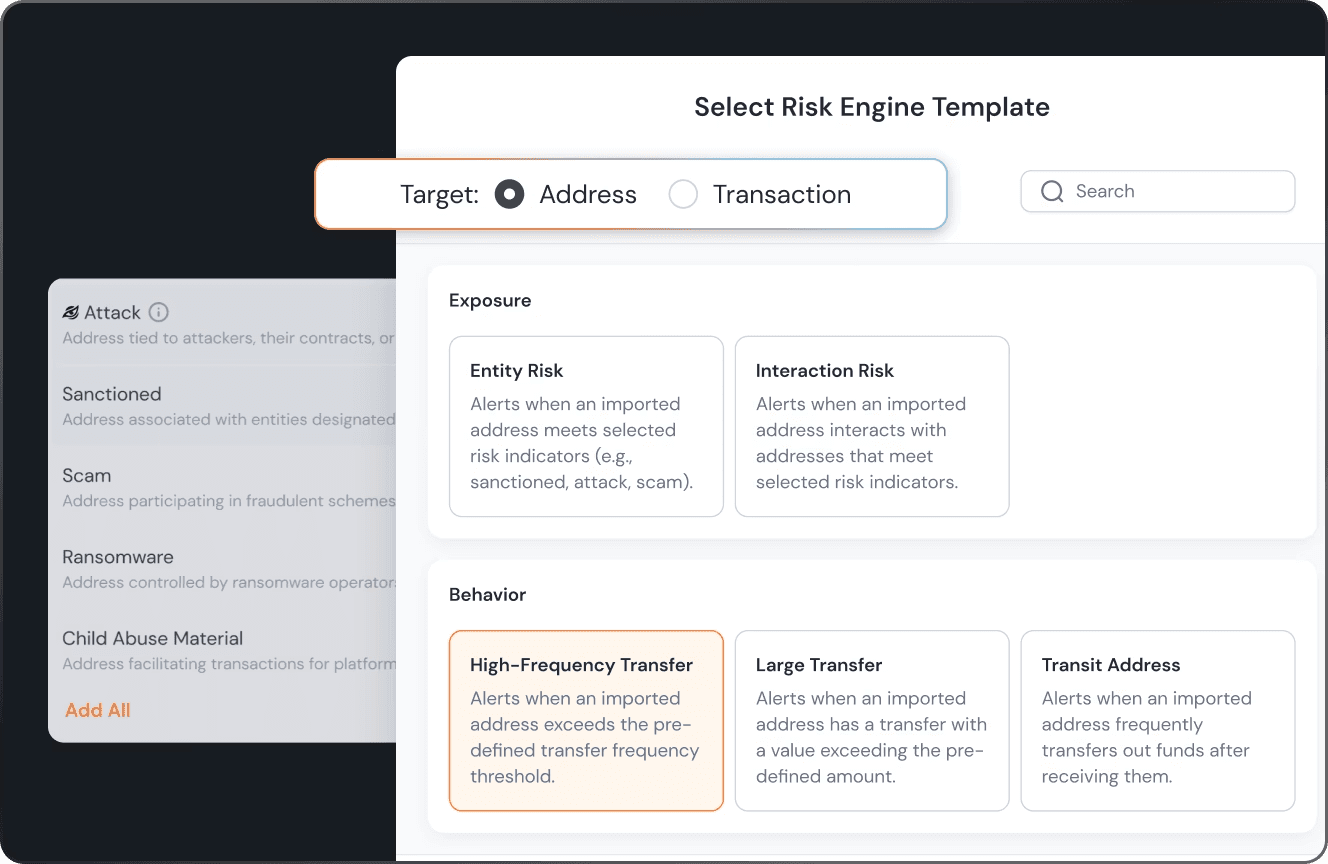
Systematic data collection limits blind spots, while the intelligence layer dictates classification accuracy. AML teams must review supported blockchains, token standards, attribution accuracy, sanction detection, illicit flow tracking, and the frequency of typology updates.
Does the platform support the blockchains, tokens, stablecoins, and DeFi protocols you monitor?
Many operational gaps begin with unsupported assets or partial token parsing. Evaluators must verify compatibility for native networks, token formats, fiat-backed stablecoins, cross-chain bridges, decentralized exchanges, lending pools, and relevant smart contract behaviors. For departments managing stablecoins, contract-level analytics are essential since risk frequently surfaces during protocol execution rather than native currency transfers.
Cross-chain asset movement requires specific testing. Illicit operators routinely route funds via bridges and decentralized swaps to break tracing links. Multi-chain routing is standard practice following protocol breaches, especially when diverted assets are fragmented into minor transfer paths. The selected software needs to track these variations without requiring investigators to manually compile every transfer hop.
How transparent are entity labels, attribution sources, and risk categories?
Entity tagging provides value only when investigators can trace the underlying rationale. A functional compliance architecture differentiates between verified attributions, probabilistic heuristic clusters, reported off-chain exposure, and algorithmic behavioral risk. It must distinctly categorize sanction proximity, fraudulent activity, diverted protocol funds, darknet market interactions, mixer deposits, and other established categories.
Evaluators should investigate how vendors source, validate, and maintain their attribution tags. Designations derived from law enforcement directives, government sanction lists, technical incident post-mortems, contract vulnerability analysis, and tested heuristics carry varying confidence weights. The interface should not display all categorizations with identical certainty levels.
Can the platform detect sanctions exposure, illicit funds, mixers, scams, hacks, and high-risk services?
Detection algorithms require testing against verified high-risk data sets. AML personnel can assemble a repository containing sanctioned public keys, addresses implicated in known protocol exploits, fraud-linked incoming transfers, mixer interaction addresses, and routing via high-risk operational entities. Providers must detail not just if they flag the exposure, but the specific mechanics of the score calculation and the underlying data points.
Missed detections present the primary regulatory risk. Conversely, excessive false positives lead to resource exhaustion and degraded investigator attention. The objective is not an arbitrary numeric score; the goal is contextual risk intelligence that supports timely, justifiable case decisions.
Checklist 2: Screening and Monitoring Workflow Quality
Screening utility depends on latency, parameter controls, and logic transparency. Compliance teams require oversight capabilities prior to, during, and following user transactions. Alert thresholds must map to institutional risk policies, jurisdictional mandates, client classifications, and transfer behaviors while maintaining visible evidence for each risk indicator.
Can analysts screen wallets and transactions before, during, and after customer activity?
Wallet screening functions primarily during client onboarding or preceding transaction authorization. Transaction monitoring analyzes the transfer either synchronously or immediately post-execution. Scheduled rescreening protocols remain necessary because an address deemed compliant previously might intersect with newly identified risk clusters.
Processing latency dictates operational viability. If the monitoring pipeline lags, high-risk capital withdrawals may execute before compliance review concludes. If screening rules block excessive legitimate volume, commercial departments often push to degrade the control thresholds. Entities utilizing synchronous or near-synchronous monitoring carry a lighter manual post-transaction review burden than those on batch-processing architectures.
Are alerts configurable by risk appetite, jurisdiction, customer type, and transaction behavior?
A retail-focused trading venue, a stablecoin issuer, and a wholesale custodian operate under divergent risk thresholds. Within a single entity, tolerance parameters shift across user tiers, product offerings, geographic zones, and transfer volumes. The underlying infrastructure should permit rule adjustments without mandating developer intervention for routine modifications.
Compliance administrators should verify adjustable threshold settings, category-specific risk weightings, client tiering parameters, transfer velocity rules, exposure-hop limits, and automated routing paths. A verified institutional participant interacting with a standard lending protocol demands a separate review matrix compared to a newly registered account receiving capital from a recognized fraud cluster.
Does the system reduce false positives without hiding explainable risk signals?
Volume reduction algorithms provide utility only when they preserve critical risk indicators. The platform must consolidate related warnings, merge redundant exposure paths, and map the risk trajectory accurately. It should never obscure underlying data points behind a generic low-risk designation.
During the technical assessment, investigators should evaluate the interface queue side-by-side. Assess which interface accelerates case determination, maps both direct and secondary exposure hops, and retains the exact rationale for alert dismissal. These functional questions measure operational utility far more effectively than standard feature matrices.
Checklist 3: Investigation, Case Management, and Audit Readiness
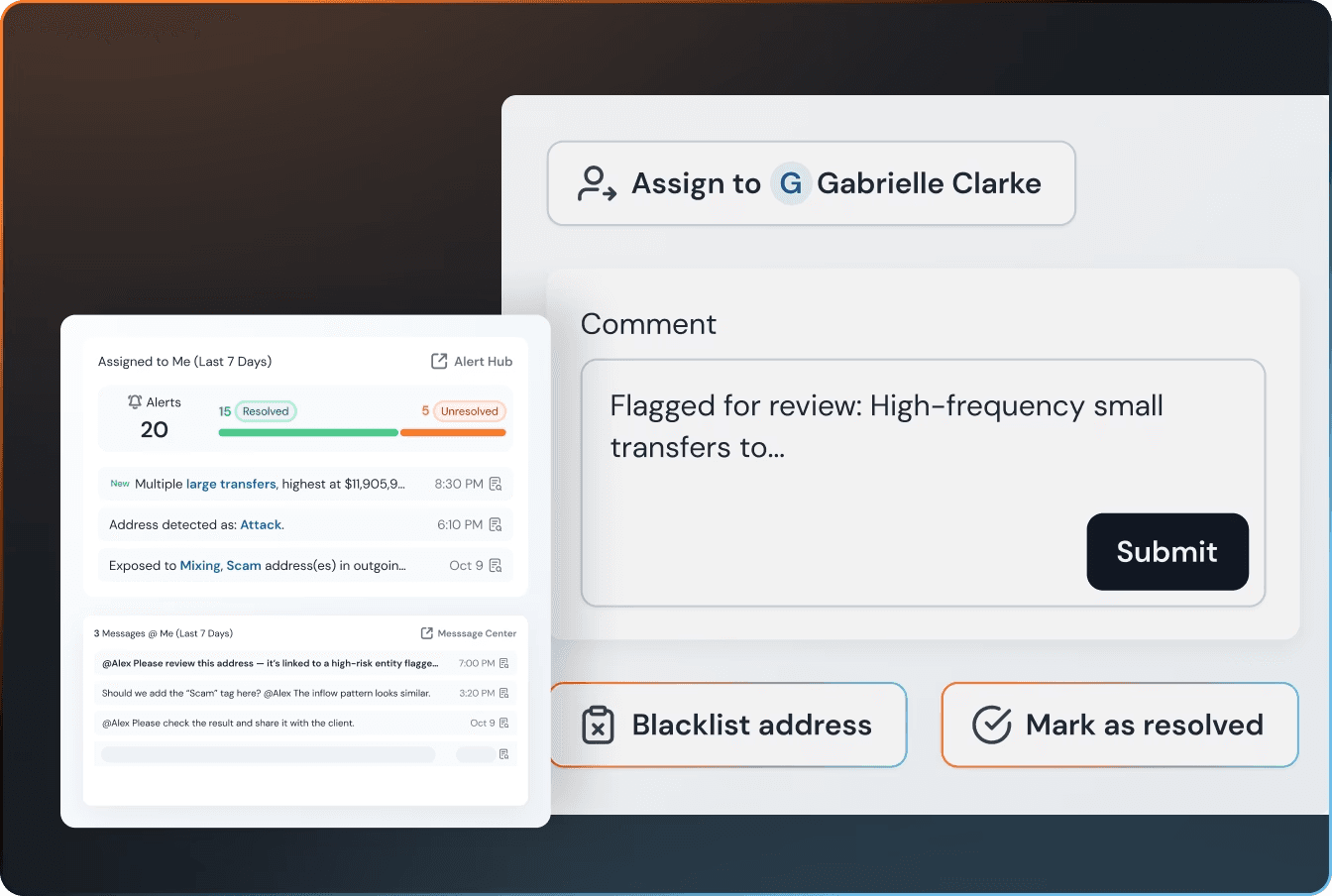
Investigation phases convert raw alerts into formal determinations. The compliance architecture must enable investigators to track asset paths, log analytical logic, route escalations, secure evidence, and generate export files. Audit preparation needs to operate as an embedded function rather than a retroactive data collection exercise.
Can analysts trace source and destination of funds across hops and chains?
On-chain investigations demand more than a basic node visualization. Analysts must map capital origins and destinations, measure exposure distance mathematically, pinpoint intermediary routing addresses, classify service providers, and parse smart contract executions. Cross-chain asset tracking becomes critical when capital flows through decentralized bridges post-exploit.
Investigators require tools to validate operational hypotheses: Did the initial deposit originate from a verified protocol breach? Did the assets route through privacy protocols? Did the user transact with a sanctioned entity cluster? Did the flagged proceeds fragment across multiple recipient addresses? Tracing cross-chain asset movement consumes considerably more analyst time when teams work without unified tracking utilities.
Does the platform support evidence capture, case notes, escalation, and reviewer workflows?
Case files must record the complete analytical lifecycle. Staff must be able to append interface captures or raw system logs, insert standardized notes, delegate ownership, route files for secondary review, log managerial sign-offs, and terminate alerts using uniform closure codes. Secondary review functions enable compliance management to prove that case dismissals follow structured, consistent policies.
All recorded evidence requires permanent timestamping linked directly to the data state present during the initial review. This requirement addresses the reality that entity categorizations and risk weightings update as off-chain intelligence evolves. A structurally sound case file proves what the investigator observed, the subsequent actions taken, and the underlying justification.
Are reports exportable in formats suitable for internal audit, regulators, and law enforcement requests?
Reporting output must serve practical administrative functions. Compliance departments typically require executive summary documents, raw transaction data files, graphical tracking representations, risk parameter breakdowns, and chronologically ordered case notes. These documents must remain accessible and legible for reviewers lacking deep technical blockchain expertise.
A functional export file details concrete variables: specific addresses, transaction identifiers, precise timestamps, tagged entities, risk proximity classifications, the identified flow path, specific investigator annotations, and the ultimate resolution. Competent software architecture minimizes the administrative hours spent formatting data so personnel can allocate time to analytical judgment.
Checklist 4: Integration, Security, and Operational Fit
Software implementations must align with current operational constraints. The quality of system integration, interface stability, processing speed, data governance, access controls, reliability metrics, and hosting options dictate if the infrastructure can sustain production loads without degrading commercial activity.
Does it integrate with KYC, KYT, transaction systems, APIs, and internal risk engines?
Digital asset compliance tools rarely function in isolation. They must interface with identity verification databases, existing transaction tracking pipelines, trade execution engines, user risk matrices, fiat sanction filters, internal proprietary scoring engines, and central case repositories. Both compliance and technical teams must evaluate API documentation, webhook functionality, authentication protocols, testing environments, and data mapping structures.
Integration capability determines whether risk alerts trigger actual operational holds. If a critical withdrawal alert fails to initiate an automated processing pause, the software merely identifies issues without mitigating them. Compliance departments utilizing automated case delegation and native transaction-system triggers shorten their average escalation delay.
Can the platform scale for real-time monitoring without slowing business operations?
Throughput capacity requires testing under actual production loads. Evaluators should require providers to parse historical transaction batches, replicate maximum load periods, and document standard processing latency. For entities managing substantial transfer volumes, fractional delays directly degrade client execution times.
System scale also applies to human resource constraints. When alert generation outpaces personnel capacity, the software must automatically sequence the queue based on raw financial value, proximity to verified risk, user profile tier, and transaction characteristics. Operational viability relies equally on hardware performance and analyst bandwidth.
What controls exist for permissions, data protection, uptime, and deployment requirements?
Information security and data governance remain non-negotiable requirements. The infrastructure must enforce strictly defined access tiers, immutable activity logs, automated data purging schedules, cryptographic data protection, documented recovery protocols, guaranteed uptime metrics, and adaptable hosting configurations. Since compliance records contain restricted user data and ongoing investigation details, system access must remain highly restricted and fully auditable.
Cross-functional procurement teams should include security, legal, and engineering personnel during initial scoping. An analytically superior tool will fail internal vendor approval if it lacks sufficient data governance protocols or flexible hosting models.
How to Compare Vendors Without Being Distracted by Claims

Marketing assertions require validation through empirical testing. Compliance departments must execute live operational scenarios using historical logs, evaluate the software against standardized metrics, and audit the vendor's technical competence. Methodical evaluation filters out bias and proves whether the software actually accelerates accurate case resolution.
Ask for a live test using your own high-risk scenarios and historical cases
A staged demonstration rarely mirrors production environments. Evaluators should supply redacted historical transaction logs, known problematic public keys, previous alert patterns, multi-chain asset movements, and instances of verified false positives. The provider must execute these inputs live to demonstrate how the software flags, contextualizes, tracks, and exports the data.
This practical assessment must track operational timeframes. Measure the exact minutes required to scan a submitted address, map a complex transfer path, compile a structured case log, and generate an external report. Investigator efficiency is a direct, measurable metric.
Score platforms across data quality, usability, alert explainability, and response time
A weighted evaluation matrix enforces objective comparisons. Standard criteria encompass protocol compatibility, attribution clarity, sanction tracking accuracy, parameter flexibility, noise reduction algorithms, tracing capabilities, file management, export legibility, technical integration, data governance, and ongoing vendor maintenance.
Each grading category requires documented evidence. For instance, risk transparency cannot score highly unless the investigator can independently verify the capital flow path, the exact entity tag, the specific exposure classification, and the baseline mathematical logic. Departments that score vendors against a fixed rubric are likelier to end up with software that still delivers value after deployment.
Review vendor expertise in both blockchain security incidents and compliance workflows
On-chain risk frequently originates from technical failures: protocol exploits, contract logic flaws, organized phishing deployments, key compromises, and malicious contract executions. Providers possessing deep technical security expertise offer substantially higher quality data feeds to compliance personnel. Simultaneously, this technical data must translate cleanly into standard regulatory formats.
Competent vendors demonstrate exactly how technical exploit analysis converts into active screening parameters, how advanced asset mapping dictates case outcomes, and how internal reporting fulfills regulatory requirements. This dual competency proves critical when a rapid protocol breach demands immediate answers regarding capital exposure.
Where an Integrated Security and Compliance Stack Adds Value
A unified infrastructure merges synchronous monitoring, asset tracking, technical incident data, and security assessments into a singular operational flow. For departments handling diverted exploit funds, fraudulent capital, and dense protocol interactions, this consolidation eliminates system jumping and translates raw technical events into auditable compliance actions.
Why compliance teams benefit from combining monitoring, fund tracing, and security intelligence
Standard regulatory software may flag problematic addresses, but decentralized risk usually requires deep technical analysis. If incoming capital stems from a smart contract exploit, investigators must understand the breach chronology, the execution pattern, the specific compromised protocols, the obfuscation route, and the subsequent wallet exposure. Technical intelligence clarifies the exact mechanics of the risk, moving beyond binary alert statuses.
Consolidating continuous monitoring with deep asset tracking accelerates the response cycle. Personnel transition seamlessly from initial alert to complex tracking without alternating between disparate software environments or manually reconstructing data trails. This integration shifts the software from a basic screening utility into a comprehensive operational risk layer.
How BlockSec’s Phalcon Compliance, MetaSleuth, and security audit services fit into a one-stop risk workflow
BlockSec operates as a global blockchain security and compliance provider established in May 2021. The firm operates under the mandate that robust security and compliance protocols function as growth catalysts rather than operational friction. The operational model centers around three technical pillars: the Phalcon Security and Phalcon Compliance platforms, the MetaSleuth tracing infrastructure, and highly technical smart contract audit services.
For compliance departments, the utility stems from operational consolidation. Phalcon Security and Phalcon Compliance handle continuous threat and compliance monitoring pipelines; MetaSleuth executes advanced asset tracking and visual investigations; the audit division secures the underlying protocol infrastructure. Teams evaluating crypto compliance software solutions should assess whether their provider can seamlessly merge raw monitoring alerts, complex tracing data, and deep incident analysis within a unified operational architecture.
This consolidated architecture delivers maximum value when departments must process capital tied to known exploits, sophisticated fraud networks, complex lending protocol interactions, or exposure to flagged operational entities. It systematically guides investigators from initial detection to factual justification to final operational action with minimal manual data transfer.
When to prioritize a platform built for both threat detection and regulatory compliance
A merged security and compliance model fits optimally for entities managing deep on-chain liquidity, active decentralized protocol interactions, significant stablecoin processing volumes, or strict institutional reporting requirements. It also serves operators requiring both synchronous preventative screening and robust retroactive incident analysis.
Compliance leaders should implement this model when operational realities dictate navigating complex routing paths, processing high volumes of critical technical alerts, or translating decentralized events for non-technical auditors. The goal is not overriding human analytical judgment, but providing investigators with verified data that is immediate, historically defensible, and directly applicable to operational workflows.
FAQ: Evaluating a Crypto Compliance Platform
Compliance directors should utilize standard procedural questions to synchronize internal departments prior to vendor selection. Explicit parameters regarding system capabilities, scoring transparency, screening versus continuous monitoring, and typology adaptation schedules ensure that compliance, legal, security, and technical teams operate under identical evaluation frameworks.
What features should every crypto compliance platform include?
Core requirements include pre-transaction wallet screening, synchronous transaction monitoring, transparent risk scoring, precise sanction and illicit flow detection, verified entity attribution, prioritized alert queues, graphical tracing interfaces, standardized case logging, tiered access permissions, immutable audit records, robust API functionality, and structured reporting exports. Depending on commercial activities, specific departments may require decentralized protocol mapping, granular stablecoin tracking, multi-chain asset tracing, and highly specific rule customization.
How do AML teams measure whether risk scoring is reliable?
Score validity requires rigorous testing via historical back-testing, randomized closed-case audits, exhaustive false-positive reviews, false-negative identification, and logic transparency checks. Investigators must process recognized illicit addresses, past system alerts, and previously cleared transactions. A mathematically sound score explicitly details the assigned risk weighting, the exact data inputs driving the calculation, and whether the historical evidence aligns with the system's recommended restriction.
What is the difference between wallet screening and transaction monitoring?
Wallet screening measures the specific risk associated with a public key or external counterparty at a singular, static moment in time. Transaction monitoring tracks operational behavior longitudinally, analyzing deposit frequencies, withdrawal volumes, capital routing shifts, changing risk exposure limits, transfer velocity, and deviations from baseline activity. Comprehensive compliance architecture utilizes both methodologies simultaneously, as an address's risk profile frequently alters following subsequent on-chain executions or newly parsed off-chain intelligence.
How often should compliance rules and risk typologies be updated?
System parameters and behavioral typologies demand continuous review paired with rigid, scheduled implementation cycles. Critical industry events—including rapid sanction deployments, high-value protocol exploits, widespread fraud campaigns, novel mixer methodologies, or emerging decentralized protocol manipulation—must initiate immediate, out-of-cycle parameter adjustments. Standard industry practice dictates comprehensive monthly reviews for standard rulesets, supplemented by immediate technical updates for material on-chain incidents.
Conclusion
Selecting a crypto compliance platform mandates rigorous empirical testing rather than relying on standard vendor messaging. The optimal infrastructure enables investigators to accurately identify risk, validate alert logic, map complex capital paths, log formal determinations, integrate with existing trade controls, and execute responses to sophisticated technical threats efficiently.
Procurement initiatives must initiate directly from internal operational realities: specific token support, primary blockchains, user classifications, expected transfer bandwidth, existing alert management steps, and external reporting mandates. The subsequent technical evaluation must stringently test data depth, classification logic, processing latency, tracking sophistication, API flexibility, and the provider's technical competency.
An effective platform delivers far more than arbitrary risk values. It empowers personnel to accurately quantify exposure, secure historical data trails, and log legally defensible actions. As the digital asset sector matures, regulatory departments require infrastructure that unifies standard AML controls with deep technical security intelligence and multi-chain asset mapping. For entities managing exposure to protocol exploits, fraud networks, decentralized interactions, and flagged service operators, a consolidated operational architecture eliminates processing friction and enforces strict corporate governance.
BlockSec’s operational structure mirrors this necessity by integrating Phalcon Security, Phalcon Compliance, MetaSleuth, and core security auditing into a centralized compliance and risk workflow. For departments requiring infrastructure that satisfies rigid regulatory frameworks while adapting to complex technical threats, this consolidation delivers measurable operational advantages across continuous monitoring, deep investigation, and formal audit preparation.