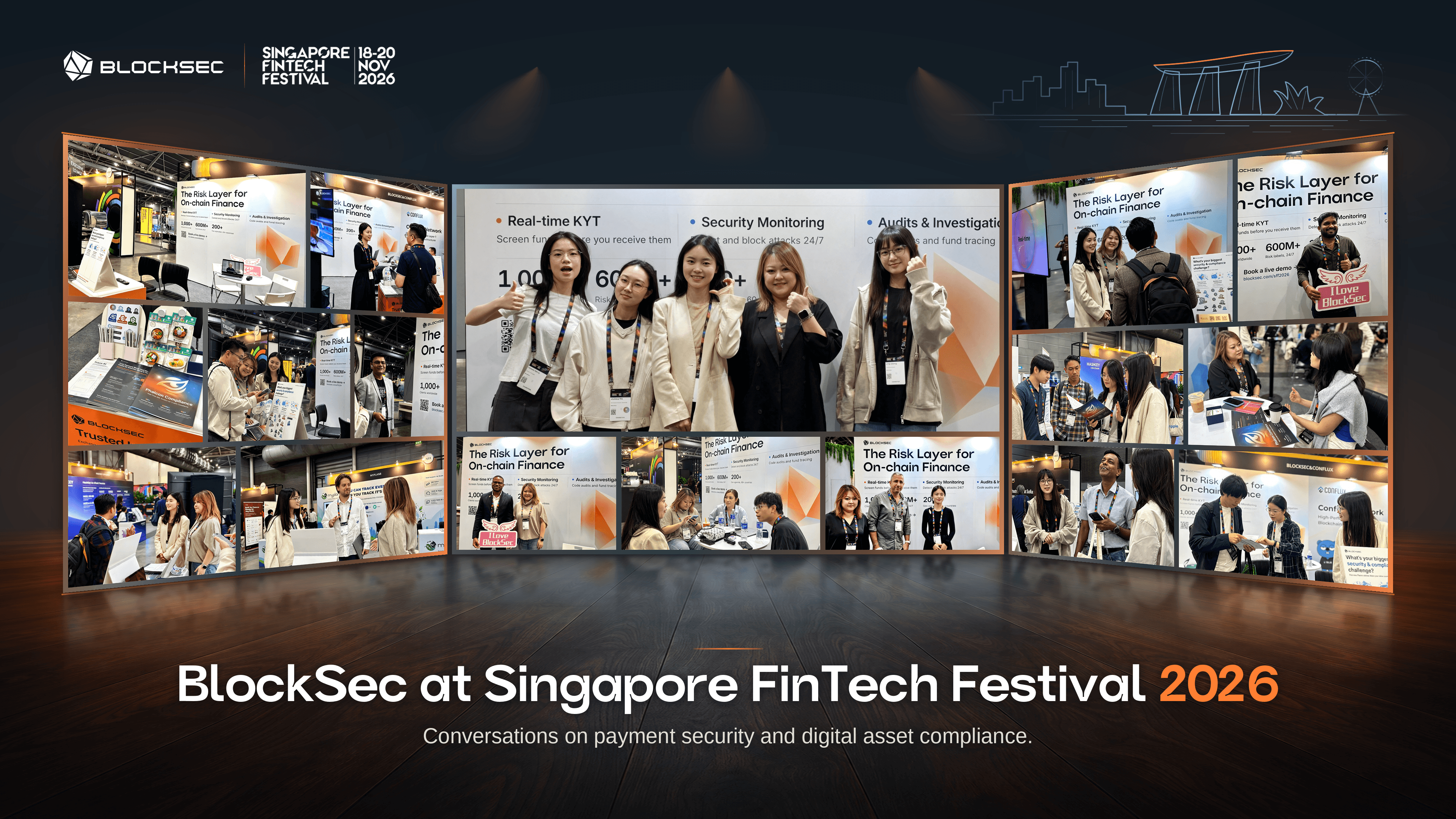
 BlockSec, a full-stack blockchain security and compliance company, showcased its Payment Security Assessment service and Phalcon Compliance at Singapore FinTech Festival 2026 hold from 18 to 20 November at Singapore EXPO.
At the festival, the BlockSec team spoke with banks, payment providers and digital asset firms about what AI means for payment security. As AI helps attackers find weaknesses faster and automate parts of an attack, the conversations focused on how institutions can identify gaps in their payment controls and respond quickly when funds are at risk.
AI is changing the game
Finding security vulnerabilities has traditionally taken specialist expertise and hours of manual work.
But AI is changing the game. Attackers can now probe systems repeatedly at lower cost and act faster on the weaknesses they find. Money moves in seconds.
Recent exchange incidents show how much is at stake.
On 21 February 2025, roughly $1.5 billion in digital assets was stolen from Bybit. On 16 July 2025, BigONE reported an estimated loss of $27 million. In its preliminary report on the 29 October 2026 incident, Binance said approximately $6.34 billion in digital assets had been affected.
For institutions that handle digital assets, these incidents raise two practical questions:
-
If an account or system is compromised, will payment approvals, transaction limits and emergency controls still work as intended?
-
If another platform is attacked, can institutions identify funds linked to the attack as they enter their own platforms and act in time?
Security next step: end-to-end testing
As AI helps attackers probe more systems in less time, testing individual controls alone leaves a critical question unanswered: what happens when one fails?
Testing controls individually only shows whether each one works as expected. For example, testers can check whether a payment API enforces access permissions, whether the system rejects withdrawals above a set limit, or whether large payments require additional approval.
End-to-end testing follows a withdrawal through the full payment workflow to see how those controls work together. For example, it checks whether the system can spot a change to the destination address after approval and respond right away.
That approach underpins the Payment Security Assessment service BlockSec showcased at SFF.
-
Follow the flow of funds. Within an agreed scope, BlockSec tests workflows such as account crediting, payouts, refunds, settlement and reconciliation. The assessment checks whether payment instructions have a valid business basis, match what was approved and meet the conditions for authorisation and execution.
-
Prioritise fixes by business impact. BlockSec’s report explains what each issue could mean for the business, such as an unauthorised payout, a duplicate refund or a discrepancy in the accounts. The findings come with remediation guidance so teams can decide what to fix first.
-
Verify the fixes. Once the institution has implemented the fixes, BlockSec includes one retest at no extra cost to check whether the reported issues within the agreed scope have been resolved.
Bringing risk intelligence into everyday compliance
When an exchange reports a security incident, as Binance recently did, other platforms need to watch for funds linked to the incident. That means screening deposits and transfers as they come in, using up-to-date risk data.
To keep that screening current, BlockSec promptly updates its risk labels as it identifies new addresses linked to attacks. BlockSec’s Phalcon Compliance uses those labels to screen wallet addresses (KYA) and transactions (KYT) and flag activity linked to known incidents.
Once activity is flagged, analysts need to understand why and decide what to review first. Lumi, the built-in AI assistant, helps them interpret screening results and prioritise their review. Institutions can also use BlockSec’s Model Context Protocol (MCP) integration to bring screening and risk analysis into their own AI workflows, where analysts can review flagged activity and decide how to respond.
Looking ahead
At the Singapore FinTech Festival, BlockSec spoke with banks, payment providers and digital asset firms about how institutions can protect funds as attacks get faster.
Building on its work with more than 1,000 customers in over 60 countries, BlockSec will continue to help institutions test payment controls, detect suspicious on-chain activity and respond when funds are at risk. The company will also work with industry partners to strengthen the security and compliance infrastructure that supports digital asset payments.
Visit BlockSec Official Website>>>