BlockSec 发布 Safe{Wallet} 安全监控解决方案

BlockSec 发布 Safe{Wallet} 安全监控解决方案

近期,Bybit 事件引起了广泛关注。据第三方对 Bybit 的报告显示,此次事件的发生源于黑客入侵了一名 Safe 开发者电脑,篡改了 Bybit 签名者在发起交易时打算签名的数据,最终执行了一次恶意升级交易。此次事件导致了近 15 亿美元的资产损失。事实上,去年已发生过两次类似的攻击,包括 Radiant(损失约 5800 万美元)和印度交易所 WazirX 黑客事件(损失超 2 亿美元),均是由通过 Safe 钱包签署恶意交易所致。

Dune 的最新数据显示(3 月 4 日),总共有超过 3914 万个 Safe 钱包已部署,管理的资产价值达 549 亿美元。为了满足用户需求并加强 Safe 钱包使用全生命周期的风险控制,BlockSec 推出了 Safe{Wallet} Monitor。该解决方案为用户提供交易详情、风险评估和交易模拟的全面可见性,以帮助保护资产并防止潜在损失。

Safe TVL over time_Dune

Safe{Wallet} 交易签名风险

  • 主要攻击目标:Safe 钱包通常管理着大量资产,使其成为黑客的主要攻击目标。例如,Bybit 事件是一次精心策划的攻击,黑客提前两天部署并测试了恶意合约。
  • 冗长的安全链:整个操作涉及的安全链非常长。用户需要信任 Safe 的智能合约、官方网站/应用程序、前后端、自己的电脑、浏览器,最后是用于签名的钱包。然而,攻击者可以瞄准 Safe 或单个签名者。任何一个环节的泄露,例如诱骗用户签署一个伪装成普通转账的升级交易,都可能导致灾难性后果。
  • 硬件钱包的局限性:大多数硬件钱包无法解读 Safe 交易。如果用户被 Safe 界面误导,在使用硬件钱包签名时将无法进行交叉验证。再加上签名者对先前批准的固有信任,这种“盲签”很容易导致严重的疏忽和安全事件。

Safe{Wallet} Monitor

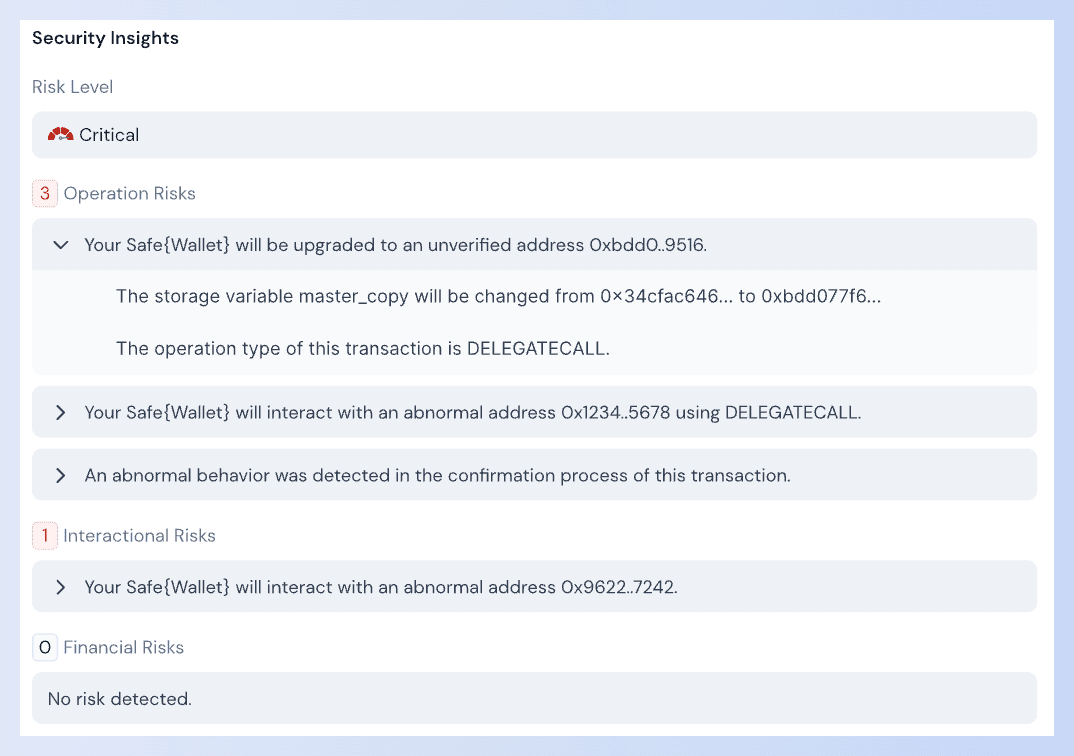
BlockSec 的 Safe{Wallet} Monitor 实时跟踪整个交易签名过程,显示交易详情,识别风险,模拟结果,并提供以下功能:

  • 在执行前预警风险:我们的系统对 Safe 钱包交易的所有阶段进行持续监控,包括发起、签名和执行。如果检测到风险交易,会在签名过程完成和交易广播之前向用户发出警报。
  • 详细的交易洞察:我们的系统会拦截复杂的交易,并将其翻译成清晰、人类可读的解释,从而做出明智的决策,并消除盲签风险。
  • 风险分析与执行模拟:我们的系统会分析每笔交易的相关风险,并在交易执行前模拟交易结果,以防止签署不受欢迎的交易。
Security Risks_Safe{Wallet} Monitor
  • 多渠道验证:警报可以发送给签名者和非签名者进行额外验证,提供额外的监督,确保彻底的交叉检查。
  • 白名单机制:用户可以将交互限制在特定的合约。系统会立即检测配置更改并做出响应。
  • 自动化响应:在检测到有害交易时,自动触发预设的响应机制来阻止攻击。

预定演示

任何使用 Safe 钱包的个人或机构,特别是管理大量资产的机构,如交易所、协议、L1/L2 网络、投资机构和投资者,都可能面临资金被盗的风险。

我们诚挚邀请您预定演示,了解 Safe{Wallet} Monitor 如何帮助您预防潜在风险并保护您的资产。

BlockSec Phalcon:威胁监控与预防

Safe{Wallet} Monitor 是 Phalcon 的一个重要模块。Phalcon 是 BlockSec 推出的安全监控和阻止平台,为协议提供全面的上线后安全保护,帮助流动性提供者、DAO、基金经理等保护其资产。除了 Safe{Wallet} Monitor,Phalcon 还包括:

  • 攻击交易的实时监控
  • 操作、交互和财务风险的实时监控
  • 代币数量/价格、关键变量、敏感事件和函数调用的灵活监控
  • 安全专家提供的定制监控解决方案
  • 使用多重签名钱包进行自动化响应
  • 紧急响应 SOP 和作战室服务
  • 根本原因分析
  • 固定智能合约代码审计
  • ...

结论

在加密世界中,安全不是一种选择,而是基础。BlockSec 的 Safe{Wallet} Monitor 构建了多层防御,以确保每一笔 Safe{Wallet} 交易都能抵御不可预见的风险,从而保护您的资产。
Sign up for the latest updates
Weekly Web3 Security Incident Roundup | Feb 9 – Feb 15, 2026

Weekly Web3 Security Incident Roundup | Feb 9 – Feb 15, 2026

During the week of February 9 to February 15, 2026, three blockchain security incidents were reported with total losses of ~$657K. All incidents occurred on the BNB Smart Chain and involved flawed business logic in DeFi token contracts. The primary causes included an unchecked balance withdrawal from an intermediary contract that allowed donation-based inflation of a liquidity addition targeted by a sandwich attack, a post-swap deflationary clawback that returned sold tokens to the caller while draining pool reserves to create a repeatable price-manipulation primitive, and a token transfer override that burned tokens directly from a Uniswap V2 pair's balance and force-synced reserves within the same transaction to artificially inflate the token price.

Top 10 "Awesome" Security Incidents in 2025

Top 10 "Awesome" Security Incidents in 2025

To help the community learn from what happened, BlockSec selected ten incidents that stood out most this year. These cases were chosen not only for the scale of loss, but also for the distinct techniques involved, the unexpected twists in execution, and the new or underexplored attack surfaces they revealed.

#10 Panoptic Incident: XOR Linearity Breaks the Position Fingerprint Scheme

#10 Panoptic Incident: XOR Linearity Breaks the Position Fingerprint Scheme

On August 29, 2025, Panoptic disclosed a Cantina bounty finding and confirmed that, with support from Cantina and Seal911, it executed a rescue operation on August 25 to secure roughly $400K in funds. The issue stemmed from a flaw in Panoptic’s position fingerprint calculation algorithm, which could have enabled incorrect position identification and downstream fund risk.