Back to Blog

BlockSec 成功阻止 ParaSpace 攻击,挽救 500 万美元加密资产

March 17, 2023
2 min read

在 2023 年 3 月 17 日 05:48:59(UTC),BlockSec 成功阻止了对 ParaSpace(一个顶级的 NFT 借贷协议)的攻击,保护了价值 500 万美元的加密资产。
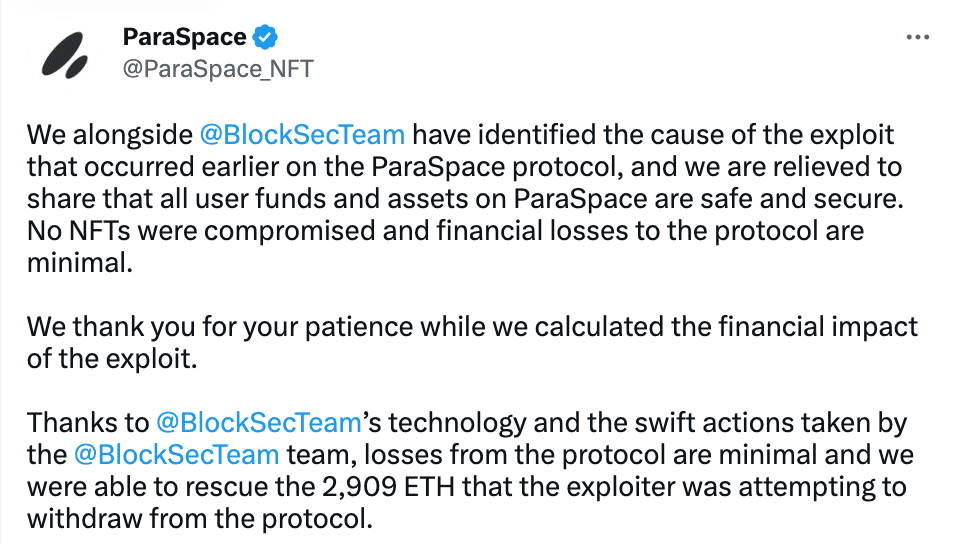
正如我们在 上一篇博客 中提到的,我们始终相信,更主动的威胁预防解决方案可以帮助抵御威胁。我们在 2022 年内部部署了这样一个系统。截至本文撰写之时,我们的系统已成功阻止了多次攻击,并为用户挽回了约 1400 万美元的资产。

请参阅我们在这篇文章中关于主动威胁预防的观点。

我们的解决方案的可行性和实践已得到社区的广泛认可,并与社区中一些顶尖的合作伙伴进行了合作。例如,我们正在与 Compound 合作,为 Compound V3 智能合约开发风险预防系统。

我们始终致力于为 Web3 社区构建区块链安全基础设施,包括 Phalcon Explorer(一个面向 Web3 开发人员和安全研究人员的交易分析工具)、MetaDock(一个面向 Web3 用户的安全工具箱)以及 MetaSleuth(一个面向 Web3 用户的资金追踪工具)。
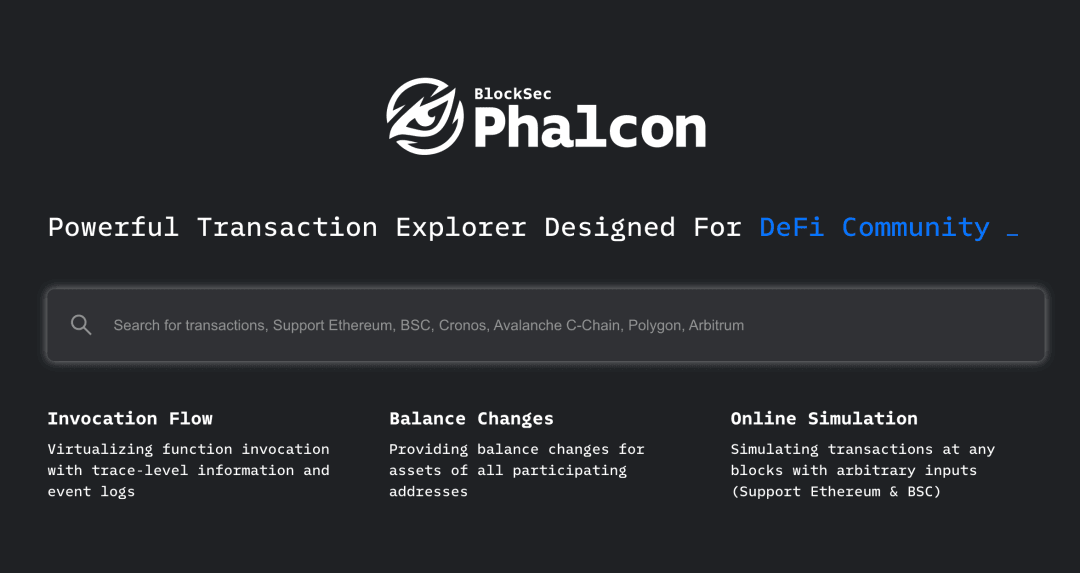

Phalcon Explorer
Phalcon Explorer
MetaDock
MetaDock
MetaSleuth
MetaSleuth

了解更多关于 BlockSec 的信息:网站 | 文档 | Twitter | Medium | TG 群组

Sign up for the latest updates
Newsletter - April 2026
Security Insights

Newsletter - April 2026

In April 2026, the DeFi ecosystem experienced three major security incidents. KelpDAO lost ~$290M due to an insecure 1-of-1 DVN bridge configuration exploited via RPC infrastructure compromise, Drift Protocol suffered ~$285M from a multisig governance takeover leveraging Solana's durable nonce mechanism, and Rhea Finance incurred ~$18.4M following a business logic flaw in its margin-trading module that allowed circular swap path manipulatio

~$7.04M Lost: GiddyDefi, Volo Vault & More | BlockSec Weekly
Security Insights

~$7.04M Lost: GiddyDefi, Volo Vault & More | BlockSec Weekly

This BlockSec weekly security report covers eight attack incidents detected between April 20 and April 26, 2026, across Ethereum, Avalanche, Sui, Base, HyperLiquid, and MegaETH, with total estimated losses of approximately $7.04M. The highlighted incident is the $1.3M GiddyDefi exploit, where the attacker did not break any cryptography or use a flash loan but simply replayed an existing on-chain EIP-712 signature with the unsigned `aggregator` and `fromToken` fields swapped out for a malicious contract, demonstrating how partial signature coverage turns any historical signature into a generic permit. Other incidents include a $3.5M Volo Vault operator key compromise on Sui, a $1.5M Purrlend privileged-role takeover, a $413K SingularityFinance oracle misconfiguration, a $142.7K Scallop cross-pool index injection, a $72.35K Kipseli Router decimal mismatch, a $50.7K REVLoans (Juicebox) accounting pollution, and a $64K Custom Rebalancer arbitrary-call exploit.

The Decentralization Dilemma: Cascading Risk and Emergency Power in the KelpDAO Crisis
Security Insights

The Decentralization Dilemma: Cascading Risk and Emergency Power in the KelpDAO Crisis

This BlockSec deep-dive analyzes the KelpDAO $290M rsETH cross-chain bridge exploit (April 18, 2026), attributed to the Lazarus Group, tracing a causal chain across three layers: how a single-point DVN dependency enabled the attack, how DeFi composability cascaded the damage through Aave V3 lending markets to freeze WETH liquidity exceeding $6.7B across Ethereum, Arbitrum, Base, Mantle, and Linea, and how the crisis forced decentralized governance to exercise centralized emergency powers. The article examines three parameters that shaped the cascade's severity (LTV, pool depth, and cross-chain deployment count) and provides an exclusive technical breakdown of Arbitrum Security Council's forced state transition, an atomic contract upgrade that moved 30,766 ETH without the holder's signature.