EigenLayer’s innovative restaking mechanism leverages Ethereum’s staking pool to enhance capital efficiency and address the “Fractured Trust” issue in the blockchain ecosystem. However, this new paradigm introduces unique security risks that require robust auditing, continuous monitoring, and proactive defense strategies to safeguard the network and its participants.
Introduction
EigenLayer, built on Ethereum, introduces the concept of Restaking, allowing participants to reuse their staked ETH to support additional distributed protocols without losing their original stake or rewards. This maximizes capital efficiency and strengthens the overall trust model in the blockchain ecosystem.
The rapid growth of EigenLayer’s Total Value Locked (TVL) — from $1 billion at the start of 2024 to $15.3 billion — highlights its market impact. It is now the second-largest protocol in DeFi after Lido. Projects like Puffer Finance and Renzo have quickly gained traction by building on EigenLayer, further solidifying its ecosystem.
What Is Restaking?
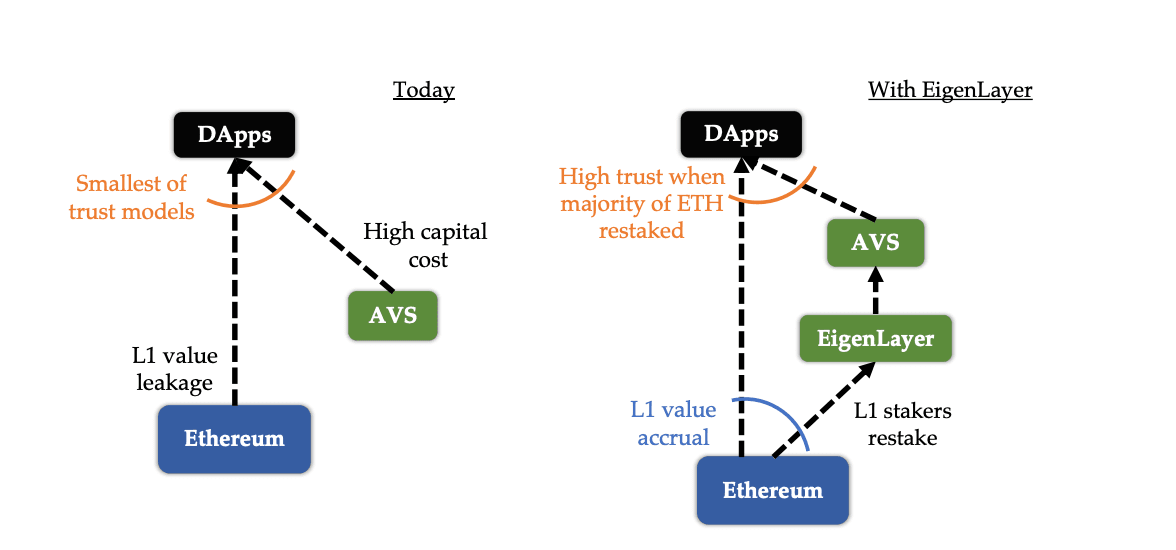
Restaking leverages the trust secured by Ethereum’s Proof of Stake (PoS) staking pool to solve broader challenges. It creates a new market for the free-market governance of consensus, enabling bidirectional trading of trust based on Ethereum’s pooled security.
EigenLayer addresses a macro-level security issue called Fractured Trust in the Ethereum ecosystem. This article explores this concept and how EigenLayer’s design aims to resolve it.
Who Are the Participants in the Free Market?
In EigenLayer’s marketplace:
- Sellers: Ethereum validators or stakers who provide PoS trust.
- Buyers: Actively Validated Services (AVSs) that require decentralized trust networks.
AVSs purchase trust from stakers to secure their services, creating a dynamic market for distributed security.
What Problems Does This Market Address?
Unsatisfied Innovation Needs
Ethereum primarily innovates at the smart contract layer. However, developers seek deeper innovations, such as modifying the Ethereum Virtual Machine (EVM) or consensus protocols themselves. EigenLayer meets this demand by enabling reuse of Ethereum’s trust, lowering barriers for fundamental blockchain innovations.

The founders of EigenLayer have recognized the developers' desire for fundamental, low-level innovations as an unsatisfied market need. They address it by providing a free-market for reusing Ethereum's trust.
Fractured Trust in the Ethereum Ecosystem
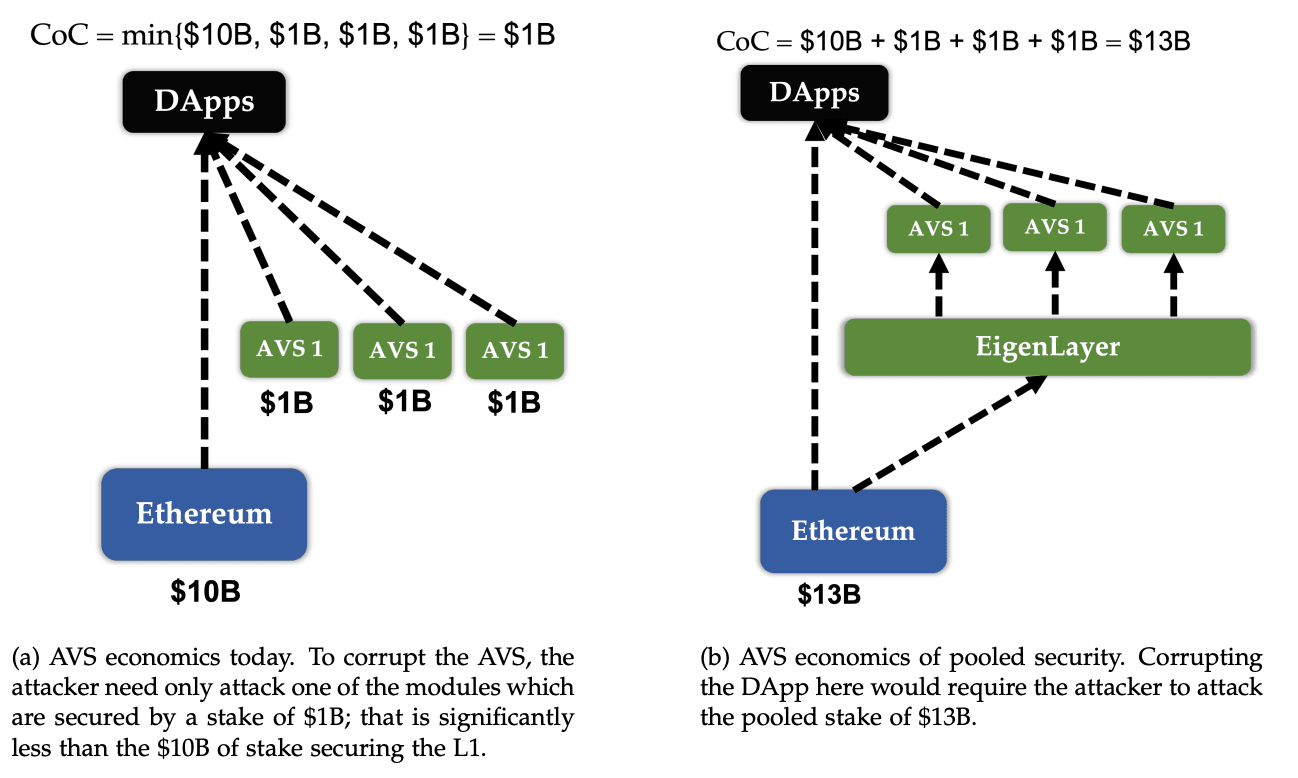
Ethereum’s PoS security depends on the amount of staked capital and the number of validators. New projects often require their own staking tokens, which fragments staked capital away from Ethereum’s mainnet, weakening overall security.

For example, if Ethereum’s mainnet has $10B staked but $3B is locked across three separate sub-services, that $3B does not directly secure Ethereum’s mainnet. This fragmentation increases security risks, as attackers may target less-secured AVSs, potentially causing cascading failures.
In summary, Ethereum faces two intertwined challenges: constrained innovation and fractured trust. EigenLayer aims to solve both.
How Does EigenLayer Address These Issues?

EigenLayer acts as middleware, enabling AVSs to access Ethereum staking pools through restaking. Validators can participate in multiple AVSs by deploying dedicated Slashing and Payment Contracts, choosing services based on profitability.
This approach:
- Reduces bootstrapping costs for new services by leveraging Ethereum’s trust.
- Facilitates the return flow of staked funds from decentralized AVSs back to Ethereum’s staking pools.
- Lowers validation costs for AVSs, attracting more re-staked assets and strengthening network security.
Unlike projects like Cosmos IBC or OP Stack, which lower blockchain launch costs but do not address fractured trust, EigenLayer directly mitigates this issue while offering higher returns (and risks) for ETH validators.
New Security Concerns in the EigenLayer Ecosystem
EigenLayer’s ecosystem consists of three main entities, each with unique security risks:
- Operators: ETH Validators or stakers selling trust.
- AVSs: Buyers requiring decentralized PoS trust.
- EigenLayer Platform: The marketplace enabling interactions.
Reduced Cost of Malicious Operators
Restaking allows validators to multiply returns from a single stake, increasing capital utilization and lowering entry barriers. However, this also reduces the cost of misconduct for malicious operators.
EigenLayer’s whitepaper proposes a publicly accessible Dashboard for AVSs to verify operators’ restaking activities. Since the market is free and bidirectional, AVSs may choose to accept risks for higher returns, highlighting the need for informed decision-making.
Malicious AVSs
AVSs define their own reward and punishment mechanisms via Ethereum smart contracts. While open sourcing and audits are encouraged, not all operators have the capacity to verify AVS reliability. Malicious AVSs may exploit contract vulnerabilities or provide misleading information, causing unintended slashing and losses for operators.
To mitigate this, security audits of AVS contracts and the establishment of regulatory committees for slashing mechanisms are recommended.
Security of the EigenLayer Platform
As a smart contract-based platform, EigenLayer’s complexity increases with customized interfaces for operators and AVSs. This complexity can introduce vulnerabilities threatening the entire ecosystem and Ethereum’s PoS consensus.
Code audits and continuous post-deployment security monitoring are essential to maintain platform integrity.
Solutions and Recommendations
EigenLayer’s restaking mechanism optimizes capital use and addresses fractured trust, but introduces new security challenges such as reduced malicious operator costs and complex platform risks.
To secure this ecosystem, blockchain developers, investors, and security experts should:
- Conduct thorough Smart Contract Audits of AVS reward and punishment mechanisms.
- Implement continuous Security Monitoring and attack detection.
- Promote transparency and open-source practices for AVS contracts.
- Establish governance committees to regulate slashing and incentives.
BlockSec offers comprehensive security services covering pre-launch audits and post-launch monitoring. Our Phalcon platform provides continuous security monitoring and automatic attack blocking, helping users, AVSs, and liquidity providers safeguard the EigenLayer ecosystem.
About BlockSec
BlockSec is a full-stack Web3 security service provider dedicated to enhancing blockchain security and usability for mass adoption. Our offerings include:
- Smart Contract Audits and Infrastructure Audits for DeFi protocols, L1/L2 chains, and centralized exchanges.
- The Phalcon platform for proactive security monitoring and threat blocking.
- MetaSleuth for on-chain fund tracking and investigation.
- MetaSuites browser extension for efficient Web3 navigation.
We have served over 300 clients, including Uniswap Foundation, Compound, Forta, and PancakeSwap, backed by top investors like Matrix Partners and Fenbushi Capital.
Explore more:
- Website: https://blocksec.com/
- Email: [email protected]
- Twitter: https://twitter.com/BlockSecTeam
- MetaSleuth: https://metasleuth.io/
- MetaSuites: https://blocksec.com/metasuites