A procurement team evaluating a KYT platform often starts with a familiar checklist. Batch processing latency, address blacklist coverage, and alert volume were the right questions for legacy financial crime tooling. On-chain, those questions miss the risk. A single transaction can contain multiple token transfers, each with its own counterparty. Funds can cross chains through bridges and mixers before they reach a deposit address. A smart contract call, not a wallet label, often determines what a transaction actually does. The selection dimensions themselves need an upgrade before any vendor comparison is meaningful. This page builds a six-dimension framework for KYT platform comparison, then maps each dimension against where legacy AML tools fail. It aligns with the FATF guidance on virtual assets as the regulatory baseline for VASP transaction monitoring.
Why KYT Selection Differs From Legacy AML
The dimensions a compliance team uses to evaluate legacy AML software were built for a different data model. Batch processing ran overnight. Risk scoring matched names against watchlists. An address was a static identifier. None of those assumptions hold on-chain.
Three structural differences break the legacy framework. First, a single on-chain transaction can contain many transfers. An ERC-20 token swap routed through an aggregator may move value across five or six token contracts in one hash. A tool that screens only the sender and receiver addresses reads the transaction as a single event and misses the internal flows. Second, funds move across chains. A counterparty can route contamination through a bridge, a mixer, and a DEX on another chain before it reaches your deposit address. A single-chain screen reads the wallet as clean while the same funds are tainted three hops away. Third, a smart contract call determines transaction intent. A transfer to a staking contract, a swap, and a direct peer-to-peer payment look identical at the address level. Without parsing the contract interaction, the tool cannot tell them apart.
These differences mean the selection criteria must change. Real-time screening replaces batch. Smart-contract semantic parsing replaces address-only matching. Cross-chain coverage replaces single-chain views. The six-dimension framework in the next section operationalizes that shift without naming any vendor, so a procurement team can score every option against the same yardstick.
The Six-Dimension Selection Checklist
Six dimensions form a reusable evaluation matrix for any KYT platform: real-time screening, API response SLA, smart-contract semantic parsing, data freshness, cross-chain coverage, and report automation. Each dimension carries a concrete question a procurement team can ask a vendor, and together they cover the gaps that legacy AML selection criteria leave open.
| Dimension | What to evaluate | How to test it |
|---|---|---|
| Real-time screening | Does the tool return a risk decision within the transaction window, or does it batch? | Ask for the synchronous response time threshold and whether long-running screens fall back to async. |
| API response SLA | Is there a documented rate limit and a published timeout policy? | Request the per-key rate limit and the threshold that triggers async task processing. |
| Smart-contract semantic parsing | Does the tool screen at the transfer level and parse transaction intent, or only at the address level? | Submit a multi-transfer aggregator transaction and check whether each internal transfer gets its own risk assessment. |
| Data freshness | How quickly does the intelligence layer reflect new sanctions designations and new illicit labels? | Ask how often the labeled-address database updates and whether continuous monitoring re-runs on a dynamic schedule. |
| Cross-chain coverage | How many chains does the tool screen, and does tracing stop at the first hop? | Confirm the supported chain list and whether cross-chain tracing penetrates bridges and mixers with unlimited hops. |
| Report automation | Can the team export STR-grade reports and audit logs without manual assembly? | Check whether per-transfer suspicious transaction reports and CSV audit logs are available as native exports. |
The matrix is vendor-neutral by design. A team can run any platform through it and compare scores. For a deeper methodology on evaluating KYT platforms end to end, see this KYT platform review walkthrough. The next two sections take two of these dimensions, smart-contract semantic parsing and data freshness, and explain why they are the dimensions where legacy tools diverge most sharply from what on-chain risk requires.
Why Smart-Contract Semantic Parsing Matters for DeFi KYT
Smart-contract semantic parsing is the difference between screening what an address is and screening what a transaction does. In DeFi, the two diverge quickly. Consider an aggregator routing a deposit through three liquidity pools before it settles. The from-to address pair is identical whether the user is swapping, staking, or laundering. An address-only tool assigns the same risk score to all three. A tool that parses the contract calls can distinguish a swap from a layering attempt.
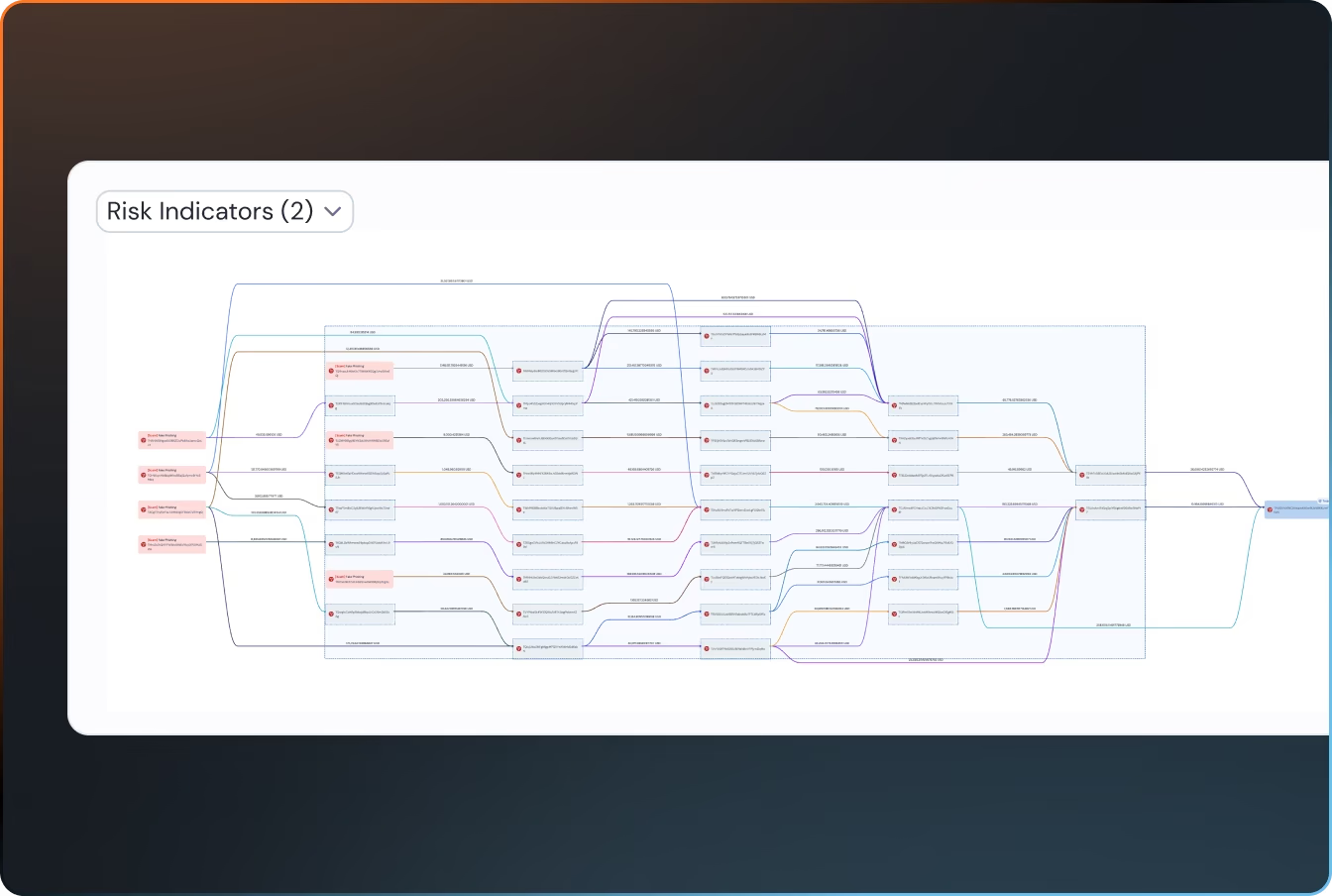
Smart-contract semantic parsing means screening at the transfer level with direction-aware fund-flow analysis. A transfer is the smallest unit of token movement inside a transaction. Screening at that unit means each internal token movement gets its own risk assessment rather than one score for the whole hash. Direction, meaning deposit, withdrawal, or both, tells the tool which fund path to trace. Deposit traces the inflow. Withdrawal traces the outflow. Together, transfer granularity and direction give the engine the semantic material to identify whether a transaction is a payment, a swap, or a layering step. Behavioral risk identification then layers on top, recognizing fund-flow patterns like rapid transit and large-value clustering that single-address screening cannot see.
This dimension matters most in DeFi. A lending protocol, a DEX, and a payment channel all produce transactions that look identical at the address level. The semantic layer is what lets a compliance team tell them apart and score the actual activity, not just the participants. For procurement, the test is simple. Hand the vendor a multi-transfer aggregator transaction and ask whether each internal transfer receives an individual risk assessment with a direction. If the answer is no, the tool screens addresses, not transactions.
Five Failure Points of Legacy KYT Tools
Legacy KYT tools fail on-chain in five ways that map directly back to the six selection dimensions: data latency, no contract semantics, no cross-chain tracing, no behavioral modeling, and no real-time API. Each failure point below is paired with the specific Phalcon Compliance capability that closes the gap, so a procurement team can verify the fix rather than take it on faith.
The first failure is data latency. An address cleared at onboarding can be linked to illicit activity days later. A tool that relies on manual re-screening misses the change until the next periodic review. Phalcon Compliance's Monitor closes this. Once enabled on an address, Monitor re-runs on a dynamic schedule and pushes a notification when the risk level changes. It does not consume screening quota. It bills at the monitored-address tier. Four event types drive the notifications: risk level increased, risk level decreased, alert triggered, and alert expired.
The second failure is the absence of contract semantics. A tool that screens only at the address level cannot distinguish a swap from a layering attempt inside a multi-transfer transaction. Phalcon Compliance screens at the transfer level, the smallest unit of token movement. Each transfer gets its own risk assessment. Direction is specified as deposit, withdrawal, or both at screening time, so the tool traces the correct fund path for each internal movement.
The third failure is the cross-chain blind spot. Contamination does not respect a single chain. A counterparty can route funds through a bridge and a mixer on another chain before they reach your deposit. Phalcon Compliance covers nine chains: Ethereum, Tron, BNB Chain, Polygon, Base, Optimism, Avalanche C-Chain, Arbitrum, and Bitcoin. Its cross-chain tracing runs with unlimited hops, penetrating DeFi paths, mixers, and bridges rather than stopping at the first counterparty. It is backed by a labeled-address intelligence layer built for cross-chain screening.
The fourth failure is the lack of behavioral modeling. Address-only tools flag exposure to known bad actors but miss the patterns that indicate layering. Phalcon Compliance's Behavioral Risk Engine identifies suspicious fund-flow patterns. Address behavior templates flag large-value transfers, high-frequency activity, and transit addresses. Transaction behavior templates flag large-value transfers and rapid transit. These sit inside 25 default risk engines, 13 address-type and 12 transaction-type, aligned with FATF guidelines and customizable per policy.
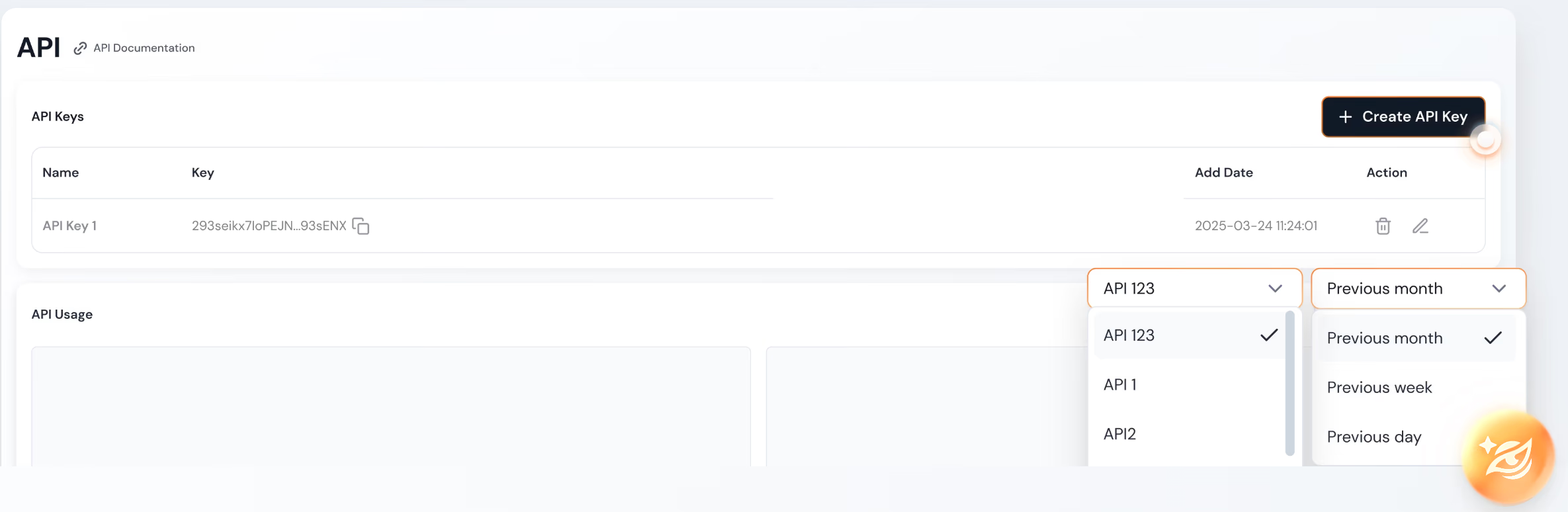
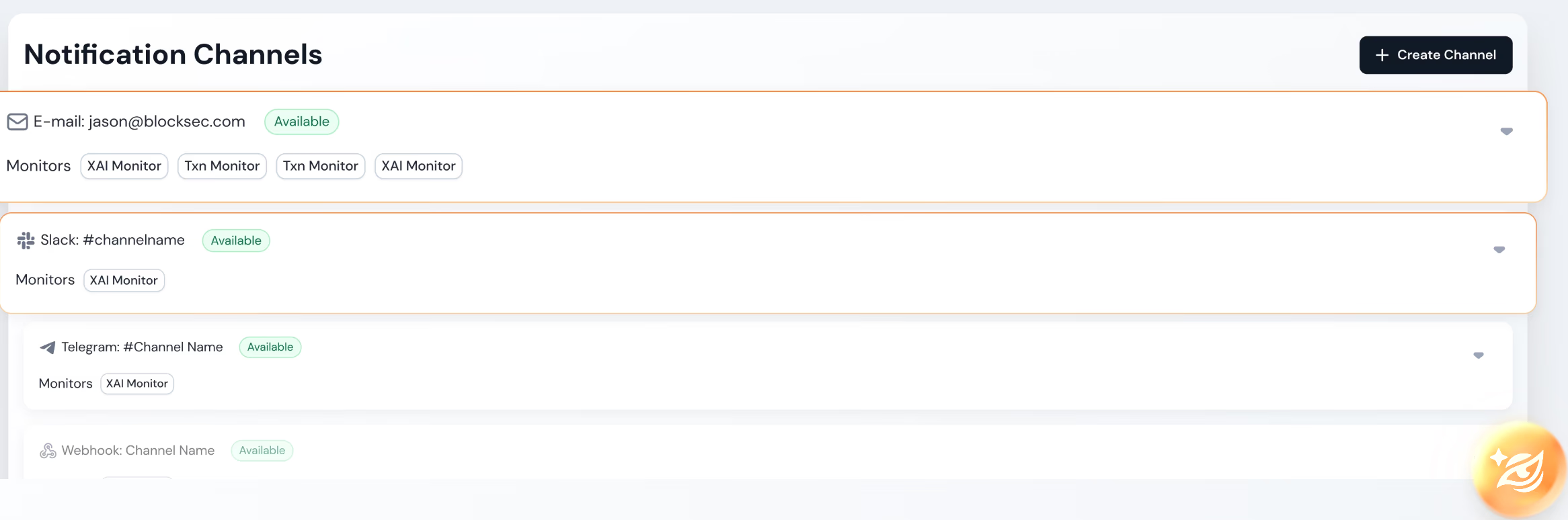
The fifth failure is the absence of a real-time API. A tool without programmatic access forces compliance teams into manual workflows. Phalcon Compliance's API exposes 18 endpoints covering address screening, transaction screening, blacklist and whitelist management, customer management, and account usage. Screening endpoints handle 50 requests per minute per key. Other endpoints handle 10 requests per second. A single screen that exceeds 10 seconds falls back to async task processing automatically. API access is available on Scale and Enterprise plans, paired with seven notification channels: Telegram, Email, Lark, Slack, Discord, PagerDuty, and Webhook. The regulatory backdrop for why legacy AML patterns fall short on-chain is covered by FinCEN's money laundering guidance.
Run the Selection Matrix Against Phalcon Compliance
The framework on this page is the evaluation tool. The six dimensions and the five legacy failure points give a procurement team a checklist that works for any vendor. Running that checklist against Phalcon Compliance means verifying each claim against a named capability. Monitor handles data freshness. Transfer-level screening with direction handles contract semantics. Nine chains with unlimited hops handle cross-chain coverage. The Behavioral Risk Engine with 25 default engines handles fund-flow modeling. Eighteen API endpoints with documented rate limits handle real-time integration. The crypto compliance platform ties these capabilities into the broader compliance workflow. Phalcon Compliance is the entry point to run the matrix against the live product.