Back to Blog

Öffentliche Übertragungsschwachstelle des Tether Gold Smart Contracts

Code Auditing
May 27, 2023

Unsere interne Analysetool hat am 5. April einen Fehler im Tether Gold Contract gefunden, der es einem Angreifer ermöglicht, XAUt (Tether Gold) Token von beliebigen Benutzern an eine vordefinierte Adresse zu übertragen. Das Team hat unseren Bericht erhalten und angegeben, dass sie dieses Problem intern bereits identifiziert hatten. Heute haben wir festgestellt, dass das Problem behoben wurde, und wir möchten die Details hier teilen. Außerdem werden wir veranschaulichen, wie man Phalcon Fork verwendet, um den Proof of Concept (PoC) dieser Schwachstelle zu entwickeln und zu debuggen.

0x0. Die Schwachstelle

In der transferFrom-Funktion des Contracts kann jeder diese Funktion aufrufen, um die Token anderer Benutzer in eine vertrauenswürdige Quittung zu übertragen, die vom Token-Besitzer definiert wird. Obwohl diese Schwachstelle nicht direkt ausgenutzt werden kann, um Token auf das Konto des Angreifers zu übertragen, kann der Angreifer dennoch Token aus dem Pool übertragen, um den Tokenpreis im Pool (z. B. WETH-XAUt-Pool) zu manipulieren und davon zu profitieren.

Die Behebung dieser Schwachstelle ist unkompliziert, wie unten gezeigt.

0x1. Wie die Schwachstelle ausgenutzt wird

Um den PoC zu schreiben und zu debuggen, können wir Phalcon Fork zu diesem Zweck verwenden. Zuerst können wir einen Fork erstellen, bevor die Schwachstelle behoben wird. Ich habe die Blockhöhe 17038763 verwendet, als ich den Fork über die Fork API erstellt habe.
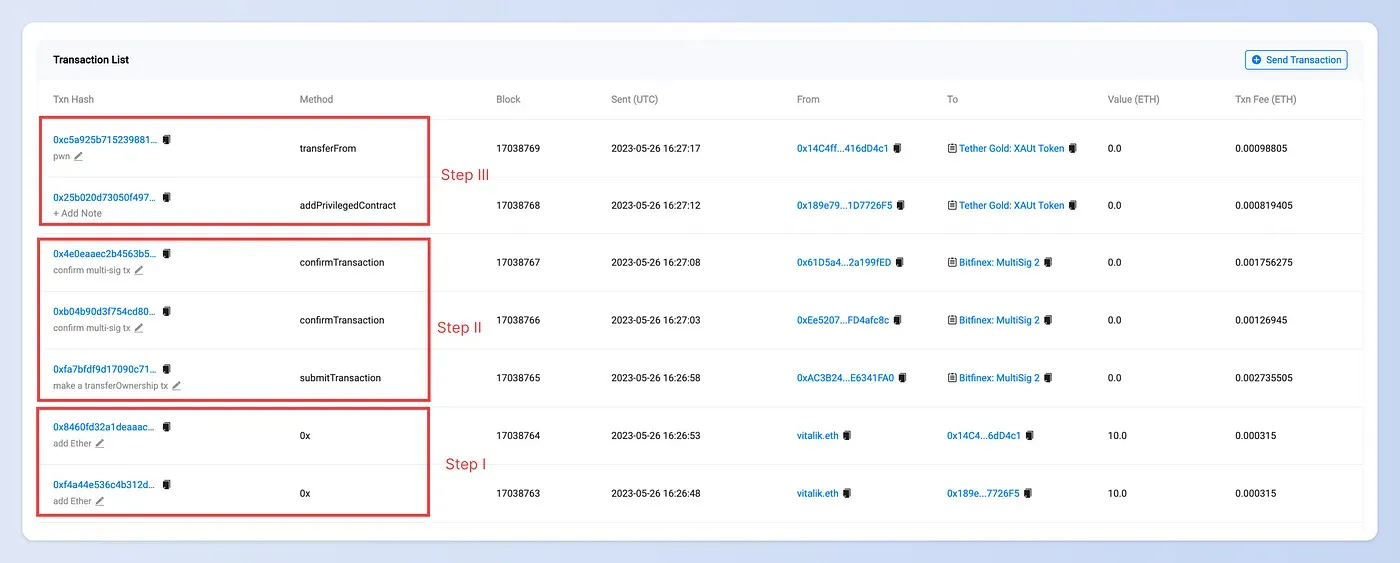
Schritt I: Genug Ether vorbereiten

Der erste Schritt ist, genug Ether für die Gasgebühr des Exploiters zu beschaffen. Wenn kein Ether im Konto vorhanden ist, wird die Transaktion gesendet, die Ether von vitalik.eth sendet.

Schritt II: Das Eigentum am Tether Gold Contract übertragen

Der Besitzer des Tether Gold Contracts ist eine Multisig-Wallet (0xC6CDE7C39eB2f0F0095F41570af89eFC2C1Ea828). Um das Eigentum an den Exploiter zu übertragen, müssen wir eine Multisig-Transaktion einreichen und dann die Transaktion bestätigen.
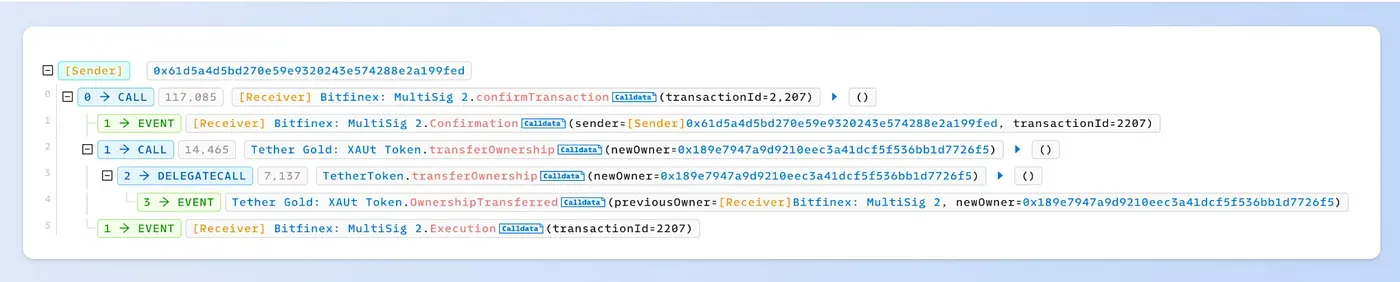
Schritt III: Ein privilegiiertes Konto zum Tether Gold Contract hinzufügen

Wir haben ein neues Konto 0x189e7947a9d9210eec3a41dcf5f536bb1d7726f5 als privilegiertes Konto hinzugefügt. Anschließend rufen wir die transferFrom-Funktion auf, um die XAUt-Token von einem Opfer an das privilegierte Konto zu übertragen.

0x2. PoC

Bitte finden Sie den PoC auf diesem GitHub:
Sign up for the latest updates
Tether Freezes $6.76M USDT Linked to Iran's IRGC & Houthi Forces: Why On-Chain Compliance is Now a Geopolitical Battlefield
Security Insights

Tether Freezes $6.76M USDT Linked to Iran's IRGC & Houthi Forces: Why On-Chain Compliance is Now a Geopolitical Battlefield

Looking ahead, targeted freezing events like this $6.76M USDT action will only become more common. On-chain data analysis is improving. Stablecoin issuers are also working closely with regulators. As a result, hidden illicit financial networks will be exposed.

Weekly Web3 Security Incident Roundup | Mar 2 – Mar 8, 2026
Security Insights

Weekly Web3 Security Incident Roundup | Mar 2 – Mar 8, 2026

During the week of March 2 to March 8, 2026, seven blockchain security incidents were reported with total losses of ~$3.25M. The incidents occurred across Base, BNB Chain, and Ethereum, exposing critical vulnerabilities in smart contract business logic, token deflationary mechanics, and asset price manipulation. The primary causes included a double-minting logic flaw during full token deposits that allowed an attacker to exponentially inflate their balances through repeated burn-and-mint cycles, a price manipulation vulnerability in an AMM-based lending market where artificially inflated vault shares created divergent price anchors to incorrectly force healthy positions into liquidation, and a flawed access control implementation relying on trivially spoofed contract interfaces that enabled attackers to bypass authorization to batch-mint and dump arbitrary tokens.

Weekly Web3 Security Incident Roundup | Feb 23 – Mar 1, 2026
Security Insights

Weekly Web3 Security Incident Roundup | Feb 23 – Mar 1, 2026

During the week of February 23 to March 1, 2026, seven blockchain security incidents were reported with total losses of ~$13M. The incidents affected multiple protocols, exposing critical weaknesses in oracle design/configuration, cryptographic verification, and core business logic. The primary drivers included oracle manipulation/misconfiguration that led to the largest loss at YieldBloxDAO (~$10M), a crypto-proof verification flaw that enabled the FOOMCASH (~$2.26M) exploit, and additional token design and logic errors impacting Ploutos, LAXO, STO, HedgePay, and an unknown contract, underscoring the need for rigorous audits and continuous monitoring across all protocol layers.

Best Security Auditor for Web3

Validate design, code, and business logic before launch. Aligned with the highest industry security standards.

BlockSec Audit