Einführung: Die entscheidende Rolle von Stablecoins für die Web3-Sicherheit
Stablecoins spielen eine entscheidende Rolle in der Kryptoindustrie und weisen zum 25. Juli 2024 eine Marktkapitalisierung von rund 165 Milliarden US-Dollar auf. Dies stellt einen erheblichen Anteil des gesamten Kryptowährungsmarktes dar, der sich auf 2,417 Billionen US-Dollar beläuft. Tether (USDT) ist bemerkenswerterweise der drittgrößte Token nach Marktkapitalisierung, hinter Bitcoin und Ether.
Dieser Artikel zielt darauf ab, tief in Stablecoins einzutauchen und ein umfassendes Verständnis ihrer Definitionen, Klassifizierungen und ihrer wichtigen Rolle in der digitalen Währungslandschaft zu vermitteln. Anhand von Ethenas USDe als Fallstudie werden wir dessen Funktionsmechanismen untersuchen und mögliche Sicherheitsrisiken im Zusammenhang mit Stablecoins beleuchten, um zu klären, ob USDe im umkämpften Bereich der Stablecoins als „aufgerüstetes" Luna betrachtet werden kann. Das Verständnis dieser Mechanismen und Risiken ist von größter Bedeutung, um die Web3-Sicherheit zu gewährleisten und Nutzervermögen zu schützen.
Was sind Stablecoins und warum brauchen wir sie?
Stablecoins werden vom Financial Stability Board und der Bank für Internationalen Zahlungsausgleich definiert als „eine Kryptowährung, die darauf abzielt, einen stabilen Wert im Verhältnis zu einem bestimmten Vermögenswert oder einem Pool bzw. Korb von Vermögenswerten aufrechtzuerhalten". In der Praxis sind Stablecoins in der Regel an Fiatwährungen wie den US-Dollar gekoppelt.
Die zentrale Frage lautet: Warum brauchen wir Stablecoins?
Brücke zwischen traditioneller Finanzwelt und Web3
Erstens bieten digitale Vermögenswerte im Kontext der massenhaften Einführung von Web3 eine bequemere Austauschbarkeit im Vergleich zu herkömmlichen Vermögenswerten. Stablecoins erleichtern alltägliche Transaktionen, indem sie als stabiles Tauschmittel dienen, und ermöglichen gleichzeitig schnelle und kostengünstige grenzüberschreitende Zahlungen, wodurch Verzögerungen und hohe Gebühren traditioneller Bankensysteme vermieden werden. Sie fungieren als entscheidende Brücke, die es Nutzern ermöglicht, mit dezentralen Finanzanwendungen (DeFi) zu interagieren, ohne der extremen Volatilität anderer Kryptowährungen ausgesetzt zu sein.
Minderung der Volatilität in Kryptomärkten
Zweitens tragen Stablecoins zur Reduzierung der Volatilität bei. Beliebte Kryptowährungen wie BTC oder ETH eignen sich aufgrund ihrer inhärenten Preisschwankungen nicht als Stablecoins. In Zeiten von Marktturbulenzen bieten Stablecoins Stabilität und dienen als Zufluchtsort zur Werterhaltung. Diese Stabilität ist für verschiedene DeFi-Protokolle, den Handel und sogar alltägliche Zahlungen unerlässlich und macht sie zu einem Eckpfeiler einer funktionierenden Kryptoökonomie.
Wie halten Stablecoins ihre „Stabilität" aufrecht? Klassifizierung und Mechanismen
Stablecoins setzen verschiedene Mechanismen ein, um ihre Kopplung aufrechtzuerhalten, die grob in besicherte und algorithmische Ansätze unterteilt werden können. Das Verständnis dieser Klassifizierungen ist der Schlüssel zur Bewertung ihrer inhärenten Sicherheitsrisiken.
Besicherte Stablecoins
Besicherte Stablecoins sind vollständig durch andere Vermögenswerte gedeckt, wodurch sichergestellt wird, dass ihr Wert durch greifbare Reserven gestützt wird. Vorausgesetzt, sie werden nach Treu und Glauben verwaltet und verfügen über einen robusten Mechanismus zur Einlösung der zugrunde liegenden Vermögenswerte, dürften diese Stablecoins aufgrund potenzieller Arbitragemöglichkeiten kaum erheblich unter den Wert ihrer zugrunde liegenden Vermögenswerte fallen.
Typische Beispiele für solche Stablecoins sind:
- Fiat-besicherte Stablecoins: Diese sind durch Reserven von Fiatwährungen wie dem US-Dollar gedeckt. Typische Beispiele sind Tether USD (USDT) und USD Coin (USDC), die nach Marktkapitalisierung die beiden größten Stablecoins sind. Stand Juli 2024 machen sie mehr als 90 % der gesamten Marktkapitalisierung von Stablecoins aus.
- Rohstoff-besicherte Stablecoins: Diese sind durch Reserven von Rohstoffen wie Gold oder anderen realweltlichen Vermögenswerten gedeckt. Ein typisches Beispiel ist Tether Gold (XAUt), das Gold als Sicherheit verwendet.
- Kryptowährungs-besicherte Stablecoins: Diese sind durch Reserven anderer Kryptowährungen wie BTC oder ETH gedeckt. Ein bemerkenswertes Beispiel ist DAI, entwickelt von MakerDAO, das ETH und andere zugelassene Ethereum-basierte Vermögenswerte als Sicherheit verwendet. Diese nutzen häufig eine Überbesicherung, um Preisrückgänge bei den zugrunde liegenden Kryptowerten abzufedern.
Algorithmische Stablecoins
Algorithmische Stablecoins wahren die Stabilität, indem sie die Sicherheit der Besicherung algorithmisch gewährleisten oder die Marktzirkulation (Angebots- und Nachfragedynamik) anpassen. Typische Methoden sind:
- Liquidation: Um sicherzustellen, dass der Wert aller ausstehenden Stablecoin-Schulden stets vollständig besichert ist, setzen manche Stablecoins einen Liquidationsmechanismus ein. Dieser Prozess umfasst die Liquidation riskanter Sicherheiten, deren Wert unter den der entsprechend ausgegebenen Stablecoins fällt, durch Auktionen. Dieser Mechanismus beinhaltet in der Regel eine Überbesicherung (z. B. ein Verhältnis von 150 %), die einen Puffer zwischen dem Wert der Sicherheiten und den entsprechenden Stablecoins bietet. Typische Beispiele sind DAI, derzeit der größte algorithmische Stablecoin, der Besicherung mit algorithmischen Anpassungen kombiniert.
- Verbrennen und Prägen: Dies umfasst das Verbrennen bestehender Token, um das Gesamtangebot zu verringern, oder das Prägen neuer Token, um das Gesamtangebot zu erhöhen, unter der Annahme, dass die Gesamtnachfrage während der Anpassung unverändert bleibt. Fällt beispielsweise der Stablecoin vom Zielpreis von 1 $ auf 0,9 $, verbrennt der Algorithmus automatisch eine Tranche von Token, um mehr Knappheit zu schaffen, was zu einer geringeren Zirkulation führt und den Preis des Stablecoins nach oben treibt. Typische Beispiele sind TerraUSD (UST), das einen festen Wechselkurs nutzte, um eine Arbitragemöglichkeit durch Verbrennen und Prägen zu ermöglichen; während erheblicher Marktabschwünge scheiterte das Protokoll jedoch daran, die Stabilität aufrechtzuerhalten, was zum größten Verlust in der Geschichte von Web3 mit über 40 Milliarden US-Dollar führte. Dieses katastrophale Ereignis verdeutlichte die inhärenten Sicherheitsrisiken rein algorithmischer Designs ohne ausreichende Besicherung.
- Anpassung des Kreditzinses: Dies umfasst die Erhöhung oder Senkung des Kreditzinssatzes, um das Angebot an Stablecoins innerhalb eines Kredit- und Ertragsrahmens zu steuern (im Wesentlichen eine Ertragschance für Stablecoin-Inhaber), unter der Annahme, dass Menschen gewinnorientiert handeln. Fällt der Stablecoin vom Zielpreis von 1 $ auf 0,9 $, erhöht der Algorithmus automatisch den Kreditzinssatz und zieht dadurch mehr Zirkulation in diesen Mechanismus (oder bindet sie), wodurch der Preis des Stablecoins nach oben getrieben wird. Typische Beispiele sind Beanstalk (BEAN), das ein kreditbasiertes System mit einem anpassbaren Gesamtkreditbetrag (als „Soil" bezeichnet) betreibt, um die Zirkulation von BEAN zu steuern.
Es ist bemerkenswert, dass sich diese Klassifizierungsmaßnahmen nicht gegenseitig ausschließen. Stablecoins können mehrere Mechanismen implementieren, um die Stabilität aufrechtzuerhalten. So ist DAI beispielsweise durch Kryptowährungen besichert und wendet gleichzeitig algorithmische Anpassungen an (d. h. Liquidation). Diese Kombination von Strategien kann die Stabilität und Zuverlässigkeit des Stablecoins verbessern, indem die Stärken jedes Mechanismus genutzt werden, um mögliche Schwächen abzumildern.
Wesentliche Sicherheitsrisiken und Lösungen für Stablecoins
Trotz ihres Versprechens von Stabilität sind Stablecoins nicht immun gegen Sicherheitsherausforderungen. Das Verständnis dieser Sicherheitsrisiken ist sowohl für Nutzer als auch für Entwickler von entscheidender Bedeutung.
Probleme bei der Transparenz der Sicherheiten
Bei Fiat- oder Rohstoff-besicherten Stablecoins könnten Nutzer sich fragen, ob die Sicherheiten sicher aufbewahrt werden und jederzeit für die Einlösung verfügbar sind. Viele Stablecoins begegnen diesem Anliegen, indem sie Sicherheiten bei Drittverwahrern wie Banken hinterlegen, regelmäßige Prüfungen durchführen und Berichte zur Reservebestätigung veröffentlichen. Diese Maßnahmen können die Transparenz der Sicherheitenverwaltung erhöhen und öffentliche Skepsis mindern, wodurch Vertrauen in die Deckung des Stablecoins aufgebaut wird.
Wertschwankungen der Sicherheiten
Bei Kryptowährungs-besicherten Stablecoins, deren zugrunde liegende Vermögenswerte volatiler sind als Fiat oder Rohstoffe, können Schwankungen im Wert der Sicherheiten zu unerwarteten Sicherheitendefiziten führen, was eine unzureichende Deckung zur Folge hat. Um dieses Problem zu lösen, setzen viele Stablecoins Überbesicherungs- und Liquidationsmechanismen ein, um die negativen Auswirkungen von Sicherheitenschwankungen abzumildern. Eine Überbesicherung stellt bis zu einem gewissen Grad sicher, dass der Sicherheitenwert während Marktschwankungen in einem sicheren Bereich bleibt, da der anfängliche Wert der Kryptowährungsreserven den Wert der ausgegebenen Stablecoins übersteigt. Der Liquidationsmechanismus ermöglicht die Liquidation unterbesicherter Positionen und hält so die Kopplung des Stablecoins aufrecht.
Schwachstellen in Smart Contracts
Stablecoins verlassen sich auf komplexe Smart Contracts, um ihre Stabilisierungsdesigns umzusetzen, insbesondere bei algorithmischen Varianten. Diese Smart Contracts können jedoch auch neue Risiken durch Schwachstellen auf Code-Ebene einführen, wie Reentrancy-Angriffe, Logikfehler oder Governance-Exploits, die zu schwerwiegenden Folgen und erheblichen finanziellen Verlusten führen können. Daher sind rigorose Smart-Contract-Audits und laufende Sicherheitsbewertungen entscheidend, um die Sicherheit und Zuverlässigkeit dieser Protokolle zu gewährleisten. Die Expertise von BlockSec im Bereich Code-Audit und Web3-Sicherheit kann helfen, diese kritischen Schwachstellen zu identifizieren und zu mindern.
Best Security Auditor for Web3
Validate design, code, and business logic before launch
Marktvolatilität und Oracle-Risiken
Extreme Volatilität bei Stablecoins und stablecoin-bezogenen Token, etwa ein plötzlicher Absturz innerhalb kurzer Zeit, kann das Vertrauen untergraben und die Stabilität stören. Unter sich schnell ändernden Marktbedingungen, etwa während eines Schwarzer-Schwan-Ereignisses, reagieren Stabilisierungsmechanismen möglicherweise nicht schnell genug, was zu erheblichen Preisabweichungen führt. In Situationen hoher Nachfrage oder Panik kann das Design des automatisierten Market Makers (AMM) von Stablecoins zu Liquiditätsengpässen in Liquiditätspools führen, was Preisschwankungen verstärkt. Illiquide Märkte sind besonders anfällig für Manipulation. Zusätzlich verlassen sich Stablecoins auf Oracles, um externe Preise zu bestimmen (z. B. USD oder ETH). Falsche Oracle-Daten können zu fehlbewerteten Stablecoins führen und eine neue Angriffsfläche schaffen, die das System verzerren und zu Exploits führen kann. Eine robuste Oracle-Sicherheit ist daher von größter Bedeutung.
Die Stablecoin-Landschaft: Top-Akteure und ihre Mechanismen
Wir haben die 20 größten Stablecoins von DefiLlama ausgewählt, die zusammen über 99 % der gesamten Marktkapitalisierung von Stablecoins ausmachen (Stand Juli 2024), wie in der folgenden Abbildung dargestellt.
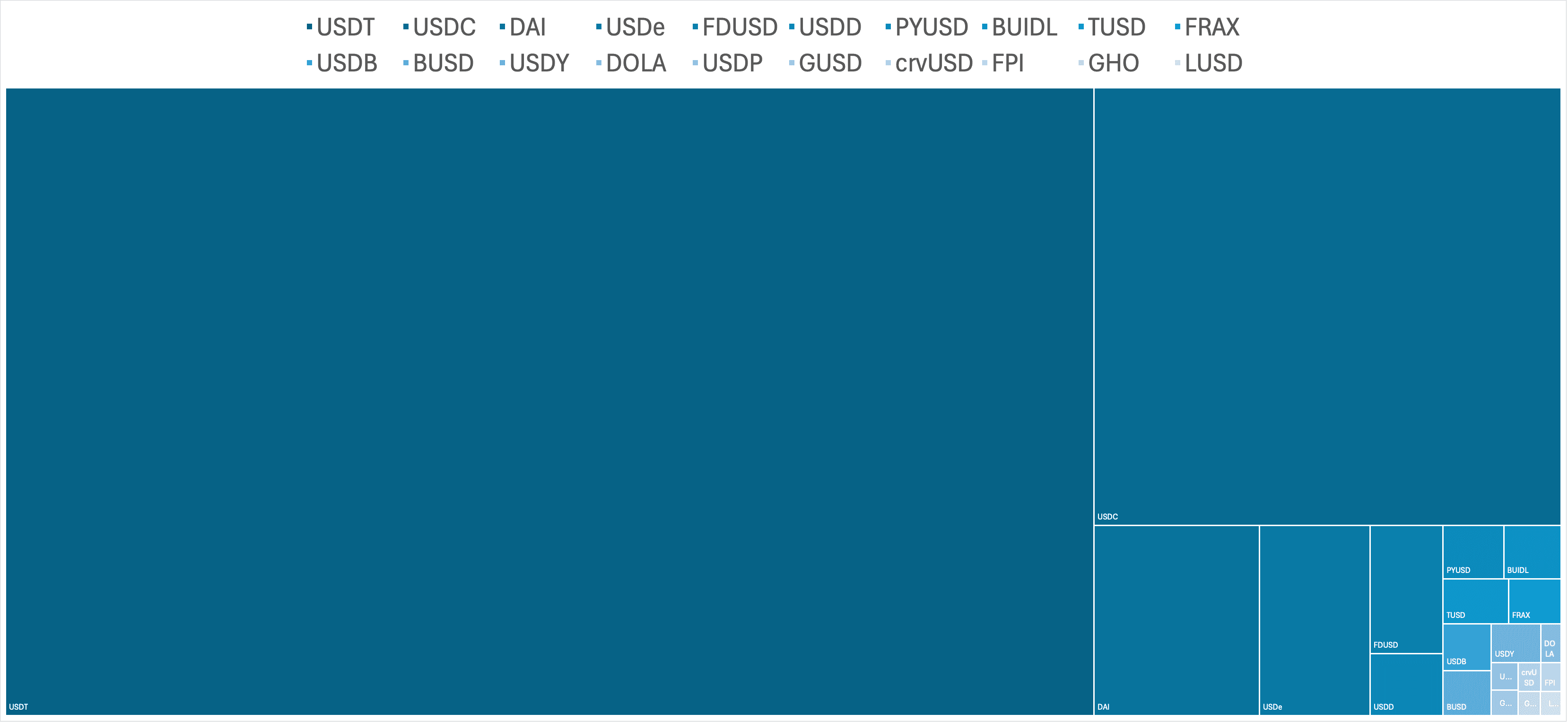
Die Marktkapitalisierung dieser Stablecoins weist eine hohe Konzentration auf, wobei die Top 5 Stablecoins (d. h. USDT, USDC, DAI, USDe und FDUSD) 96 % der gesamten Marktkapitalisierung ausmachen und die Top 20 Stablecoins 99 %. Dies deutet auf einen Markt hin, der von wenigen Schlüsselakteuren stark dominiert wird, was mit dem Pareto-Prinzip übereinstimmt.
Unter den Top 20 Stablecoins sind alle durch bestimmte Vermögenswerte besichert, wie US-Dollar, US-Staatsanleihen oder andere Kryptowährungen. Zusätzlich integrieren 9 dieser Stablecoins auch einen algorithmischen Stabilisierungsmechanismus, um die Zirkulation (das Angebot) anzupassen oder die Sicherheit der Besicherung zu gewährleisten.
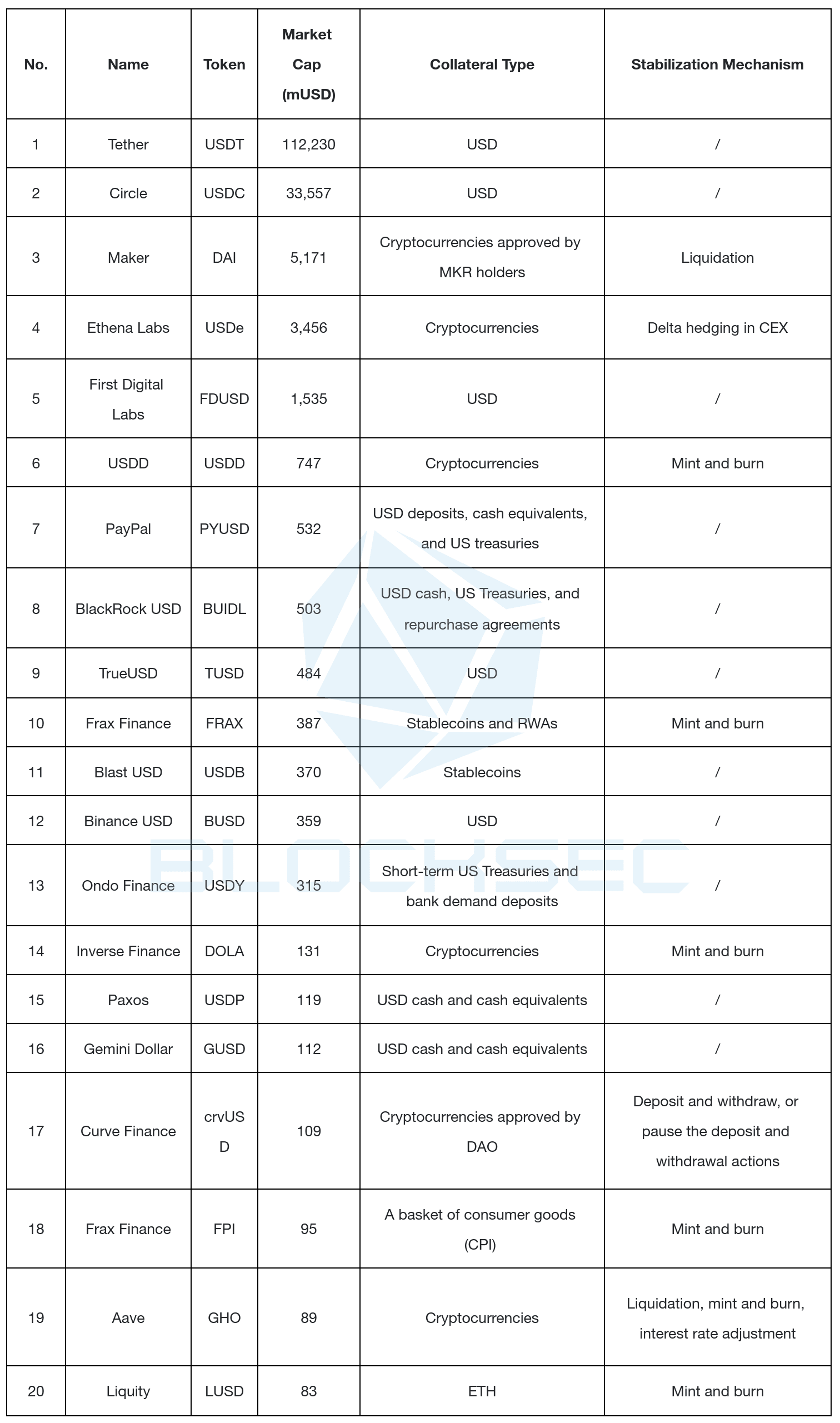
Dieses Phänomen deutet auf eine vorherrschende Präferenz der Nutzer für vollständig besicherte Stablecoins hin, insbesondere solche, die durch Fiatwährungen gedeckt sind, trotz der Behauptungen algorithmischer Stablecoins hinsichtlich ihrer gut durchdachten und stabilen Mechanismen. Wie Sam Kazemian, der Gründer von Frax, erklärte: „Wenn man einen sehr großen Stablecoin schaffen will, will man sicherer werden, je größer man wird, nicht umgekehrt; wenn Menschen Geld verwenden, will man, dass es sicherer wird." Diese Einschätzung unterstreicht die Bedeutung einer robusten Deckung und transparenter Mechanismen, um Vertrauen aufzubauen und Stablecoin-Sicherheit zu gewährleisten.
Fallstudie: Ethena Labs - USDe und seine einzigartigen Risiken
Im vergangenen Jahr hat USDe, herausgegeben von Ethena Labs, erhebliche Aufmerksamkeit erregt und rangiert laut DefiLlama zum Juli 2024 als viertgrößter Stablecoin. Dieser Abschnitt untersucht USDe als Fallstudie und beleuchtet dessen Funktionsmechanismen sowie potenzielle Sicherheitsrisiken.
Verständnis von Ethenas Delta-Hedging-Mechanismus
USDe ist als Stablecoin konzipiert, der auf zentralisierten Börsen (CEX) basiert, wobei sein Stabilitätsmechanismus derzeit stark von der operativen Stabilität der CEX abhängt. Konkret verwendet USDe gängige Kryptowährungen als Sicherheiten und setzt eine „Delta-Hedging"-Strategie ein, um die Stabilität aufrechtzuerhalten.
Was also ist „Delta-Hedging"? Betrachten wir folgendes Beispiel. Wenn 1 ETH bei der Prägung von USDe übertragen wird, ist der Stablecoin einem „positiven Delta von 1 ETH" ausgesetzt, was bedeutet, dass sein Wert vollständig sensibel gegenüber dem Spotmarktpreis von ETH ist. Idealerweise besteht das Ziel für einen Stablecoin darin, diese Sensibilität zu minimieren und ein „Delta von 0" anzustreben, um Stabilität zu gewährleisten. Um dies zu erreichen, wendet Ethena Delta-Hedging an, indem es eine „Short-Position" in einem Perpetual-Kontrakt mit einer nominalen Positionsgröße von 1 ETH eingeht. Diese Strategie neutralisiert die Exponierung des Sicherheitenwerts gegenüber Marktschwankungen. Folglich bleibt der Sicherheitenwert stabil, unabhängig davon, wie sich der Marktpreis von ETH verändert.
Der Ertrag von USDe setzt sich aus zwei Hauptkomponenten zusammen: dem Staking-Ertrag, der den nativen Ertrag aus ETH-Staking darstellt, und den Erträgen aus Delta-Hedging-Derivatpositionen. Die zweite Komponente gliedert sich weiter in zwei Teile: 1) Erträge aus dem Funding Rate, den periodischen Zahlungen zwischen Long- und Short-Positionen auf CEXs, und 2) Erträge aus dem Basis-Spread, den Gewinnen aus der Preisdifferenz zwischen dem Spotmarkt und Terminkontrakten. Laut der historischen Datenanalyse von Ethena bleibt diese Ertragskombination auch in Baisse-Marktbedingungen positiv, wie etwa während des Terra-Vorfalls und des FTX-Zusammenbruchs.
Sicherheitsrisiken von Ethenas USDe
Trotz seines innovativen Ansatzes bringt USDe aufgrund seiner Abhängigkeit von zentralisierten Instanzen und komplexen Marktdynamiken einzigartige Sicherheitsrisiken mit sich.
Zentralisierungsrisiko
Das Hauptsicherheitsproblem rührt von der Abhängigkeit von CEXs für das Delta-Hedging und der Verwahrmethode des „Off-Exchange-Settlement" her. Wir bezeichnen dieses Problem als Zentralisierungsrisiko. Diese Abhängigkeit schafft eine Schwachstelle, bei der das Scheitern dieser Börsen — sei es aufgrund operativer Probleme oder eines Bank-Runs — die Stabilität des Stablecoins gefährden könnte. Trotz der Verteilung der Sicherheiten über mehrere Börsen sind über 90 % auf drei große Börsen konzentriert: Binance, OKX und Bybit. Ein bedeutendes Ereignis, das eine dieser großen CEXs betrifft, könnte Kaskadeneffekte auf die Stabilität von USDe haben.
Marktrisiko
Zusätzlich sollte das Marktrisiko nicht vernachlässigt werden. Der Ertragsmechanismus von USDe kann Phasen anhaltend negativer Funding Rates erleben, was dazu führen kann, dass einige Komponenten des Ertragsdesigns von Ethena negativ werden. Obwohl historische Daten darauf hindeuten, dass solche negativen Phasen relativ kurz waren (weniger als zwei Wochen), ist es entscheidend, die Möglichkeit anhaltender ungünstiger Bedingungen in der Zukunft zu berücksichtigen. Daher sollten angemessene Gegenmaßnahmen, wie etwa Reservefonds, stets für diese schwierige Phase gut vorbereitet sein. Eine anhaltende Phase negativer Funding Rates könnte die Fähigkeit von USDe, seine Kopplung aufrechtzuerhalten und Erträge zu generieren, erheblich beeinträchtigen und möglicherweise zu Instabilität führen.
Fazit: Die Zukunft der Stablecoin-Sicherheit meistern
Zusammenfassend spielen Stablecoins eine entscheidende Rolle im Kryptowährungs-Ökosystem, indem sie Stabilität bieten und Transaktionen in einem volatilen Markt erleichtern. Ihre Klassifizierungen, von Fiat-besicherten über algorithmische Mechanismen wie Ethena Labs' USDe bis hin zu RWA-gedeckten Stablecoins wie Ondo, decken verschiedene Bedürfnisse innerhalb der Krypto-Community ab, bergen aber auch inhärente Sicherheitsrisiken wie Transparenz der Sicherheiten, Wertschwankungen, Schwachstellen in Smart Contracts und Marktvolatilität.
Während Ethena Labs weiterhin an USDe feilt und Innovationen einführt, stellt sich eine entscheidende Frage: Wird USDe die Marktvolatilität meistern, ohne den Zusammenbruch zu erleben, den Luna erlebt hat? Die Krypto-Community beobachtet aufmerksam, ob USDe tatsächlich Stabilität aufrechterhalten und möglicherweise eine führende Rolle in der wettbewerbsintensiven Stablecoin-Landschaft beanspruchen kann. Seine Abhängigkeit von CEXs und Delta-Hedging bringt eine neue Reihe von Herausforderungen mit sich, die eine sorgfältige Überwachung und ein robustes Risikomanagement erfordern.
Angesichts der bedeutenden Marktkapitalisierung und des Einflusses von Stablecoins ist es entscheidend, sich auf ihre Sicherheitsrisiken zu konzentrieren. Kontinuierliche Audits, sorgfältige Aufsicht und fortschrittliche Web3-Sicherheits-Tools sind unerlässlich, um Stabilität und Vertrauen im Markt zu erhalten. BlockSec bleibt der Verbesserung der Sicherheit und Nutzbarkeit der Web3-Welt verpflichtet und bietet wesentliche Dienstleistungen zum Schutz der Zukunft von Stablecoins und des breiteren Krypto-Ökosystems.
Über BlockSec
BlockSec ist ein Full-Stack-Web3-Sicherheitsdienstleister. Das Unternehmen hat es sich zur Aufgabe gemacht, die Sicherheit und Nutzbarkeit der aufstrebenden Web3-Welt zu verbessern, um deren Massenakzeptanz zu fördern. Zu diesem Zweck bietet BlockSec Smart-Contract- und EVM-Chain-Sicherheitsauditdienste, die Phalcon Security-Plattform zur sicheren Entwicklung und proaktiven Abwehr von Bedrohungen, die MetaSleuth-Plattform zur Verfolgung von Geldern und für Ermittlungen sowie die MetaSuites-Erweiterung für Web3-Entwickler, die effizient in der Kryptowelt navigieren möchten.
Bis heute hat das Unternehmen über 1.000 Kunden bedient, darunter Uniswap Foundation, Compound, Forta und PancakeSwap, und in zwei Finanzierungsrunden zweistellige Millionenbeträge in US-Dollar von führenden Investoren erhalten, darunter Matrix Partners, Vitalbridge Capital und Fenbushi Capital.
- Website: https://blocksec.com/
- E-Mail: [email protected]
- Twitter:https://twitter.com/BlockSecTeam
- MetaSleuth: https://metasleuth.io/
- MetaSuites: https://blocksec.com/metasuites