Dubai is rapidly cementing its position as one of the world's most attractive hubs for crypto payment companies. Operating a virtual asset business in the UAE is risky without strict compliance. VARA has issued enforcement notices to 37 firms. These firms engaged in unlicensed activities and broke regulations. The rules are detailed, the oversight is continuous, and the enforcement is active. This guide explains what VARA expects from crypto payment companies. It also shows how to create a strong compliance program to succeed in Dubai.
The Virtual Assets Regulatory Authority (VARA) was established under Dubai Law No. 4 of 2022. For payment companies, the most important recent development is that VARA updated key compulsory and activity rulebooks in 2025, with the transition period ending on June 2025. It is the world's first independent regulator just for virtual assets. This was a major step for digital finance. Before VARA, no regulator focused exclusively on virtual assets.
VARA covers the Dubai mainland and its free zones. It does not cover the Dubai International Financial Centre (DIFC). The DIFC has its own regulator called the Dubai Financial Services Authority (DFSA). If you operate in the DIFC, different rules apply.
Dubai offers a great opportunity for crypto payment companies. Some countries are making rules stricter. Singapore has tightened its grip on Web3 projects. The UAE is different. It welcomes business. But it also demands strong compliance. VARA follows the rules of the Financial Action Task Force (FATF). It also adds specific local rules that go beyond the FATF baseline.
VARA is unique because of how it issues licenses. It does not give one license for everyone. Instead, it gives specific licenses for different activities. These include trading, brokerage, custody, lending, and payments. You must clearly define what your business does. Then, you only follow the rules for those activities. This is called an activity-based licensing regime.
This is good news for payment companies. You do not have to follow rules meant for a trading firm. You only need to meet the standards that apply to your specific operations. This makes compliance more focused and manageable.
Dubai is also a global financial hub. It connects the Middle East, Africa, and South Asia. Companies based in Dubai can reach billions of potential users. The city has a business-friendly environment, a strong talent pool, and world-class infrastructure. This makes it a perfect base for crypto payment companies. But you must take compliance seriously. Without it, you cannot operate legally.

Do You Need a VARA License? Who It Applies To
What Counts as a Payment Service?
You need a VARA license if your company transfers, settles, or remits virtual assets in or from Dubai. This covers many different business models. Crypto card issuers need a license. Cross-border remittance platforms need one. Merchant payment gateways need one too. If your platform lets people pay for goods or services with crypto, you need VARA authorization.
Think about what your product actually does. Does it move crypto from one wallet to another? Does it convert crypto to fiat for a merchant? Does it allow users to pay at checkout with digital assets? If yes, you are a payment service provider under VARA's rules.
VARA's rules apply even if your office is not in Dubai. If you target Dubai residents, you need a license. If you operate from a Dubai free zone, you need a license. Many companies have tried to serve the Dubai market without permission. This is one of the most common violations VARA has punished.
The Two-Stage Licensing Process
Getting a VARA license is not easy. It is a strict, multi-stage process. VARA designed it to keep bad actors out. There are two stages: Initial Approval and Full VASP License.
During Initial Approval, VARA reviews your business plan. They check your corporate structure. They look at your compliance framework. You must show that you understand the rules and take them seriously. Only firms with a credible approach move to the next stage.
After Initial Approval, you apply for the Full VASP License. This is when VARA does a deeper review. They check your technology, your staff, and your risk controls. You must prove that your business is ready to operate safely.
This process takes time. Plan ahead. Do not wait until you are ready to launch to start the application. Start early and get your compliance program in order first.
Minimum Capital and Eligibility Criteria
You must meet minimum capital requirements to apply. VARA sets these thresholds to make sure only strong companies handle user funds. The exact amount depends on your specific activities and jurisdiction.
VARA also checks your technology and governance. You must provide technical documents. These include your system architecture, cybersecurity plan, and business continuity plan. If your systems go down, you need a plan to keep running.
VARA also checks the backgrounds of key staff. They must meet "fit and proper" standards. This means no criminal history and relevant experience. This is not just a one-time check. VARA monitors key personnel on an ongoing basis.
| Category | Details |
|---|---|
| Registered Entity | Legal entity in Dubai (mainland or free zone such as DMCC); company charter and shareholder documents required. |
| Minimum Capital | AED 50,000–500,000 depending on activity; higher-risk activities (e.g., exchange services) require more capital. |
| Governance Structure | Senior management must be qualified and have a clean criminal record; adequate technical and operational capabilities required. |
| AML/CFT Readiness | Functioning KYC/AML framework in place; a qualified MLRO must be appointed. |
| Application Process | 1. Submit a Letter of Intent (LOI) to VARA 2. Preliminary approval: business plan, risk assessment, technical architecture 3. Full application: compliance documentation and audit reports 4. Receive MVP Permit or full license — typical timeline: 3–6 months |
| Licensed Activities | Advisory · Broker-Dealer · Custody · Exchange · Lending & Borrowing · VA Management & Investment · VA Transfer & Settlement · Virtual Asset Issuance |
VARA's Core Compliance Requirements for Payment Companies
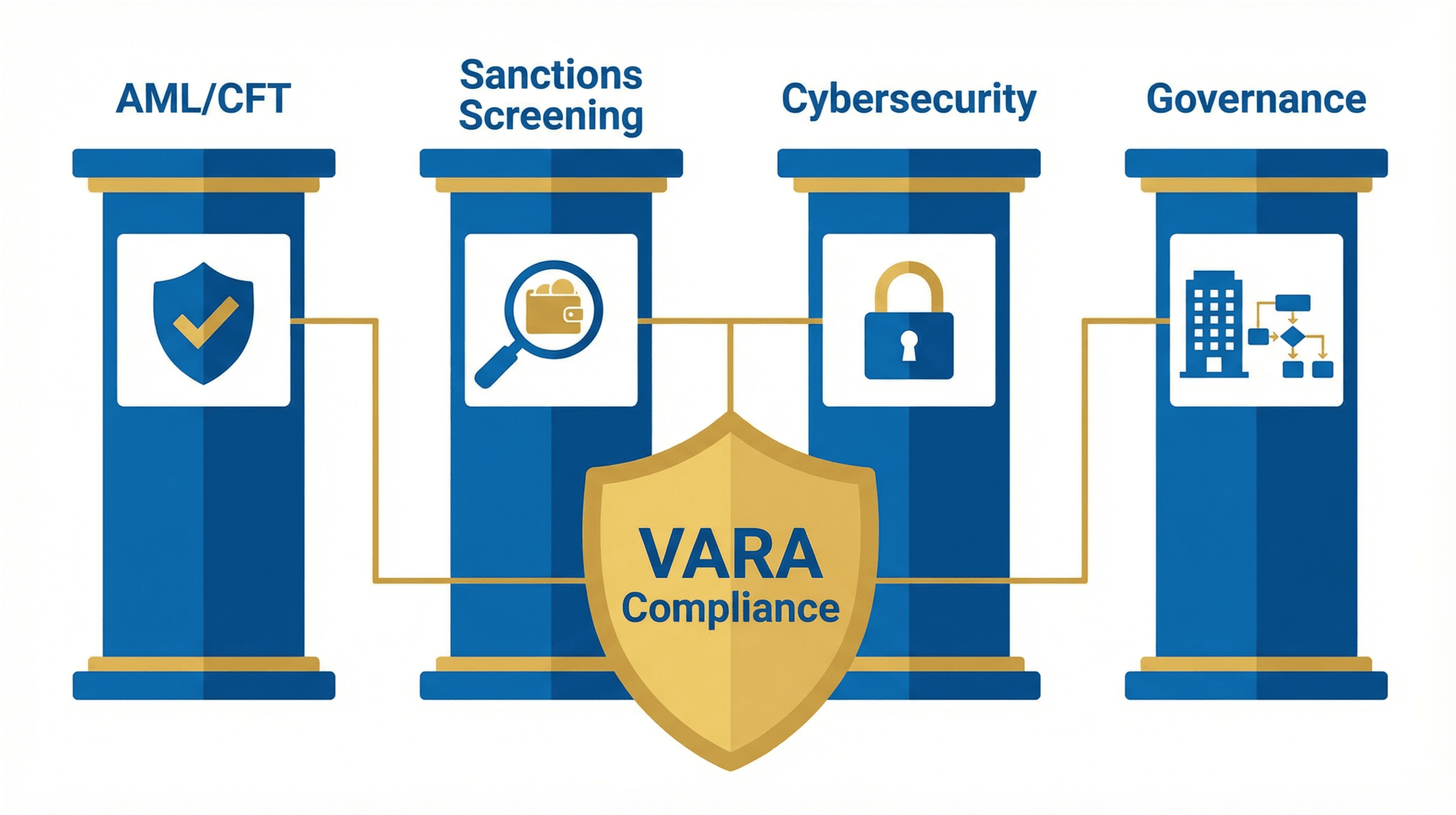
Once you get a license, the real work starts. VARA has several rulebooks. You must follow them every day. These are not just checklists. VARA wants to see that your controls actually work. They use a risk-based, outcomes-focused approach. This means you must prove your systems are effective in practice, not just on paper.
AML/CFT Obligations
The Compliance & Risk Management Rulebook is the most important rulebook for payment companies. You must have strong Anti-Money Laundering (AML) controls. You must also have Combating the Financing of Terrorism (CFT) controls.
This starts with Know Your Customer (KYC) checks. You must verify every user before they join your platform. You must also conduct Customer Due Diligence (CDD). This means understanding who your customers are and what they do.
But basic checks are not enough. You must monitor transactions constantly. Crypto moves fast. A payment can cross multiple jurisdictions in seconds. You need smart systems to spot bad behavior. These systems must go beyond simple rules. They must adapt to new financial crime patterns.
You must report suspicious transactions to the relevant authorities. You must also keep detailed records. VARA may ask to review these records at any time. If you cannot provide them, you are in violation.
VARA pays special attention to crypto-specific risks. Funds move fast. Wallets can be anonymous. Transactions are irreversible. These features make crypto attractive to criminals. VARA expects you to address these risks directly.
Sanctions Screening and Cross-Border Risk
Payment companies face high sanctions risks. One bad payment can cause serious trouble. You might unknowingly process a payment for a sanctioned person or entity. VARA expects you to prevent this.
You must screen everyone. Check your customers, partners, and wallet addresses. Check them against global sanctions lists. These include lists from OFAC, the UN, and the EU. You must do this in real time.
This is hard to do at scale. You might process thousands of transactions a day. Manual checking is impossible. You need automated tools. These tools must run checks instantly. They must also flag high-risk jurisdictions. VARA requires this level of automation.
Cross-border payments add another layer of risk. When money moves across countries, it can pass through high-risk regions. Your monitoring must track this. You need to know where funds come from and where they go.
Technology and Cybersecurity Standards
Virtual assets are digital. So, VARA demands strong technology. You must keep your systems secure. You need proactive cybersecurity. You cannot wait for an attack to happen. You must prepare before it does.
VARA's Technology and Information Rulebook sets the standards. You must have a tested incident response plan. If you get hacked, you need to act fast. You must also have a business continuity plan. Your business must keep running even if systems fail.
You must also keep perfect records. VARA wants audit trails for every transaction. You must record compliance decisions and risk checks. These records must be ready if VARA asks for them. Missing records are a serious violation.
Governance and Accountability
VARA requires strong corporate governance. You must have independent compliance teams. They must report directly to senior management. The board must oversee everything. You must document who is responsible for what.
You must also manage conflicts of interest. If someone in your company benefits from a bad decision, that is a problem. You must identify these conflicts and manage them. This protects your customers and keeps the market fair.
Compliance is not just a back-office job. It must be part of your core business. Senior leaders must take responsibility. They must understand the rules and enforce them. VARA holds leadership accountable.
The Consequences of Non-Compliance: VARA Enforcement in Action
VARA writes the rules and enforces them. You are responsible for compliance. But VARA watches closely. If you break the rules, VARA acts fast.
According to the official VARA Enforcement records, VARA has issued enforcement notices to 37 firms. Most of them operated without a license. Some did unauthorized marketing of virtual asset services. Others failed to control AML risks. Some had poor governance. Some hid information from VARA.
Common Violation Types
The most common violation is operating without a license. Many companies think they can test the market before getting authorized. VARA does not allow this. If you serve Dubai users without a license, you are breaking the law.
Unauthorized marketing is also common. Some companies advertise their services to Dubai residents without VARA approval. This is a violation even if you do not have local operations. VARA monitors marketing activity and acts on it.
AML failures are serious. If your monitoring systems miss suspicious transactions, VARA will find out. Firms have been penalized for exactly this. Poor governance is also a red flag. If your compliance team does not have real authority, VARA will notice.
VARA's Enforcement Measures
VARA uses different punishments based on how serious the violation is. For minor violations, they issue Cease-and-Desist Orders. This tells you to stop the illegal activity immediately.
For more serious violations, they issue Financial Penalties. These can be significant. VARA also makes Public Statements. This means your violation is announced publicly. This damages your reputation with customers and partners.
In the worst cases, VARA appoints a Skilled Person. This is an external expert who comes into your company. They oversee your remediation efforts. You pay for this expert. It is expensive and disruptive.
Public enforcement is a powerful deterrent. It signals to the whole market that VARA is serious. If you handle real user funds, do not take risks. VARA enforcement is real and active.
How to Build a VARA-Ready Compliance Program
You cannot use manual processes to satisfy VARA. You need technology. Here is a step-by-step guide for crypto payment companies:
Step 1 — Map Your Activities to the Correct License Category. Define every service you offer. Match each one to a VARA license category. If you operate outside your license, VARA will punish you. Be clear about whether you do payments, custody, or brokerage. Do not assume. Check with VARA if you are unsure.
Step 2 — Implement Automated Wallet Screening. Know who is on the other end of every payment. Use automated tools to screen wallet addresses. Check them against global sanctions lists. Look for links to darknet markets, ransomware, or fraud. Do this when users join and during every transaction. Manual screening cannot keep up with transaction volume.
Step 3 — Set Up Real-Time Transaction Monitoring. Crypto settles in seconds. Your controls must be just as fast. Monitor flows in real time. Learn normal behavior for each user. Automatically flag strange activity. Simple rules are not enough. You need intelligent systems that adapt to new patterns.
Step 4 — Establish a Suspicious Activity Reporting Workflow. When your system flags a bad transaction, you need a clear plan. Document how you investigate it. Document how you escalate it. Document how you report it to authorities. Test this workflow regularly. Update it when new financial crimes appear.
Step 5 — Prepare for Continuous Audits and Regulatory Reporting. Keep perfect records of all transactions and decisions. VARA wants proof that your controls work. Regular internal audits are essential. Always be ready for an external review. If VARA asks for records, you must provide them immediately.
UAE vs. Other Crypto Hubs: Why VARA Stands Out
VARA offers distinct advantages over other regions. This is why Dubai is so popular for crypto payment companies.
VARA vs. MiCA (EU)
The European Union uses the MiCA framework. It applies to all 27 EU countries. MiCA categorizes tokens into three types: Electronic Money Tokens (EMTs), Asset-Referenced Tokens (ARTs), and Utility Tokens. Each type has different rules. You must get authorization for each token type you use.
MiCA is comprehensive. But it is also very broad. It applies the same rules to all 27 countries. This can create complexity for specialized companies. You may have to follow rules that do not fit your business model.
VARA is different. It gives you a license just for your specific activities. You focus on the rules that matter for your business. This is clearer and more efficient.
| Dimension | VARA (Dubai) | MiCA (EU) |
|---|---|---|
| Approach | Modular, activity-based licensing | Harmonized, token-classification-based |
| Scope | Dubai mainland and free zones | 27 EU member states |
| AML/CFT | FATF-aligned with localized requirements | AMLR/AMLA unified framework |
| Payment Services | Specific payment service license | EMT/ART authorization required |
| Innovation Stance | Pro-business, innovation-friendly | Comprehensive but broad |
VARA vs. Singapore MAS
Singapore's Monetary Authority (MAS) is very strict about retail crypto access. Consumer-facing payment companies find it hard to operate there. MAS has denied or delayed many license applications. The environment is conservative.
Dubai is different. It is pro-business and encourages innovation. You can build consumer products and get licensed. But you must meet international compliance standards. This balance makes the UAE a great place to grow globally.
If you want to reach global markets and need a supportive regulatory environment, Dubai is the right choice. VARA gives you clarity and flexibility. You know exactly what you need to do.
How BlockSec Helps Crypto Payment Companies Stay VARA-Compliant
Meeting VARA's strict rules requires enterprise-grade technology. Manual work cannot handle the speed and volume of crypto payments. You need robust, real-time oversight.
This is where BlockSec helps. We provide the infrastructure you need. We secure your operations and satisfy regulators from day one. Through Phalcon Compliance, you can automate your risk controls. You can screen wallets and monitor transactions in real time. You can block interactions with sanctioned addresses. You do all this from one platform.
Phalcon Compliance maps directly to VARA's requirements. It covers wallet screening, transaction monitoring, and automated risk controls. You do not need to build these systems yourself. We have already done it. You just connect and go.
For payment companies operating globally, BlockSec gives you confidence. You can scale your business without failing compliance. We serve over 1,000 customers. These include crypto exchanges, wallets, OTC desks, and financial institutions. We also work with regulators and law enforcement in over 50 jurisdictions. We understand the exact challenges you face in Dubai.
If you are building a crypto payment business in Dubai and need to get VARA-ready, explore how Phalcon Compliance can help you meet every requirement in VARA's framework.