During the past week (2026/06/08 - 2026/06/14), 4 notable incidents were detected across Ethereum and Solana, resulting in approximately $5.98M in total losses. The table below highlights the representative events:
| Date | Incident | Type | Estimated Loss |
|---|---|---|---|
| 2026/06/08 | Flooring Protocol | Integer Overflow | ~$900K |
| 2026/06/09 | Top Token | Governance Attack | ~$1.59M |
| 2026/06/10 | Raydium (on Solana) | Lack of Input Validation | ~$1.34M |
| 2026/06/14 | Aztec | Lack of Input Validation | ~$2.15M |
- Aztec: A validation gap between the rollup's proof path and L1 settlement path allowed the two to process different transaction sets, reaching inconsistent states.
- Raydium: A missing validation check allowed the attacker to manipulate the LP token redemption calculation, draining full reserves from four pools.
Best Security Auditor for Web3
Validate design, code, and business logic before launch
Weekly Highlight: Aztec
In this incident, the ZK proof verifier and the L1 settlement logic processed different transaction sets because a single parameter was left unbounded. This consistency gap between proof and settlement applies to any rollup design where these two paths run as separate code.
On June 14, 2026, Aztec Connect, a privacy-focused rollup on Ethereum, was exploited for approximately $2.15M [1]. The root cause was a mismatch between the verified rollup transaction set and the L1 settlement processing boundary, which allowed the ZK proof path and the settlement logic to process different transaction lists. The attacker exploited this gap to credit unbacked deposit balances in the rollup state, then withdrew them through normal settlement flows.
Background
Aztec Connect is a privacy-focused rollup on Ethereum that enables private transactions on L2. Since user funds originate on L1, they must first be deposited into the rollup processor contract before they can be represented as notes in the L2 Merkle tree.
The deposit process works in two stages:
Stage 1: The user calls depositPendingFunds(), which increases userPendingDeposits[assetId][owner] through increasePendingDepositBalance() and transfers the tokens into the RollupProcessor. This creates a pending deposit on L1.
function depositPendingFunds(uint256 _assetId, uint256 _amount, address _owner, bytes32 _proofHash) external {
    increasePendingDepositBalance(_assetId, _owner, _amount);
    // ... transfer tokens into the contract
}
Stage 2: The user submits a deposit proof, which is later included in a rollup and added to the L2 state. When processRollup() runs, decodeProof() reads numTxs from the encoded calldata and returns it alongside the decoded proof data. Both are then passed to processRollupProof():
function processRollup(bytes calldata, bytes calldata _signatures) external {
    (bytes memory proofData, uint256 numTxs, uint256 publicInputsHash) = decodeProof();
    processRollupProof(proofData, _signatures, numTxs, publicInputsHash, rollupBeneficiary);
}
Inside processRollupProof(), two functions are called sequentially. First, verifyProofAndUpdateState() verifies the ZK proof against all decoded transactions and updates the rollup state. Then, processDepositsAndWithdrawals() handles L1 settlement, iterating only the first _numTxs slots and calling decreasePendingDepositBalance() for each deposit (this call reverts if the user did not actually deposit funds in Stage 1, tying the rollup credit to a real L1 transfer):
function processRollupProof(bytes memory _proofData, bytes memory _signatures,
    uint256 _numTxs, uint256 _publicInputsHash, address _rollupBeneficiary) internal {
    verifyProofAndUpdateState(_proofData, _publicInputsHash);       // proof path: all decoded transactions
    processDepositsAndWithdrawals(_proofData, _numTxs, _signatures); // settlement path: first _numTxs only
}
// inside processDepositsAndWithdrawals:
end := add(proofDataPtr, mul(_numTxs, TX_PUBLIC_INPUT_LENGTH))
while (proofDataPtr < end) {
// ... for each deposit:
decreasePendingDepositBalance(assetId, publicOwner, publicValue);
}This two-stage design requires that the L1 settlement logic processes exactly the same set of transactions that the ZK proof verified. If the two paths mismatch on which transactions to process, deposits can be credited in the rollup state without consuming their pending balances on L1.
Vulnerability Analysis
In the rollup processor contract (0x7d65...2728), the circuit internally enforced the correct num_txs but did not expose it as a public input. The Solidity side read numTxs from unverified calldata metadata, so the proof path and the settlement path could process different transaction lists.
In the off-chain rollup_circuit, num_txs is loaded as a witness and used to gate which slots are treated as real transactions. The circuit does enforce that num_txs matches the actual count of non-padding proofs — if a slot contains a real proof (non-zero data root) but is_real is false (because i >= num_txs), the is_real.assert_equal(data_root_exists) check fails and proof generation aborts. However, num_txs is not exposed as a public input of the proof:
const auto num_txs = uint32_ct(witness_ct(&composer, rollup.num_txs));
field_ct(num_txs).create_range_constraint(MAX_TXS_BIT_LENGTH);
// ...
auto is_real = num_txs > uint32_ct(&composer, i);  // gates real-tx logic per slot
// ...
is_real.assert_equal(data_root_exists);  // enforces num_txs == actual real tx count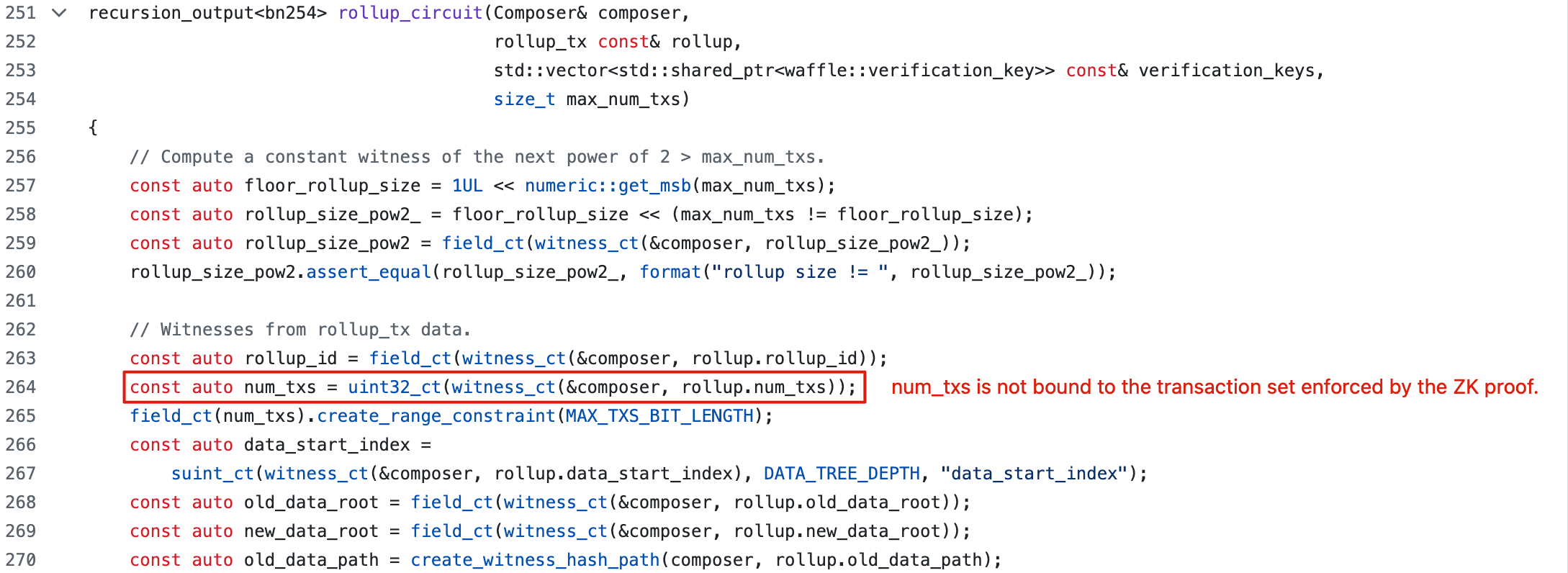
On the Solidity side, decodeProof() reads numTxs from calldata metadata that is not copied into the reconstructed proofData verified by verifyProofAndUpdateState(). Because the circuit's internal num_txs is not a public input, the verifier has no way to check whether the calldata numTxs matches the value proven inside the circuit:
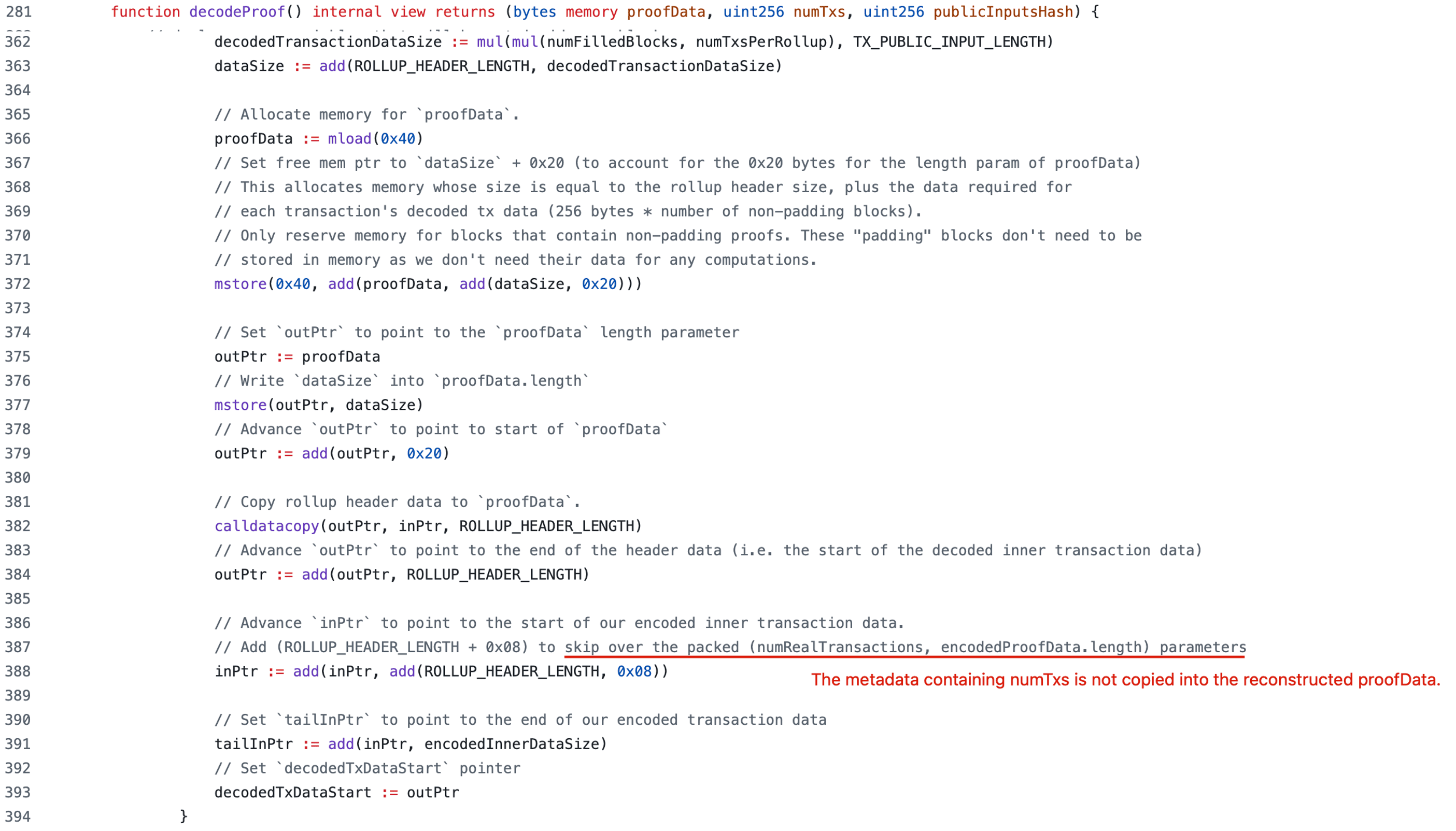
An attacker could therefore set the calldata numTxs lower than the circuit's proven num_txs. The settlement loop would then skip transactions that the proof had credited in the rollup state. A non-actionable transaction could occupy the first decoded slot (within the settlement scan range), while a real deposit could sit in a later slot (proven by the circuit but outside the settlement scan range). The proof would credit the deposit in the rollup state, but the settlement logic would skip it entirely, including the decreasePendingDepositBalance() call. This left the pending deposit balance unconsumed on L1 while the rollup state already reflected the deposit.
Attack Analysis
The following analysis is based on the transaction 0x074ec9...9aeeb1.
The attacker exploited the gap between the proof path and the settlement path in two phases.
Phase 1: Creating unbacked balances
-
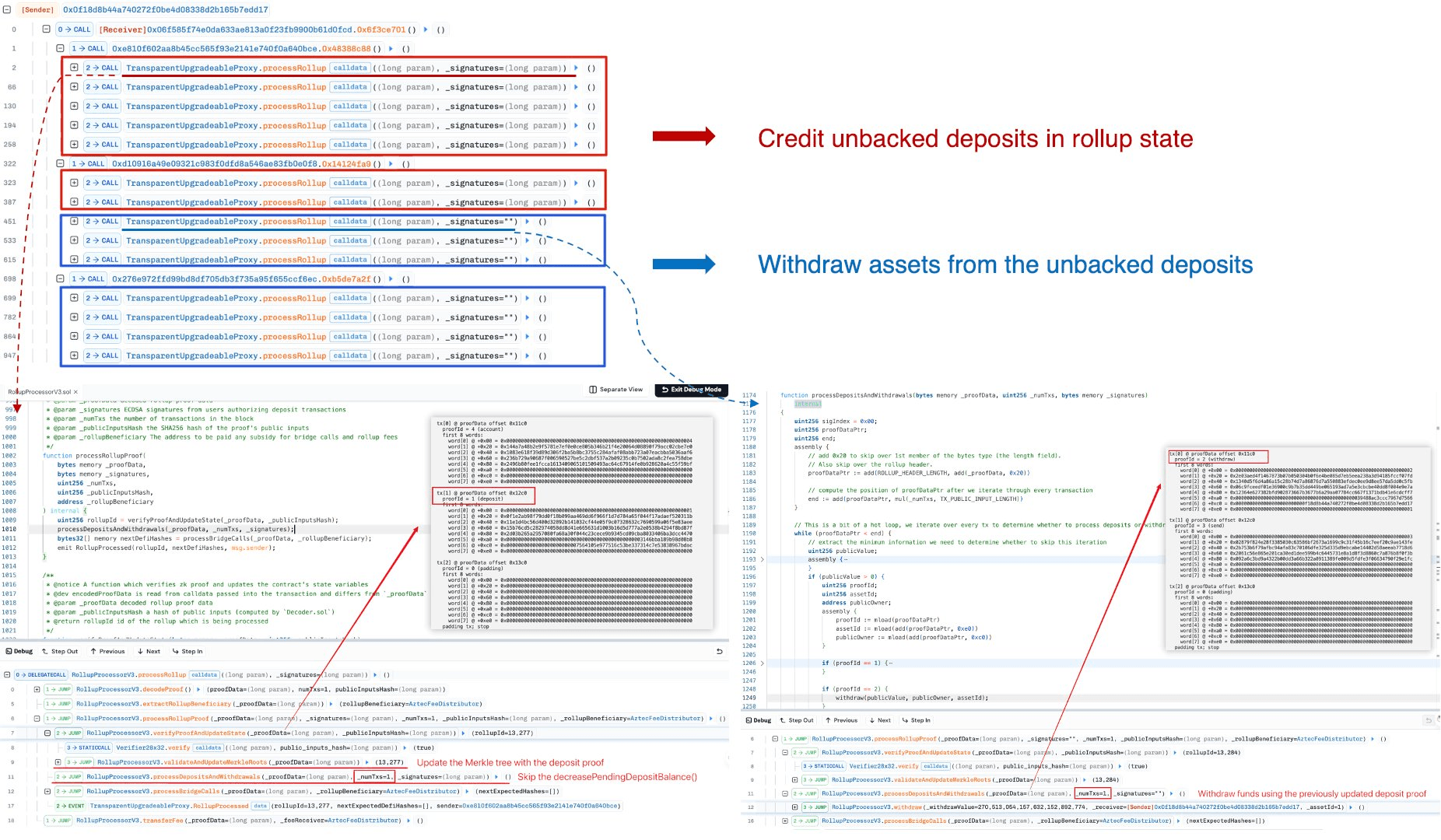
Step 1: The attacker submitted multiple rollup batches, each containing two decoded transactions: a non-actionable (junk) transaction in slot 1 and a real deposit in slot 2. The circuit's
num_txswas set to 2 (matching both real transactions), but the calldatanumTxswas set to 1. The L1 settlement logic processed only the junk transaction in slot 1, completely skipping the real deposit in slot 2. -
Step 2: The ZK proof, however, verified and credited all decoded transactions including the deposit in slot 2. Because the settlement logic never reached this deposit,
decreasePendingDepositBalance()was not called, and the L1 pending deposit balance remained unconsumed. The attacker repeated this pattern for seven different assets, building up unbacked balances in the rollup state.
Phase 2: Extracting funds
- Step 3: Once the seven unbacked balances were established, the attacker initiated standard withdrawals for each asset. These withdrawals appeared legitimate to the settlement logic because the balances existed in the rollup state, so the L1 contract released the corresponding funds — approximately $2.15M in total.
Conclusion
This vulnerability was not a cryptographic weakness but a state consistency bug between two critical code paths in the rollup architecture. The root cause: while the circuit internally enforced that num_txs matched the actual real transaction count, this value was not exposed as a public input. The Solidity decoder read numTxs from unverified calldata metadata with no way to check it against the proven value. The attacker set the calldata numTxs lower than the circuit's proven count so that the settlement logic skipped deposits that the proof had already credited in the rollup state. The resulting unbacked balances were then withdrawn through normal settlement flows.
The vulnerability predated the Aztec Connect sunset. The rollup announced a sunset with transaction processing and withdrawals scheduled to end by March 31, 2024 [2]. However, the rollup processor contract was upgraded on April 10, 2024 via a pull request [3], which opened proof submission to all users — making the pre-existing vulnerability exploitable by anyone.
The fix requires binding numTxs to the full set of transactions verified by the ZK proof so that both paths always process the same set. Any rollup design that separates proof verification from L1 settlement must enforce that both paths operate on an identical, verifiably bounded transaction set. A discrepancy in even one parameter can turn an otherwise sound proof system into a vector for unbacked balance creation.
References
- [1] BlockSec Phalcon Alert: Aztec Incident Analysis
- [2] Aztec Connect Sunset Notice
- [3] RollupProcessorV3 Upgrade PR #67
More Incidents This Week
Raydium
On June 10, 2026, four pools on Raydium's legacy AMM v3 program on Solana were exploited for approximately $1.34M [1]. The withdrawal handler did not verify that a caller-supplied account matched the pool's stored counterpart, so the attacker substituted a controlled account to manipulate the payout calculation. The same technique drained all reserves from four pools within seconds.
Background
Raydium's AMM is a constant-product market maker on Solana. Each pool holds two token vaults and mints an LP token representing a proportional share of the reserves. When a liquidity provider withdraws, the handler computes the payout proportionally and transfers the corresponding share of both vaults:
coin_out = total_coin * withdraw_amount / lp_supply
pc_out   = total_pc   * withdraw_amount / lp_supply
On Solana, each token type is defined by a Mint account that stores the total supply, decimals, and mint authority. Each holder's balance is stored in a separate Token account bound to that Mint — one Mint can have many Token accounts across different holders. This differs from EVM, where a single ERC-20 contract manages both the token definition and all balances internally.
In the withdrawal formula above, lp_supply is read from the pool's LP Mint account — the one that tracks total LP supply. The correctness of the calculation depends on this value being the real LP Mint. However, on Solana, the caller passes every account into each instruction positionally, so the handler must validate that each caller-supplied account matches the canonical account stored in the pool state.
Vulnerability Analysis
The exploited program (27haf8...8vQv) was not open-sourced, and its executable data (ProgramData) was closed after the attack, making direct bytecode inspection impossible. The analysis below is based on the bytecode reconstructed from the program's last upgrade buffer and cross-referenced with on-chain transaction behavior.
In the withdrawal handler, the LP Mint account passed by the caller was not bound to the pool's recorded amm.lp_mint. The following reverse-engineered pseudo-code reconstructed from the on-chain bytecode shows the account layout. The handler checked bindings for the pool state, PDA authority, both vaults, and user accounts — but not for the LP Mint at slot 5:
let amm_info         = next_account_info(it)?;  // accounts[1] — pool state (holds amm.lp_mint)
// ...
let amm_lp_mint_info = next_account_info(it)?;  // accounts[5] — caller-supplied mint

let amm = AmmInfo::load(amm_info)?;
// authority, vaults, open_orders bindings checked here...
// >>> MISSING: check that accounts[5].key == amm.lp_mint <<<

let lp_mint = Mint::unpack(&amm_lp_mint_info.data.borrow())?;
let lp_mint_supply = lp_mint.supply;  // reads from the unverified mint

let coin_amount = total_coin * withdraw_amount / lp_mint_supply;
let pc_amount   = total_pc   * withdraw_amount / lp_mint_supply;
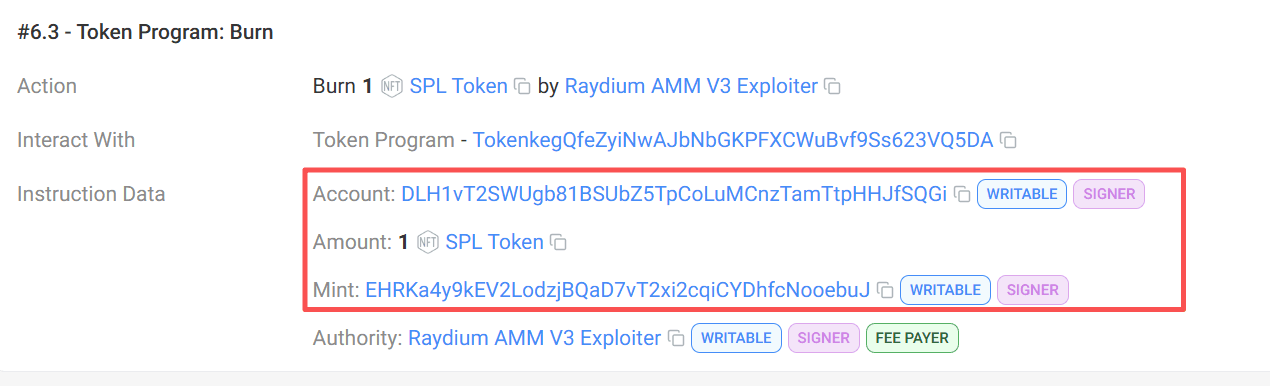
Because the LP Mint account was unbound, an attacker could substitute a Mint account they fully controlled. Setting its total supply to 1 and burning 1 token yielded a payout ratio of 1 / 1 = 100% of each reserve.
The vulnerable code had been live and unchanged since the program's last upgrade on January 3, 2023, approximately 1,254 days before the exploit.
Attack Analysis
The following analysis is based on the transaction 1csN6v...3s7s.
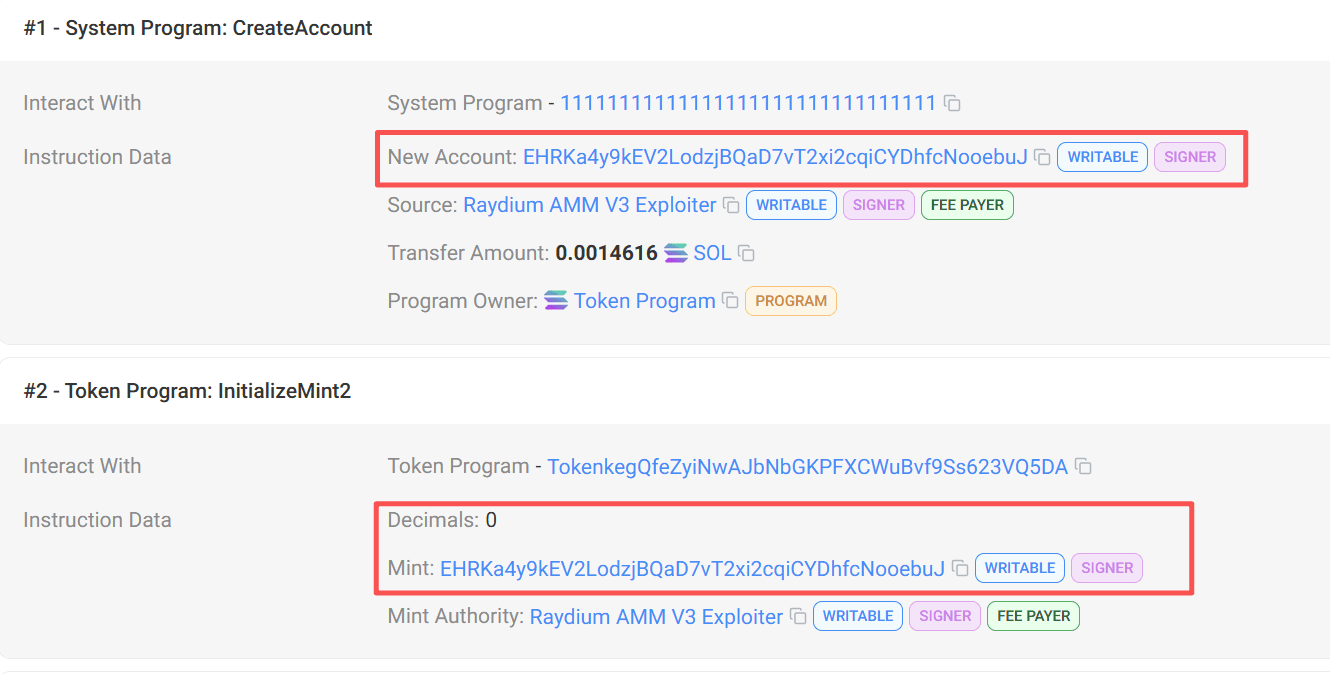
- Step 1: The attacker created a fake LP Mint account with
decimals = 0and totalsupply = 0.
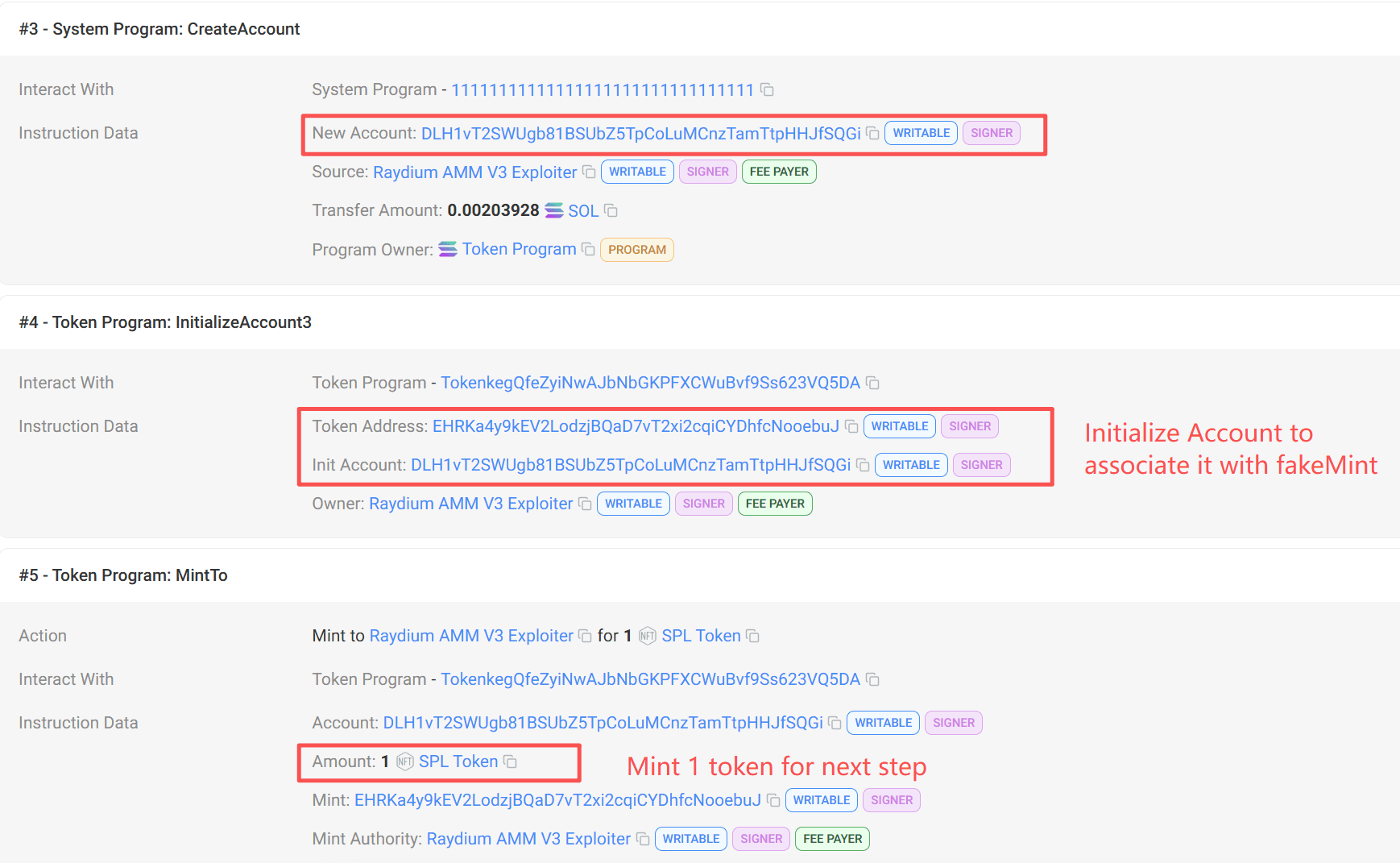
- Step 2: The attacker initialized a Token account bound to the fake LP Mint, then minted exactly 1 token into it (as the Mint authority), pinning the Mint's total
supplyto 1.
- Step 3: The attacker called the withdrawal function, passing the fake LP Mint in the expected account slot and the Token account from Step 2 (holding 1 fake LP token) as the LP source. With
withdraw_amount = 1andlp_supply = 1, the handler computedtotal_coin * 1 / 1andtotal_pc * 1 / 1, which equaled 100% of both reserves (893,700USDCand 66,837RAYfor the RAY/USDCpool).
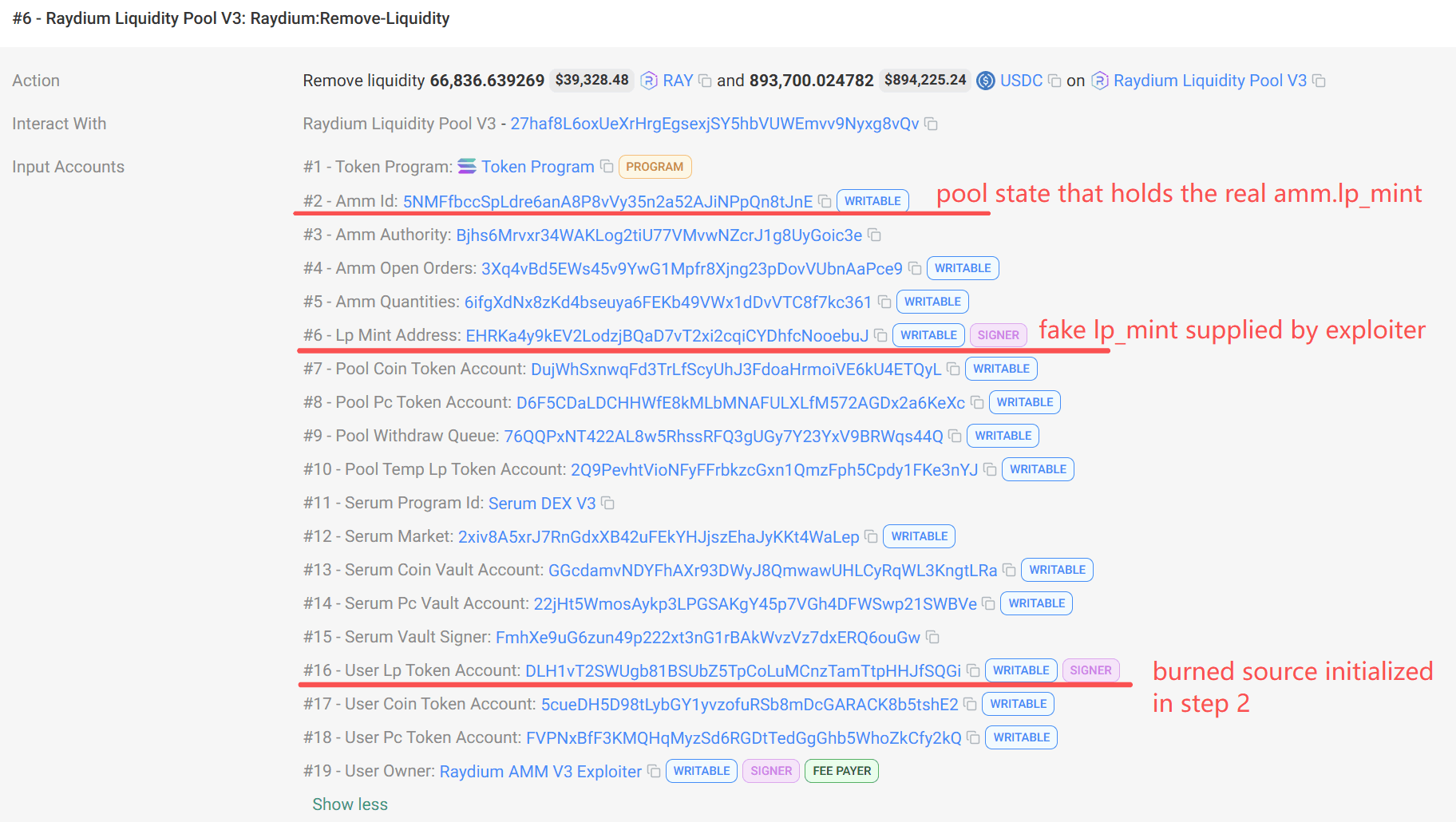
- Step 4: The handler burned the attacker's 1 token and transferred the full reserves out of both pool vaults, which drained the RAY/
USDCpool entirely.
The attacker repeated the same pattern against three more pools within approximately 15 seconds. Across all four pools, the drained amounts were:
| Pool | Drained (approx.) |
|---|---|
| RAY/USDC | ~66,837 RAY + ~893,700 USDC |
| RAY/wSOL | ~74,720 RAY + ~5,603 wSOL |
| RAY/SRM | ~8,622 RAY + ~10,692 SRM |
| RAY/Sollet ETH | ~5,038 RAY + ~16 Sollet ETH |
Conclusion
The root cause is a single missing account-validation check: the withdrawal handler used the supply of a caller-supplied Mint account as the LP supply divisor without binding it to the pool's recorded amm.lp_mint. On Solana, every caller-supplied account must be bound to its canonical counterpart stored in the pool state. A correct implementation should reject any LP Mint whose key does not match the pool's stored record, and compute redemption from a pool-internal LP counter rather than the externally supplied Mint's supply. The exploited contract was an older deployment (last upgraded January 2023) that was closed the same day as the attack. According to the Raydium team, full compensation will be handled by Raydium's treasury [1].
References
About BlockSec
BlockSec is a full-stack blockchain security and crypto compliance provider. We build products and services that help customers to perform code audit (including smart contracts, blockchain and wallets), intercept attacks in real time, analyze incidents, trace illicit funds, and meet AML/CFT obligations, across the full lifecycle of protocols and platforms.
BlockSec has published multiple blockchain security papers in prestigious conferences, reported several zero-day attacks of DeFi applications, blocked multiple hacks to rescue more than 20 million dollars, and secured billions of cryptocurrencies.
-
Official website: https://blocksec.com/
-
Official Twitter account: https://twitter.com/BlockSecTeam