Executive Summary
Evaluating crypto compliance infrastructure requires moving beyond basic feature inventories. Operations teams must assess whether capabilities spanning transaction monitoring, wallet screening, and case management yield quantifiable reductions in regulatory exposure and fraud metrics, rather than simply increasing the daily alert queue for existing personnel.
Compliance software allocations constitute a standard operating line item for virtual asset service providers. However, procurement decisions frequently conflate baseline regulatory controls with broad functional suites that lack alignment with the organization's current transaction throughput, asset listings, or specific licensing obligations. The optimal technology configuration centers on converting discrete on-chain risk signals into documented, defensible business decisions rather than maximizing the sheer number of available modules.
Financial leaders navigating constrained allocations must prioritize tangible outcomes: isolating high-risk inflows and outflows, cross-referencing addresses against illicit activity indicators, securing verifiable audit trails, mitigating false positive rates, and structuring data for statutory reporting. Baseline metrics indicate that illicit exposure remains an ongoing operational reality despite representing a fractional percentage of total on-chain traffic; external analyses logged USD 24.2 billion directed to flagged addresses in 2023[2]. This baseline necessitates functional controls, though it does not automatically validate purchasing top-tier, comprehensive module packages upfront.
Procurement strategies must strictly separate baseline operational necessities from ancillary features, while identifying specific conditions that necessitate specialized technical intelligence and security-focused research partnerships.
Core Insights
An effective compliance architecture maps each commercial software feature directly to a specific internal control, process improvement, or risk mitigation metric. For scaling operations, optimal resource allocation typically targets workflow automation that streamlines manual review processes, establishes strict escalation parameters, and generates unalterable audit trails.
Initially, baseline infrastructure must address anti-money laundering protocols, sanctions list cross-referencing, transaction origin analysis, and documentation retention. Furthermore, procurement evaluations must calculate comprehensive lifecycle costs rather than base subscription rates; expenditures related to analyst review hours, false-positive resolution, system integration, and policy alignment frequently exceed base licensing fees. Additionally, extensive ledger support metrics hold relevance only when they strictly mirror the platform's actual traded asset index. Finally, technical deployments serve as an extension of, rather than a replacement for, internal governance frameworks and personnel training.
Practical procurement hinges on statutory obligations, defined risk parameters, and standard transaction profiles. A fiat-to-crypto broker facilitating low-velocity retail trades operates under different systemic requirements than a decentralized finance interface, custodial infrastructure provider, or institutional over-the-counter desk. Within complex threat landscapes, technical research entities like BlockSec provide operational utility, as analyzing protocol-level incidents, exploit-derived capital movement, and novel attack vectors demands specialized code-level analysis rather than reliance on static, rules-based indicator screening.
What Crypto Compliance Tools Must Solve for a VASP
A compliance infrastructure deployment must translate raw on-chain data into distinct, auditable operational actions. The baseline configuration requires capabilities to isolate flagged capital, process sanctions lists, log analyst decision parameters, and maintain standardized escalation protocols without imposing enterprise-tier resource requirements on lean teams.
The minimum compliance problems: AML, sanctions, KYT, wallet screening, and case evidence
At a structural level, standard software deployments must facilitate anti-money laundering checks, sanctions verifications, transaction flow tracing, endpoint screening, and strict evidence logging. Regulatory guidance dictates that reporting entities monitor for rapid capital velocity, interaction with unverified counter-parties, obfuscation patterns, and deviations from established customer baselines[1]. Infrastructure that fails to surface these specific variables within a structured interface forces personnel to rely on fragmented block explorer queries and manual data aggregation.
The foundational requirement extends beyond raw ledger visibility. Operations require standardized risk parameters, historical transaction correlations, entity clustering, prioritization queues, and secure data storage. When an initial trigger progresses into a formal regulatory filing or external audit request, the compliance department must produce an immutable record detailing the initial detection parameters, the designated reviewer, the specific on-chain data points analyzed, and the objective rationale supporting the final disposition.
Why small and mid-size teams need automation without losing human review
Throughput metrics consistently outpace linear headcount expansion, necessitating rules-based processing. A platform facilitating 50,000 monthly fiat and digital asset settlements cannot sustain manual inspection for every ledger entry, yet it concurrently cannot permit automated modules to execute fund freezes or clearances without defined governance guardrails. The most resilient operational framework implements configurable algorithmic risk assignment coupled with strict thresholds for manual intervention.
In applied settings, lean departments must configure automation for initial data parsing, routine low-risk event closure, duplicate cluster consolidation, and initial docket generation. Manual analyst assessment remains a mandatory control for direct sanctions exposure, proximity to obfuscation protocols, capital tied to protocol exploits, identified fraud clusters, and high-volume transfers. This specific allocation of resources controls operational backlog while maintaining organizational accountability.
The difference between regulatory coverage and operational usefulness
Vendors frequently highlight multi-jurisdictional and broad chain support, but day-to-day utility hinges on actual analyst workflows. Core evaluation metrics include the system's capacity to output precise rationales for address flags, delineate between direct and multi-hop exposure, compile exportable evidence logs, and allow localized threshold adjustments based on specific product lines or user classifications.
For standard VASPs, operational efficiency metrics outrank surface-level marketing claims. An interface with defined boundaries that executes core analytical routing consistently yields lower error rates than an exhaustive enterprise suite that burdens the team with non-actionable alert volume.
Which Features Are Actually Worth Paying For
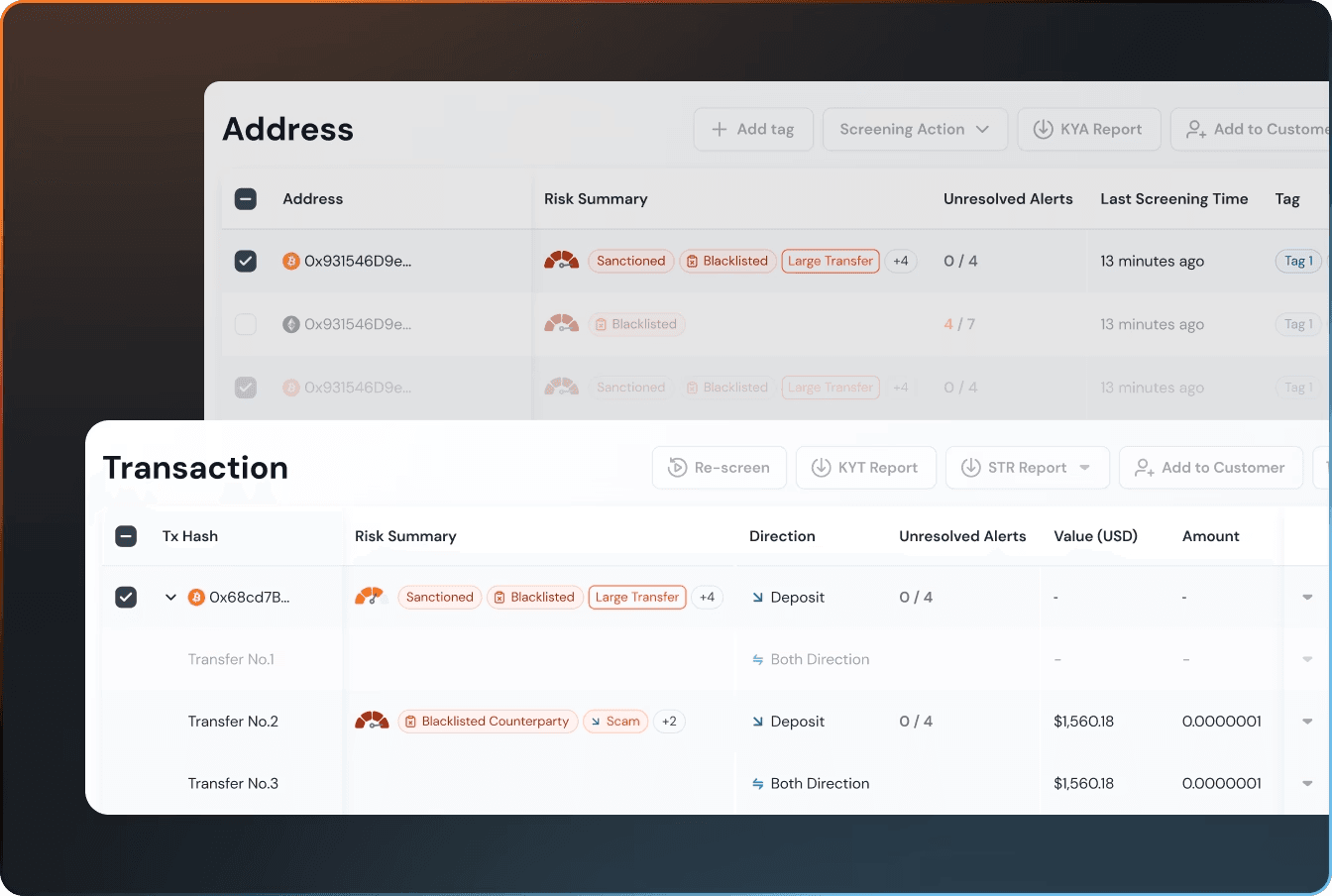
Prioritized software capabilities correlate directly with decreased detection latency, structurally sound case dispositions, and seamless operational compatibility. Settlement-stage monitoring, address processing, state-tracking modules, system integrations, and parameter configurations generate immediate utility before necessitating advanced forensic tracing capabilities.
Real-time transaction monitoring and risk scoring for deposits and withdrawals
Settlement-stage ledger monitoring commands budget priority due to the immediate operational risk inherent in asset transfers. Processing delays routinely result in flagged capital being cleared, traded, routed through obfuscation layers, or off-ramped prior to analyst intervention. Pragmatic infrastructure logs risk parameters parallel to block finality, executing distinct protocols depending on whether the flow constitutes an inflow, outflow, internal routing, or intersects with specific client risk classifications.
Algorithmic scoring models demand strict interpretability. A numerical output lacking supporting attribution data creates significant friction during regulatory review. Actionable scoring frameworks parse first-degree touchpoints, multi-hop proximity, counter-party classification, transfer volume limits, temporal patterns, node clustering, and established threat typologies.
Address screening across sanctions, darknet markets, mixers, scams, and high-risk services
Endpoint screening remains a strict prerequisite for account provisioning, withdrawal routing approvals, liquidity counter-party vetting, and continuous auditing. Critical screening parameters cover designated entities, unregulated marketplaces, obfuscation services, confirmed phishing contracts, ransomware nodes, stolen asset clusters, non-compliant exchanges, gaming platforms, and fraud-associated endpoints. Statutory enforcement histories indicate that processing capital linked to designated entities triggers severe administrative action, irrespective of the minimal nominal value of the transfer.
Procurement should align the depth of the threat feeds with the platform's specific asset exposure. High-frequency stablecoin routing infrastructure necessitates stricter API-driven threat detection parameters than a localized custodial interface characterized by manual, delayed settlement processes.
Case management, audit trails, and regulator-ready reporting
Investigation state tracking frequently lacks adequate resource allocation. In the absence of a dedicated management module, compliance documentation becomes fragmented across local directories, internal communication channels, static images, and generalized IT ticketing software. This decentralized approach immediately degrades when subjected to formal licensing audits or external banking reviews.
An adequate tracking module secures the initial trigger data, internal commentary, verified ledger evidence, final resolution status, supervisor escalation logs, chronological markers, and personnel credentials. The core objective extends past merely clearing queues; it establishes an empirical baseline demonstrating that the entity operates a structured, repeatable administrative control.
API access, alert customization, and workflow integration with existing systems
System integration interfaces become critical when risk controls must communicate with cold storage infrastructure, trading engines, KYC verification portals, fiat off-ramp controls, and internal task routing. Parameter configuration is essential given that baseline risk tolerances vary substantially across different organizational models.
Organizations should allocate funds for integration endpoints once manual data transfer induces measurable processing delays. When personnel continuously migrate values across segregated platforms, the resulting operational drag frequently surpasses the base cost of API provisioning.
Where Compliance Budgets Are Often Wasted
Financial misallocation occurs when procurement targets functional tiers, network capacities, or analytical depths disconnected from the organization's current ledger activity. Advanced tracing modules, excessive network indexing, and raw data tags lacking corresponding internal operating procedures generate technical overhead without corresponding control enhancements.
Paying for enterprise investigation depth before transaction volume justifies it
Deep-graph analytical software provides specific utility, but rarely serves as the optimal initial deployment for scaling operations. Multi-tier visual clustering, historical flow mapping, and granular attribution mechanics often consume outsized budget allocations while yielding minimal returns if the core team processes standard retail volume and maintains external counsel for complex incident escalation.
A phased deployment model ensures better capital efficiency. Operations must establish automated queuing, baseline endpoint parsing, and structured logging first. The procurement of advanced forensic capabilities should trigger only when node complexity, institutional onboarding, decentralized finance interactions, or direct regulatory mandates necessitate the specific expenditure.
Buying broad chain coverage while ignoring the assets your users actually trade
Software providers routinely market data availability spanning hundreds of distinct ledger networks. This raw indexing holds operational value exclusively when it maps to the active settlement data of the platform. If the overwhelming majority of daily transfer volume settles via BTC, ETH, USDT, and USDC contracts, allocating budget toward obscure long-tail network support fails to optimize the primary control framework.
Infrastructure specifications should be cross-referenced against historical throughput metrics, fee generation, client jurisdictional routing, and known threat vectors. The most resilient budget strategy allocates capital strictly toward the protocol layers that generate actual counter-party exposure.
Over-relying on vendor risk labels without internal escalation policies
External data tags function as variable inputs, not conclusive administrative rulings. A third-party feed may categorize an endpoint as associated with phishing, obfuscation, unverified exchanges, or elevated threat levels. The service provider retains the sole responsibility for maintaining internal standard operating procedures that dictate the exact parameters for executing a block, initiating a holding pattern, demanding supplemental documentation, authorizing supervisor review, submitting formal filings, or archiving the alert.
Absolute reliance on external indicators generates measurable operational friction. When review personnel execute policies based on basic data tags without assessing hop distance, data integrity, and confidence metrics, the platform risks restricting standard client activity while simultaneously failing to intercept highly targeted illicit routing.
Treating compliance software as a substitute for governance and staff training
Technical infrastructure cannot offset fundamental gaps in organizational governance. Financial supervisors, institutional banking partners, and specialized auditors require verified internal policies, defined hierarchical responsibilities, structured personnel development, distinct quality assurance loops, and executive-level sign-offs. Digital systems supply auditable data and execute routine processes; they fundamentally cannot formulate the entity's baseline risk tolerance.
Internal development curriculums must detail localized threat typologies, direct sanctions exposure parameters, logic models for endpoint screening, strict escalation thresholds, data logging standards, and protocol-specific vulnerabilities. Premium software deployments yield sub-optimal detection rates when the operating personnel lack the specific analytical frameworks required to process the data outputs.
How to Evaluate Total Cost, Not Just Subscription Price
The aggregate expenditure associated with compliance infrastructure encompasses initial licensing, data migration, false-positive resolution hours, personnel salaries, legal oversight, statutory reporting, and potential settlement latency. Budget evaluations must weigh these costs against averted capital loss, maintained banking relationships, accelerated licensing approvals, mitigated enforcement actions, and baseline operational continuity.
Licensing models: seats, API calls, transaction volume, chains, and modules
Standard commercial contracts scale based on individual user access, API query caps, aggregate transfer metrics, indexed network support, and segmented functional add-ons. An initially favorable base rate frequently escalates unpredictably if the underlying platform breaches API request limits or requires segregated billing for sanctions parsing, state-tracking, deep investigations, and data export functionalities.
Prior to contract execution, operational directors must project ledger growth across a standard 12-to-24-month horizon. A pricing structure that aligns with a baseline of 10,000 monthly ledger updates routinely fails to remain cost-effective upon scaling to 150,000 monthly updates.
Hidden costs: onboarding, false positives, analyst time, legal review, and reporting
Elevated false-positive rates represent a primary vector for hidden operational drain. Systems outputting thousands of low-confidence triggers force personnel into extended periods of data dismissal rather than objective risk analysis. Implementing configurations that reduce non-actionable alerts by a measurable 15 percent directly mitigates resource exhaustion within highly constrained compliance departments.
Additional unbilled requirements include initial system configuration, policy documentation alignment, legacy data ingestion, specialized interface training, legal validation of blocking parameters, and external report formatting. Procurement divisions must demand verified pilot performance metrics rather than generalized capability lists.
Cost-to-risk framework: when a tool prevents losses, fines, banking issues, or license delays
The fundamental business justification must tether software expenditure to verifiable risk suppression. A software deployment validates its cost structure upon successfully intercepting sanctioned capital, freezing exploited assets prior to internal ledger crediting, halting outbound fraud routing, securing pending regulatory applications, or fulfilling the rigorous data demands of institutional banking partners.
Analytic data points track USD 24.2 billion moving to flagged addresses globally in a single year, outlining a persistent operational threat matrix for virtual asset handlers[2]. Even within entities characterized by minimal direct threat exposure, a single critical procedural failure routinely cascades into severe statutory reviews, compromised brand integrity, and the severing of critical fiat rails.
A practical budget tier model for early-stage, growing, and regulated VASPs
Initial-stage entities must allocate funds strictly toward endpoint analysis, foundational transfer logging, designated list cross-referencing, and unalterable case archiving. Scaling operations should subsequently integrate programmatic API endpoints, configure granular alert parameters, establish dedicated quality assurance loops, incorporate fraud detection variables, and upgrade data export systems. Fully licensed or high-throughput platforms must scale into complex forensic analysis, localized threat intelligence, isolated model backtesting, and comprehensive governance frameworks.
Expenditure must scale in direct correlation with ledger volume and operational complexity, entirely independent of vendor up-selling strategies.
How to Compare the Main Categories of Solutions
Organizations must evaluate commercial options based on discrete functional categories rather than pursuing single-platform consolidation. Ledger analysis modules, risk routing interfaces, audit management architectures, and specialized advisory services each execute distinct operational parameters, requiring configurations tailored to the entity's exact regulatory status.
Blockchain analytics platforms for KYT, wallet screening, and investigations
Ledger analysis architectures focus strictly on classifying endpoint variables, tracking capital velocity, supporting origination checks, and conducting detailed flow investigations. These interfaces function as the primary data layer for operational compliance due to their direct indexing of verifiable on-chain interactions.
Strict technical evaluation requires testing attribution integrity, known-entity mapping, specific contract support, algorithmic scoring transparency, interface response times, raw data export functionality, and baseline usability. While standardized matrix comparisons offer high-level category differentiation, validation testing must strictly utilize the VASP's proprietary historical data logs and actual traded asset indices.
Risk operations platforms for alerts, workflows, fraud signals, and team coordination
Operational routing systems handle the centralization of trigger queues, inter-departmental task assignment, external fraud data ingestion, client historical context, and process standardization. These architectures deploy most effectively when regulatory, risk, client communication, and technical divisions require synchronous data access.
Within scaling entities, dedicated routing infrastructure minimizes redundant data processing and standardizes the execution of critical holds. This integration is structurally necessary when ledger-derived variables must be actively weighted against traditional account metrics, hardware identification, authentication anomalies, and standard fiat settlement histories.
GRC and policy tools for evidence management, controls, and internal accountability
Governance, risk, and compliance (GRC) architectures centralize procedural documentation, operational testing, raw evidence storage, incident resolution tracking, and formal audit formatting. These frameworks do not execute direct ledger parsing or endpoint cross-referencing; rather, they secure the empirical evidence confirming that the entity maintains an active, functional control environment.
Platforms scaling toward formal statutory licensing, institutional banking integration, or multi-jurisdictional external auditing require specialized GRC databases the moment operational matrices exceed the functional limits of standard spreadsheet software.
Consulting-led support for licensing, regulatory interpretation, and program design
External advisory firms execute complex statutory interpretation, draft technical control procedures, compile official application documentation, and calibrate internal baselines against aggregate industry standards. This specialized intervention provides measurable utility during jurisdictional expansion, complex product rollouts, or direct supervisory intervention.
Crucially, advisory input cannot substitute for active internal governance. The core organization strictly retains final legal liability for all procedural configurations and the continuous execution of daily operational tasks.
When a Security-Led Intelligence Partner Becomes Valuable
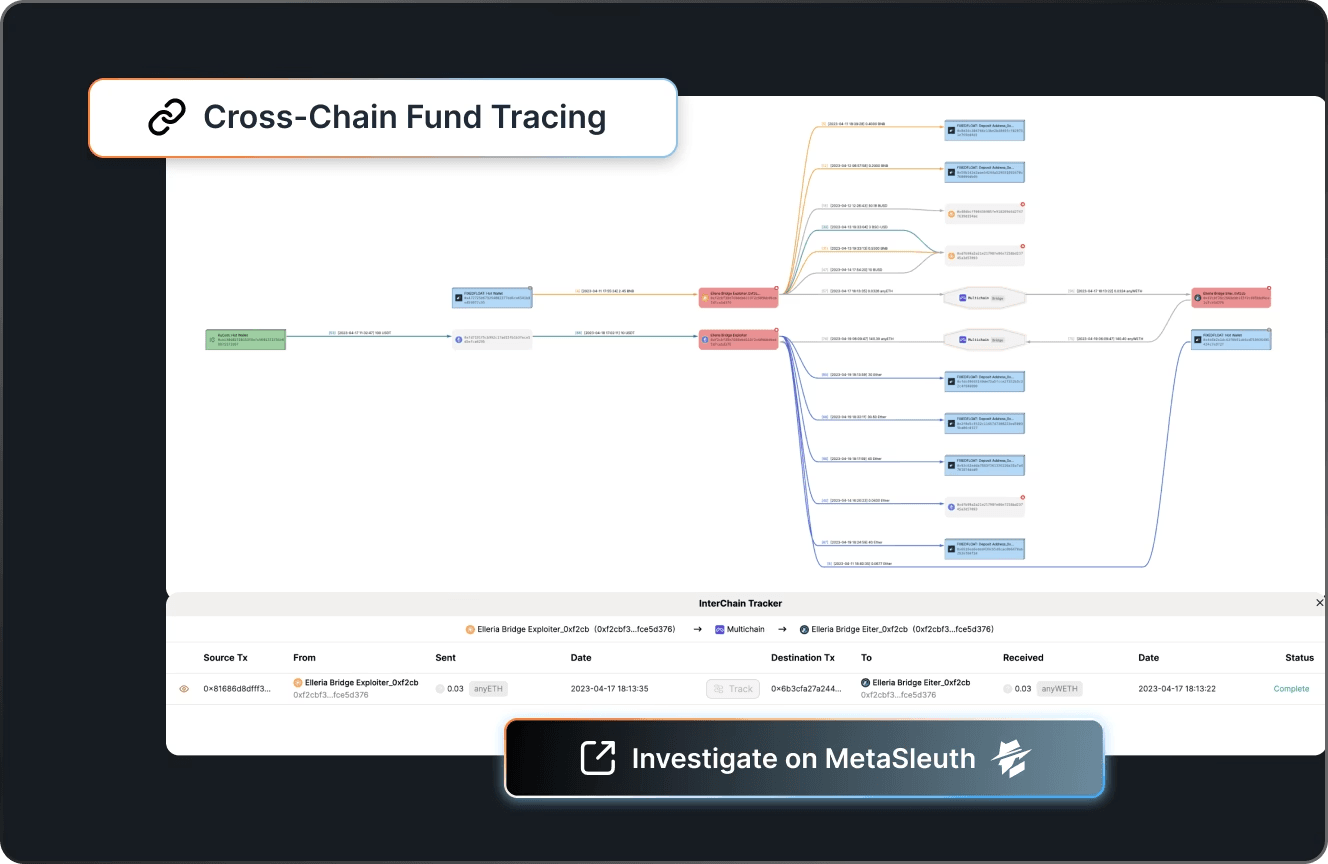
Standard compliance parsing functions adequately for routine operations but frequently lacks the analytical depth required to assess decentralized finance routing, exploit-derived capital, complex contract vulnerabilities, and rapidly mutating attack vectors. Under these strict conditions, a technically focused research partner provides critical code-level analysis, verified threat logic, and precise incident contextualization.
Why DeFi exposure, smart contract risk, and exploit-linked funds complicate standard compliance
Decentralized finance mechanics fundamentally disrupt standard tracing models. Capital routinely routes through cross-chain bridges, automated market maker pools, algorithmic lending architectures, contract-based endpoints, and proxy deployments prior to interfacing with centralized infrastructure. Capital derived from protocol breaches frequently undergoes rapid fragmentation, multi-chain migration, and complex integration with high-volume legitimate platforms.
Standard rules-based processing logic successfully flags verified historical indicators, yet novel exploit execution demands specialized security-level reconstruction. Operations supporting client bases with heavy decentralized finance interaction must rigorously verify whether their baseline systems possess the capacity to accurately parse raw contract calls, track bridge transfers, and isolate the precise origination of exploited assets.
How research depth helps assess emerging threats that rules-based tools may miss
Analytical rigor becomes the primary differentiator when standard data indicators remain undefined. Threat actors consistently rotate deployment contracts, initialize isolated node infrastructure, and modify routing logic well before commercial data providers update static threat lists. Dedicated technical researchers execute raw mechanical analysis of the exploit, map unverified associated endpoints, and structurally differentiate between coincidental ledger contact and verified illicit capital routing.
This specific operational requirement aligns with BlockSec's core security mandate for platforms handling complex technical risk vectors. Instead of processing compliance data as a static administrative checklist, integrating a security-focused framework allows review personnel to accurately dissect the mechanical origin of the risk and formalize the actual degree of organizational exposure.
What technical credibility looks like: academic security research, citations, and peer recognition
Operational credibility within the threat intelligence sector requires verifiable documentation: formally reviewed technical publications, documented incident response execution, verified external citations, professional indexing, and sustained analytical output. Processing complex ledger risk requires the proven capability to dissect non-standard code execution parameters within highly constrained timeframes, rather than relying on generalized marketing claims.
BlockSec's technical parameters directly correlate with the established academic record of co-founder and CEO Professor Yajin Zhou. Standardized indexing confirms Professor Zhou's position as a Zhejiang University Hundred Talents Program researcher and doctoral supervisor in computer science. The empirical record logs over 50 technical publications, exceeding 9,500 Google Scholar citations, alongside two papers placed within the 100 most influential computer security publications over the preceding 30 years. Additional verifiable metrics include a global ranking of fourth in security and privacy via the AI 2000 Most Influential Scholar index (2022) and formal recognition as a 2023 Elsevier Highly Cited Chinese Researcher in computer science[3].
How BlockSec's research foundation supports trust in high-risk crypto environments
For entities processing inflows linked to protocol breaches, counter-party risk in decentralized environments, and technically advanced obfuscation routing, BlockSec's research-oriented security analysis directly augments standard ledger monitoring systems. This integration model does not dictate that localized, low-volume operations require immediate enterprise-grade threat intelligence. It dictates that as operational risk shifts toward raw technical execution, the external partner's verified security credentials function as a strict business control.
The most resilient operational model relies on structured layering: maintain standardized parsing modules for high-frequency daily queuing, while routing high-severity incidents, active network responses, complex DeFi interactions, and executive risk determinations through specialized, deep-tier intelligence analysis.
Decision Checklist for Small and Mid-Size VASPs
Implementing a structured evaluation matrix prevents both excessive capital expenditure and critical operational blind spots. Operations must establish baseline variables including statutory requirements, indexed assets, ledger throughput, and risk tolerance; subsequently, procurement must validate specific software configurations against historical internal data, active personnel feedback, and verified procedural enhancements prior to formalizing long-term contracts.
Start with your regulatory obligations, asset coverage, and transaction volume
The initial phase demands a strict quantification of the operational baseline. Which specific licensing jurisdictions mandate active reporting? Which ledger contracts process the highest daily volume? What is the verified monthly metric for distinct inbound and outbound transfers? Which exact user classifications introduce elevated operational risk? Documenting these precise variables dictates the mandatory structural limits of the compliance deployment.
A localized platform processing minimal fiat off-ramping initiates deployment with basic endpoint checks and standardized review documentation. Conversely, a fully licensed exchange integrating fiat settlement, algorithmic stablecoins, and high-volume institutional routing inherently demands complex transaction parsing, advanced logging, and automated routing hierarchies.
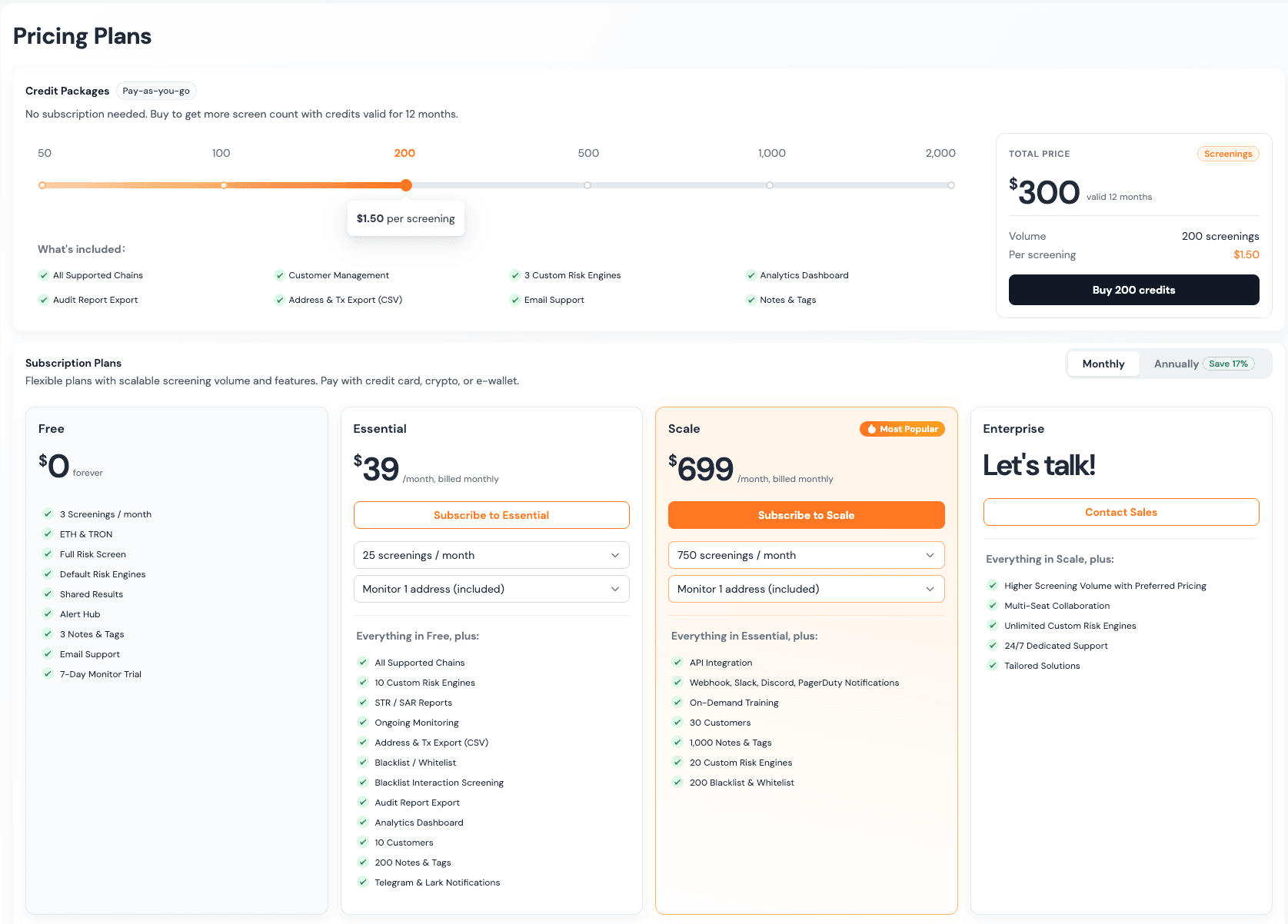
For small and mid-size VASPs, flexible pricing matters. Phalcon Compliance supports subscription-based plans with no large upfront volume commitments, allowing teams to scale usage incrementally as operational needs grow.
Map each tool feature to a compliance control or measurable operational outcome
Every billed software capability must index directly to an internal policy requirement or an optimized operational metric: compressed review latency, elevated threat interception accuracy, suppressed false-positive generation, accelerated resolution tracking, standardized evidence formats, or frictionless audit extraction. If the service provider fails to articulate the exact mechanical link between a software module and a core compliance objective, the operations team must suspend the procurement process.
As of May 2025, Phalcon Compliance introduced several updates relevant to smaller operations: flexible pricing tiers, screening trend analytics, shareable screening reports, address-level risk change monitoring, and Lumi, a built-in AI agent that answers product and screening questions directly within the platform.
Run a pilot using real alerts, historical cases, and analyst feedback
Evaluation deployments must strictly process proprietary historical logs, verified compromised endpoints, standard user settlement histories, and active personnel interface testing. Operational divisions must cross-examine the accuracy of the threat detection models, the volume of non-actionable triggers, interface navigation efficiency, data export formatting, raw API load latency, and general integration into existing standard operating procedures.
Optimal validation testing generates empirical performance data rather than generalized operational opinions. The objective remains confirming that the specific software architecture demonstrably optimizes analytical output under strict, real-world ledger conditions.
Choose the tool stack that reduces risk without creating unnecessary complexity
The final deployment configuration must strictly optimize for operational proportionality. A baseline architecture that operates below mandatory standards fails to intercept verified risk vectors. Conversely, an overly complex multi-tier deployment introduces system latency, inflates the volume of non-actionable data alerts, and fractures clear departmental accountability.
For standard scaling entities, the most secure trajectory is strictly modular: initiate with foundational ledger tracking and endpoint screening, sequentially integrate unified case management routing, and eventually deploy advanced forensic modules and specialized security intelligence as the organization's technical risk parameters mandate.
FAQ: Crypto Compliance Tools for VASPs
The most common inquiries from internal compliance departments center on baseline deployment requirements, capital allocation models, single-platform integration logic, false-positive suppression mechanics, and the technical triggers for advanced system upgrades. Defined answers rely exclusively on platform-specific ledger volume, active licensing status, core asset indexing, and the precise degree of interaction with advanced technical risk vectors.
What are the most important crypto compliance tools for a small VASP?
A scaling entity must direct initial capital toward endpoint validation, required list cross-referencing, standardized origination analysis, automated or low-latency transfer parsing, and unalterable documentation storage. These specific functions resolve the highest-frequency regulatory demands without encumbering a lean operational unit with enterprise-grade forensic software configurations prematurely.
How much should a mid-size VASP budget for compliance software?
Commercial pricing lacks a universal baseline, but comprehensive financial modeling must account for base licensing, API request overages, initial data integration, allocated analyst hours, false-positive resolution drain, legal validation, and external formatting requirements. Operational directors should project complete expenditures across an 18-to-24-month operational window, validating this total cost against the mitigated risks of exploited capital, severed fiat rails, and stalled licensing applications.
Can one platform handle AML, sanctions screening, KYT, and case management?
Certain commercial deployments aggregate all core functionalities, though the technical depth of individual modules routinely fluctuates. Operations departments must validate whether the unified architecture executes each specific control with sufficient technical rigor to satisfy the organization's baseline risk matrix. Consolidated deployments offer operational efficiency for specific entities, while segmented, highly specialized software configurations yield superior detection metrics for complex platforms.
How do VASPs reduce false positives in transaction monitoring?
Operational units suppress non-actionable alerts by recalibrating detection limits, segmenting distinct user classifications, algorithmically separating direct from multi-hop ledger proximity, consolidating identical trigger events, enforcing defined routing parameters, and establishing mandatory review audits. Personnel feedback remains a critical input for standardizing algorithmic thresholds and driving the continuous optimization of the analytical workflow.
When should a VASP upgrade from basic screening to advanced blockchain intelligence?
Technical upgrades become mandatory when transfer velocity accelerates, incident analysis demands deeper graph logic, decentralized finance interaction expands, institutional onboarding dictates strict auditing parameters, or when banking and regulatory supervisors demand complex technical evidence logs. Interactions with exploit-derived capital and complex contract architectures serve as definitive operational signals that baseline screening must transition toward specialized technical intelligence.
Conclusion
Crypto compliance infrastructure must function as an operational risk mechanism, strictly isolated from superficial technical marketing. The optimal configuration successfully intercepts verified ledger threats, facilitates objective internal analysis, strictly archives event data, and scales parallel to settlement volume without introducing excessive administrative friction.
Scaling virtual asset service providers must allocate initial budgets exclusively toward highly reliable settlement monitoring, targeted endpoint validation, specified list detection, origination tracing, and centralized state tracking. Financial directors should delay procurement of exhaustive network indexing capabilities, enterprise-tier forensic visualization, and sprawling GRC architectures until defined internal metrics necessitate the operational expansion. Total expenditure calculations must rigorously internalize personnel costs, false-positive resolution drain, data migration latency, external reporting overhead, and ongoing procedural governance.
As the entity's ledger activity compounds, the technical infrastructure must adapt proportionately. Accelerated settlement volume, complex decentralized finance routing, exploit-derived capital tracking, and intensive supervisory audits mandate the integration of deeper analytical parsing and specialized intelligence partnerships. Under these specific conditions, BlockSec's established research foundation and technical security parameters provide necessary operational verification where standard, rules-based compliance matrices fail to deliver adequate code-level context.
The operational mandate is no longer establishing whether software integration is required. It is executing strict procurement discipline regarding immediate necessities versus deferred capabilities, and systematically deploying infrastructure that mitigates verified exposure while maintaining processing velocity, analytical integrity, and strict organizational accountability.