Back to Blog

Our Short Analysis of the Accusation Against the Wintermute Project

Code Auditing
September 27, 2022
2 min read

After investigating the report named Analysis of the Wintermute Hack: An Inside Job published by James Edwards (@libreshash), we believe that the accusation of the Wintermute project is not as solid as the author claimed.

0x1. The privilege of the account 0x0000000fe6a514a32abdcdfcc076c85243de899b

The report just looked up the current state of the account in the mapping variable _setCommonAdmin, however, it is not reasonable because the project may take actions to revoke the admin privilege after knowing the attack.

The storage slot key of _setCommonAdmin[0x0000000fe6a514a32abdcdfcc076c85243de899b] is 0x1488acaeec0884899a8f09209808003200bbe32c28e8f074961d28a1dc78daa1, and we just investigated the storage change in history accordingly. The result shows that the value has been altered twice in the following two transactions:

  • 0x37ab1d41fe3fa405b993c72ad9812d2074d55639f31ead8db2668993f3028f2a (at block 15007314);
  • 0x3456571463b98eb253bfd894f06ed706073942a89fb21c42fc12ea56c190b528 (at block 15575003).

The first modification just changed the value from 0 to 1; while the second changed the value from 1 to 0, as follows:
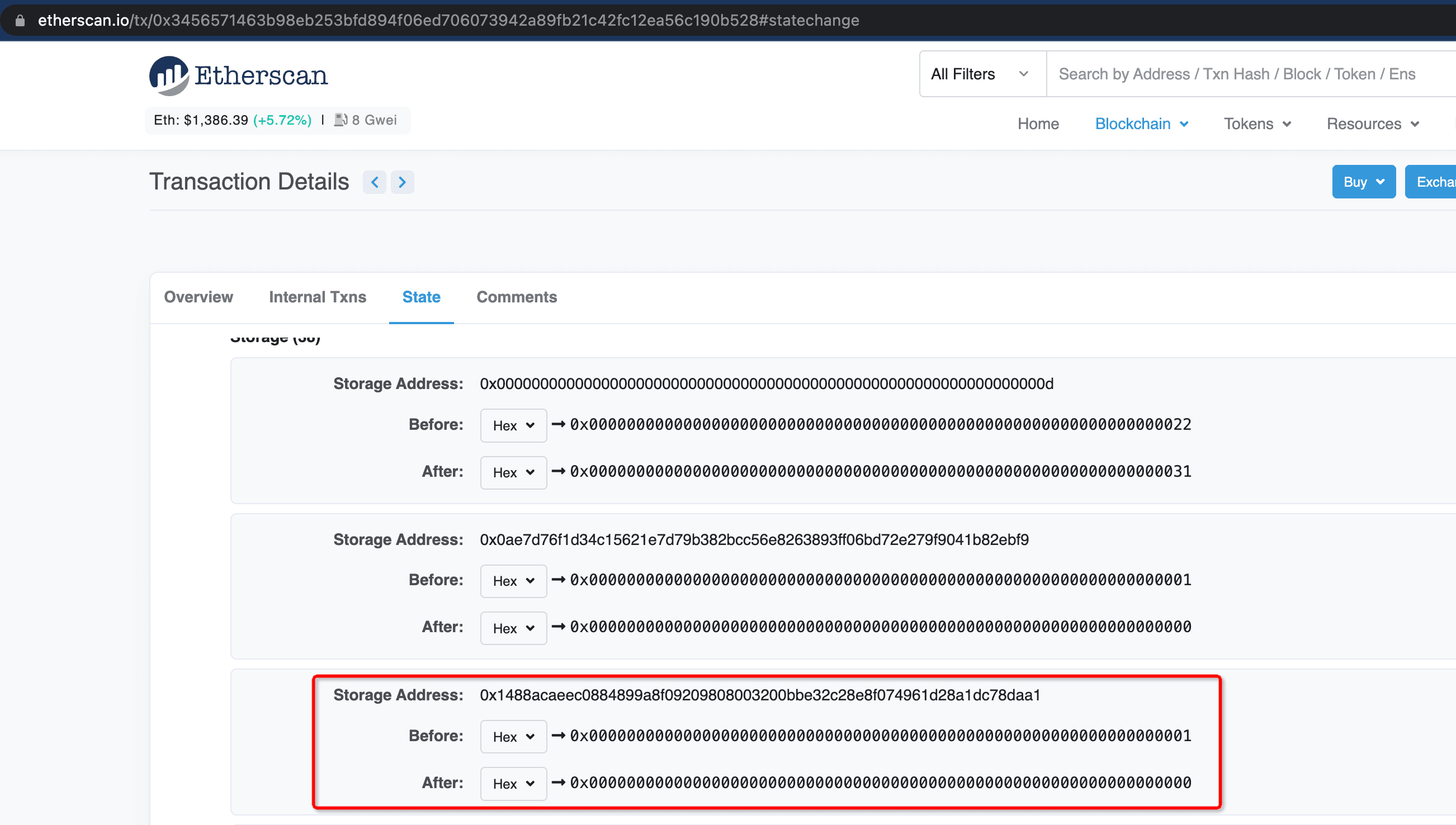
Note that the attack analyzed in the report occurred at block 15572515 (0xd2ff7c138d7a4acb78ae613a56465c90703ab839f3c8289c5c0e0d90a8b4ce16), which is in between the first modification and the second one.

Obviously, the second modification of the value means the project just revoked the admin privilege of the account.
0x2. The suspicious activity

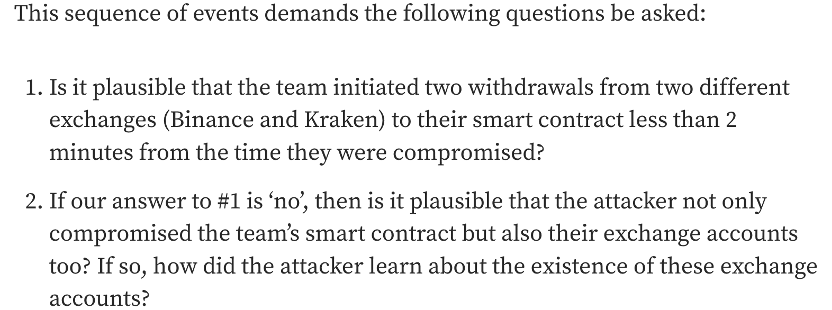
The report regarded the following activity as suspicious:

However, it is not as plausible as it claimed. The attacker could monitor the activity of the transferring transactions to achieve the goal. It is not quite weird from a technical point of view. For example, there exist some on-chain MEV-bots which continuously monitor the transactions to make profits.

0x3. Conclusion

In brief, this report is not convincing enough to accuse the Wintermute project.

About BlockSec

BlockSec is a pioneering blockchain security company established in 2021 by a group of globally distinguished security experts. The company is committed to enhancing security and usability for the emerging Web3 world in order to facilitate its mass adoption. To this end, BlockSec provides smart contract and EVM chain security auditing services, the Phalcon platform for security development and blocking threats proactively, the MetaSleuth platform for fund tracking and investigation, and MetaDock extension for web3 builders surfing efficiently in the crypto world.

To date, the company has served over 300 esteemed clients such as MetaMask, Uniswap Foundation, Compound, Forta, and PancakeSwap, and received tens of millions of US dollars in two rounds of financing from preeminent investors, including Matrix Partners, Vitalbridge Capital, and Fenbushi Capital.

Official website: https://blocksec.com/

Official Twitter account: https://twitter.com/BlockSecTeam
Sign up for the latest updates
Newsletter - April 2026
Security Insights

Newsletter - April 2026

In April 2026, the DeFi ecosystem experienced three major security incidents. KelpDAO lost ~$290M due to an insecure 1-of-1 DVN bridge configuration exploited via RPC infrastructure compromise, Drift Protocol suffered ~$285M from a multisig governance takeover leveraging Solana's durable nonce mechanism, and Rhea Finance incurred ~$18.4M following a business logic flaw in its margin-trading module that allowed circular swap path manipulatio

~$7.04M Lost: GiddyDefi, Volo Vault & More | BlockSec Weekly
Security Insights

~$7.04M Lost: GiddyDefi, Volo Vault & More | BlockSec Weekly

This BlockSec weekly security report covers eight attack incidents detected between April 20 and April 26, 2026, across Ethereum, Avalanche, Sui, Base, HyperLiquid, and MegaETH, with total estimated losses of approximately $7.04M. The highlighted incident is the $1.3M GiddyDefi exploit, where the attacker did not break any cryptography or use a flash loan but simply replayed an existing on-chain EIP-712 signature with the unsigned `aggregator` and `fromToken` fields swapped out for a malicious contract, demonstrating how partial signature coverage turns any historical signature into a generic permit. Other incidents include a $3.5M Volo Vault operator key compromise on Sui, a $1.5M Purrlend privileged-role takeover, a $413K SingularityFinance oracle misconfiguration, a $142.7K Scallop cross-pool index injection, a $72.35K Kipseli Router decimal mismatch, a $50.7K REVLoans (Juicebox) accounting pollution, and a $64K Custom Rebalancer arbitrary-call exploit.

The Decentralization Dilemma: Cascading Risk and Emergency Power in the KelpDAO Crisis
Security Insights

The Decentralization Dilemma: Cascading Risk and Emergency Power in the KelpDAO Crisis

This BlockSec deep-dive analyzes the KelpDAO $290M rsETH cross-chain bridge exploit (April 18, 2026), attributed to the Lazarus Group, tracing a causal chain across three layers: how a single-point DVN dependency enabled the attack, how DeFi composability cascaded the damage through Aave V3 lending markets to freeze WETH liquidity exceeding $6.7B across Ethereum, Arbitrum, Base, Mantle, and Linea, and how the crisis forced decentralized governance to exercise centralized emergency powers. The article examines three parameters that shaped the cascade's severity (LTV, pool depth, and cross-chain deployment count) and provides an exclusive technical breakdown of Arbitrum Security Council's forced state transition, an atomic contract upgrade that moved 30,766 ETH without the holder's signature.

Best Security Auditor for Web3

Validate design, code, and business logic before launch. Aligned with the highest industry security standards.

BlockSec Audit