We are excited to announce the official launch of the brand-new BlockSec website!
As a full-stack blockchain security service provider, BlockSec is committed to transcending the boundaries of traditional security services to offer comprehensive lifecycle security for blockchain projects. From pre-launch security audits to post-launch security monitoring and attack blocking, BlockSec ensures the most robust security for every stage of protocol development.
This website upgrade is not just a complete refresh of our brand image but also a significant milestone for BlockSec. This article will provide a detailed introduction to the full-stack security services and products offered by BlockSec, as well as how they meet the differentiated needs of projects at various stages.
Ensuring Full Lifecycle Security for Protocols
Pre-Launch:
- Security Auditing
Post-Launch
- Security Monitoring + Attack Blocking: Phalcon
Security Auditing
🔗 https://blocksec.com/code-audit
BlockSec provides smart contract and EVM chain auditing services:
-
Thorough audits covering technical, business, and financial aspects.
-
Professional reports with actionable solutions for every issue identified in our audits
-
Superior audit quality drives high client satisfaction and helps our clients win their users' trust
Check out our audit reports: https://blocksec.com/audit-reportt
Learn about our cutting-edge research: https://blocksec.com/research
Attack Monitoring & Blocking Platform: Phalcon
🔗 https://blocksec.com/phalcon
Phalcon is a security platform developed by BlockSec to monitor and block hacks. The system detects suspicious transactions, instantly alerts users, and takes automated actions in response.
- Early and Precise Attack Monitoring: Phalcon's detection engine scans every mempool and on-chain transaction for malicious proposals and contracts, among other potential threats. It leverages DeFi semantics and AI algorithms to achieve minimal false positives.
- Operational Risk Monitoring: Beyond just monitoring for malicious activities, the system also keeps an eye on changes to admin keys, role grants, and key variables. This enables timely detection of private key leaks, privilege alterations, and other security risks.
- Automated Attack Blocking with Customized Actions: When a transaction meets trigger conditions, Phalcon initiates automated actions within one block time (supporting multi-signature wallets). It provides standard response action templates, and users also have the option to customize actions.
- Low-Code Configuration: Monitor transactions, functions, events, and variables with ease, utilizing a variety of pre-set monitoring templates. No coding is required to effortlessly set up monitoring rules and response actions.
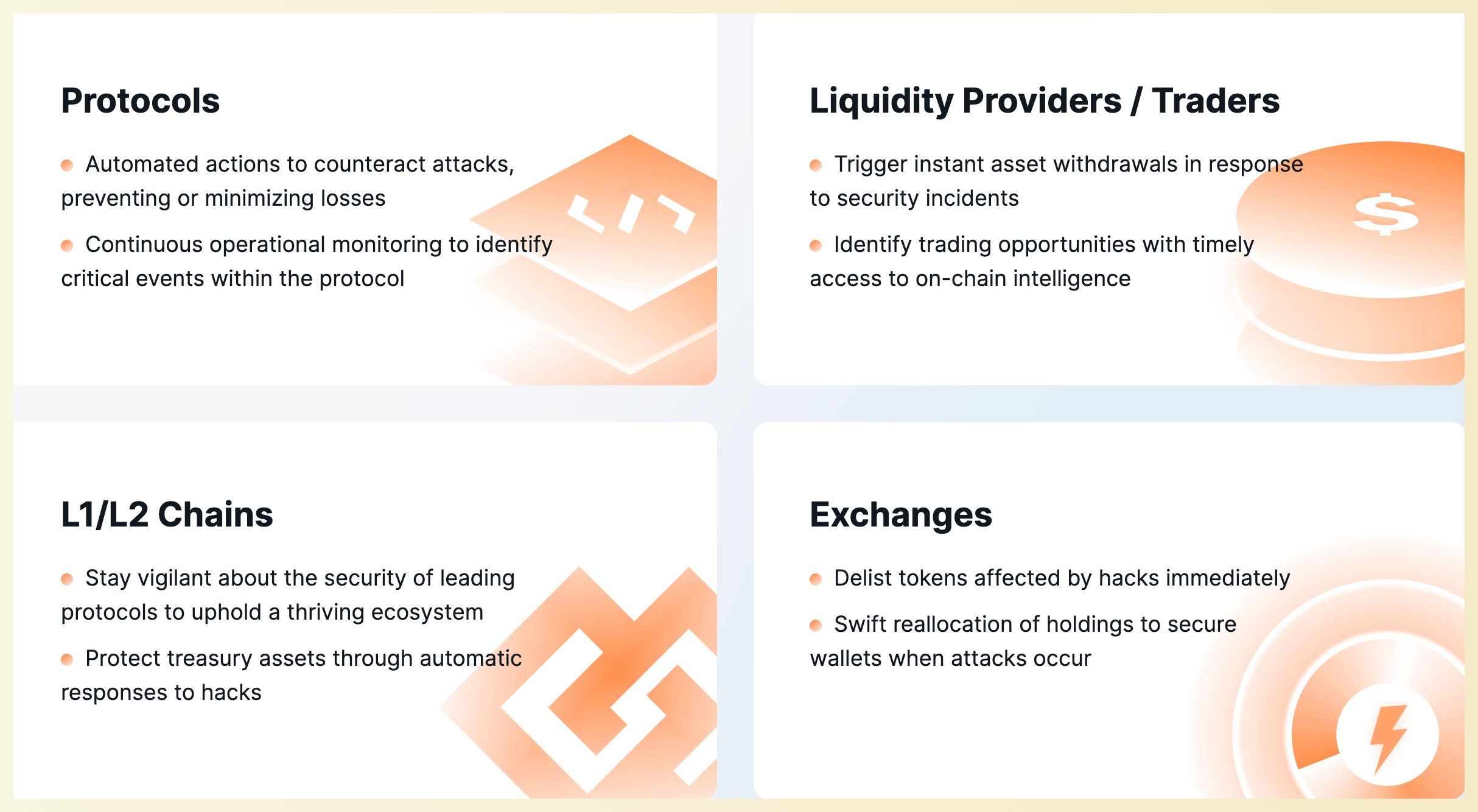
Support Tool: Phalcon Explorer
Phalcon Explorer is the support tool for the Phalcon platform. This powerful transaction explorer is designed for the DeFi community. It provides comprehensive data on call flows, balance changes, and transaction fund flows, as well as supports transaction simulation. This helps developers, security researchers, and traders to more intuitively understand transactions.
More BlockSec's Builder Toolkit
Crypto tracking and investigation platform: MetaSleuth
Metasleuth simplifies investigations for everyone, offering profressional-grade tools tailored to meet the needs of experts. MetaSleuth is a comprehensive platform that enables users to gain a deeper understanding of blockchain activities. It offers a diverse range of features specifically designed for crypto investigations, such as fund tracking, visualizing fund flows, real-time transaction monitoring, and the ability to save and share analysis results. With its intelligent capabilities and cross-chain analysis, MetaSleuth simplifies the process of tracking funds within complex DeFi transactions, making it more accessible and efficient than ever before.
Browser Extension: MetaSuites
🔗 https://blocksec.com/metasuites
MetaSuites is a browser extension to generate fund flow, display address labels, download data with one-click, simulate transactions, view storage and proxy upgrades, along with more than 20 utilities on over ten blockchain browsers.
We warmly invite you to experience the new official BlockSec website and join us in building a safer Web3 world.