How to Verify a Signature in a Wrong Way — The AssociationNFT Case

How to Verify a Signature in a Wrong Way — The AssociationNFT Case
Image: Raymond Clarke/Flickr

The Association NFT is a NBA launched NFT. However, we find the NFT sale contract has a serious vulnerability which allows an attacker to mint a large number NFTs, without paying any Tokens.

The root cause of the vulnerability is the incorrect use of signature verification. Basically, the contract fails to ensure that the signature can only be used by the user (and only the user) once. In this case, the attacker can reuse a privileged user’s signature and mint tokens to him/herself.
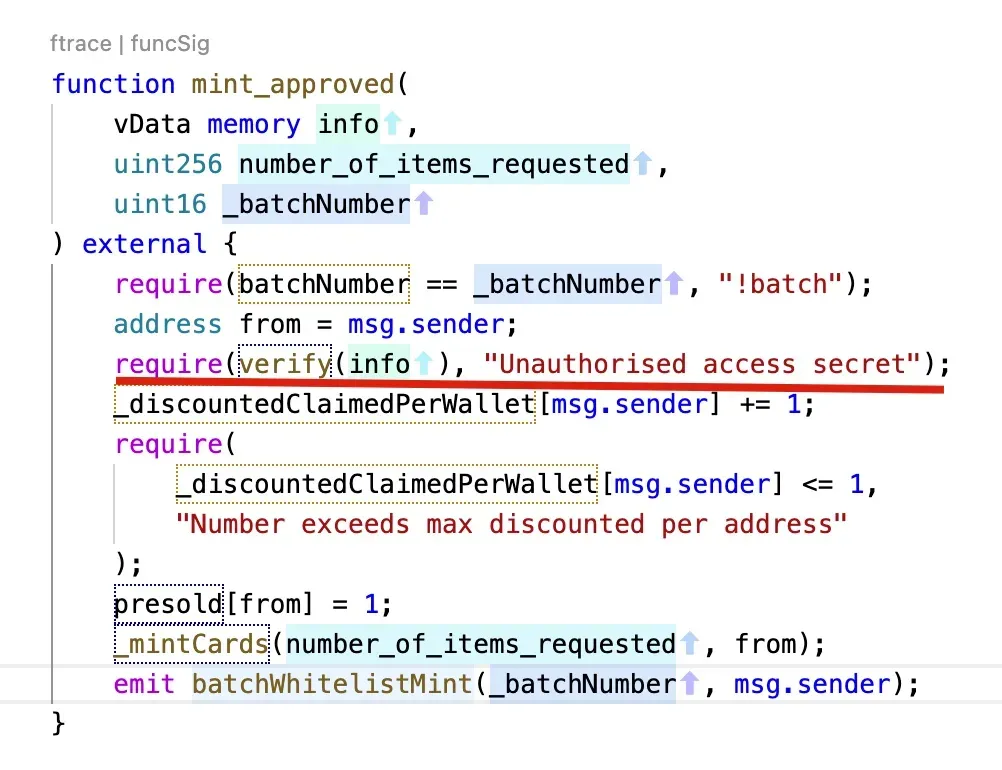
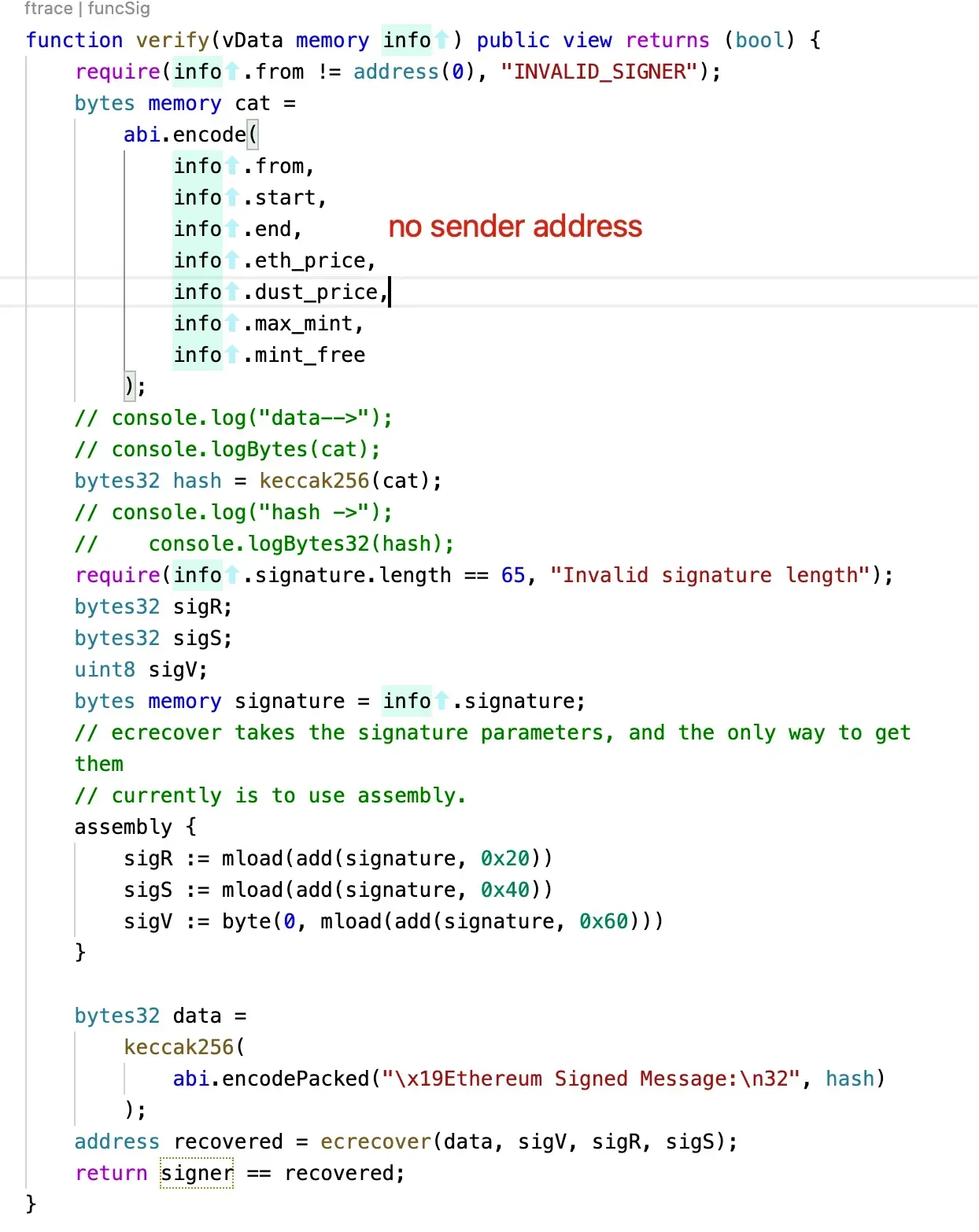
We can see that in the verify function, there is no sender's address in the signature. Besides, there is no mechanism to include a nonce to ensure that the signature can only be used once. These security requirements are the basic knowledge in the software security class.

We are surprised that how such a vulnerability can exist in a popular NFT project. The whole community needs to pay more attention to the security of the contract.

About BlockSec

BlockSec is a pioneering blockchain security company established in 2021 by a group of globally distinguished security experts. The company is committed to enhancing security and usability for the emerging Web3 world in order to facilitate its mass adoption. To this end, BlockSec provides smart contract and EVM chain security auditing services, the Phalcon platform for security development and blocking threats proactively, the MetaSleuth platform for fund tracking and investigation, and MetaSuites extension for web3 builders surfing efficiently in the crypto world.

To date, the company has served over 300 esteemed clients such as MetaMask, Uniswap Foundation, Compound, Forta, and PancakeSwap, and received tens of millions of US dollars in two rounds of financing from preeminent investors, including Matrix Partners, Vitalbridge Capital, and Fenbushi Capital.

Official website: https://blocksec.com/

Official Twitter account: https://twitter.com/BlockSecTeam
Sign up for the latest updates
Weekly Web3 Security Incident Roundup | Feb 9 – Feb 15, 2026

Weekly Web3 Security Incident Roundup | Feb 9 – Feb 15, 2026

During the week of February 9 to February 15, 2026, three blockchain security incidents were reported with total losses of ~$657K. All incidents occurred on the BNB Smart Chain and involved flawed business logic in DeFi token contracts. The primary causes included an unchecked balance withdrawal from an intermediary contract that allowed donation-based inflation of a liquidity addition targeted by a sandwich attack, a post-swap deflationary clawback that returned sold tokens to the caller while draining pool reserves to create a repeatable price-manipulation primitive, and a token transfer override that burned tokens directly from a Uniswap V2 pair's balance and force-synced reserves within the same transaction to artificially inflate the token price.

Top 10 "Awesome" Security Incidents in 2025

Top 10 "Awesome" Security Incidents in 2025

To help the community learn from what happened, BlockSec selected ten incidents that stood out most this year. These cases were chosen not only for the scale of loss, but also for the distinct techniques involved, the unexpected twists in execution, and the new or underexplored attack surfaces they revealed.

#10 Panoptic Incident: XOR Linearity Breaks the Position Fingerprint Scheme

#10 Panoptic Incident: XOR Linearity Breaks the Position Fingerprint Scheme

On August 29, 2025, Panoptic disclosed a Cantina bounty finding and confirmed that, with support from Cantina and Seal911, it executed a rescue operation on August 25 to secure roughly $400K in funds. The issue stemmed from a flaw in Panoptic’s position fingerprint calculation algorithm, which could have enabled incorrect position identification and downstream fund risk.