Introduction
MetaSleuth is a platform specifically designed for crypto tracking and investigation and users need to utilize on-chain tools for DYOR (Do Your Own Research). It offers diverse features such as fund tracking, visualizing fund flows, real-time transaction monitoring, and the ability to save and share analysis results. MetaSleuth helps m ![]onitor market movements, track the flow of funds in criminal activities, and support users in conducting independent research to avoid scams. Supporting over 20 blockchains, MetaSleuth is widely used by the community for various investigative purposes.
In this blog, we will demonstrate how to use MetaSleuth to track the "smart money" on Solana.
Tracking Smart Money on Solana Using MetaSleuth: A Case Study
Let's take a look at the activity of the Solana address 8ssfZm5R3XYXDvei5XQmPrnehLum832gnXdwRzRSsBga. This address invested $640 to purchase approximately 2.6 million $DJCAT tokens. Remarkably, all of these tokens were sold within a single day, with the address earning around $7470 from the transaction. This quick turnaround resulted in a stunning ROI of 1067%. Such examples highlight the potential of smart money movements and underscore the importance of tools like MetaSleuth in tracking these investment strategies within the Solana ecosystem.
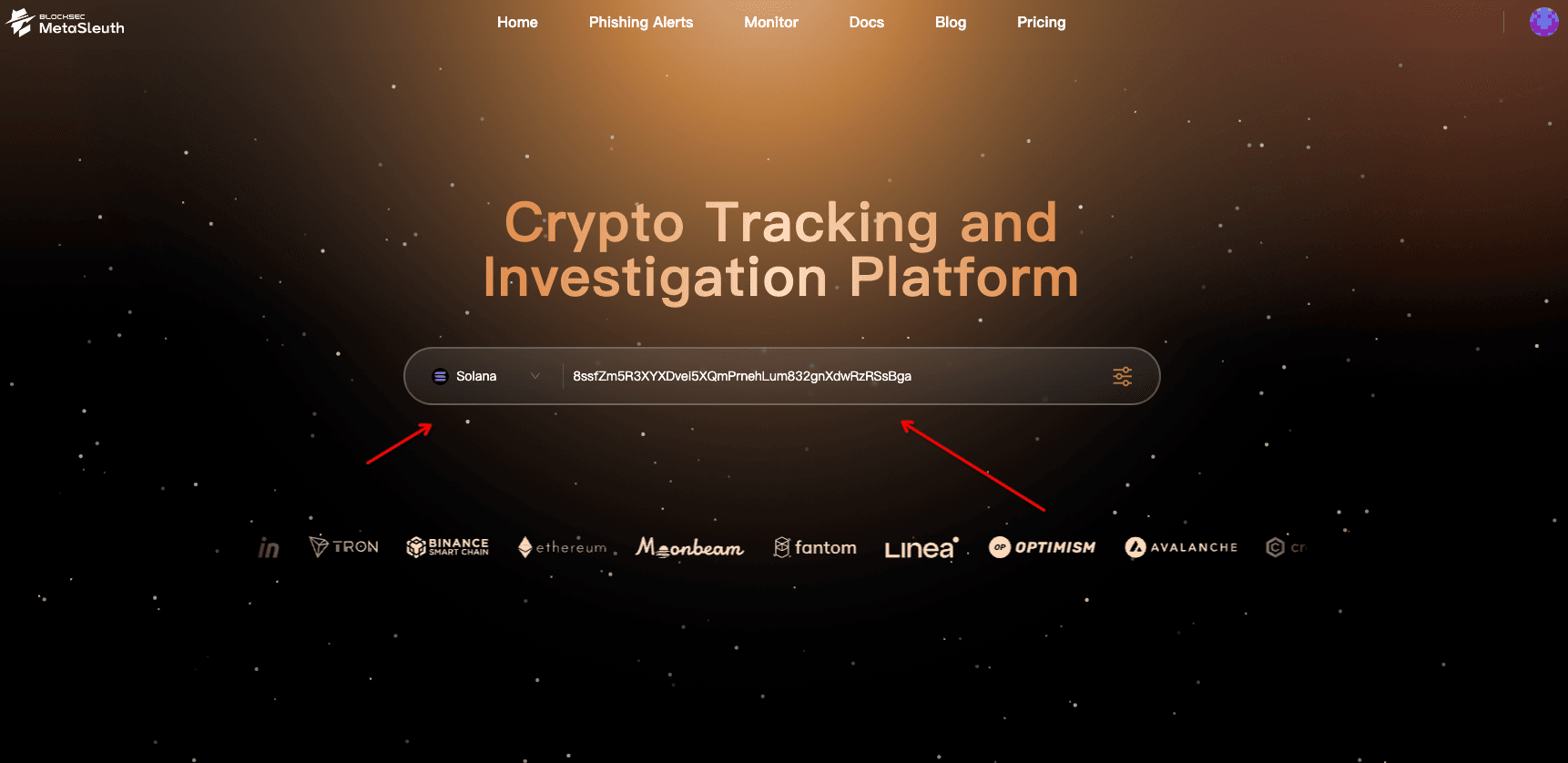
First, locate the dropdown menu on the left of the search bar, select "Solana" from the list, and then input the address 8ssfZm5R3XYXDvei5XQmPrnehLum832gnXdwRzRSsBga.
 MetaSleuth automatically generates the fund flow associated with the address. Each node represents an address, and the edges between nodes indicate aggregated token transfers. Even if there are multiple transactions for the same token between two nodes, only one edge will be shown.
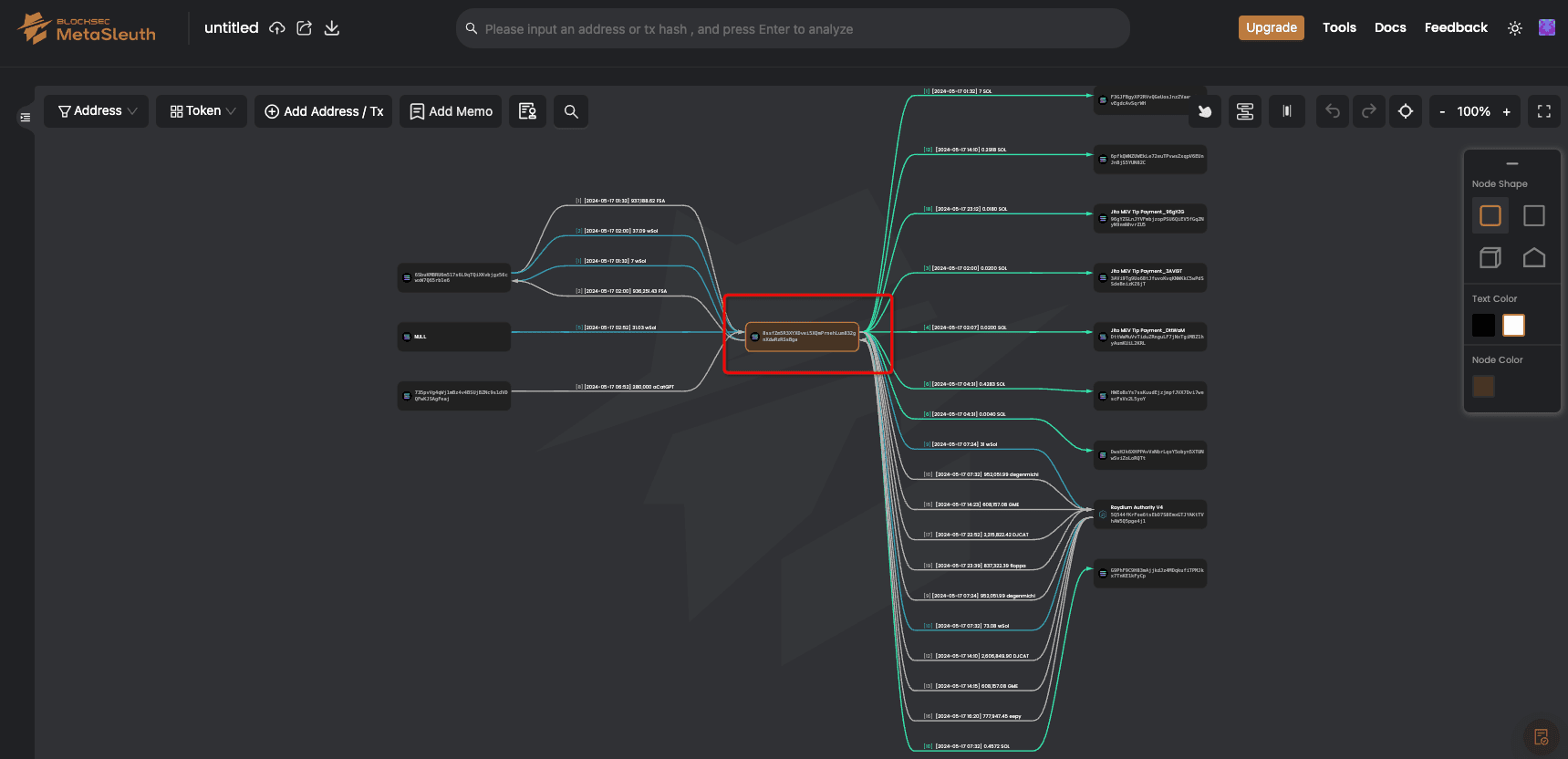 You can also search for specific tokens by simply clicking the Token filter in the left corner to exclude irrelevant tokens, like aCatGPT, eepy, FSA, GME, etc.
 we can see a token swap in Raydium, with 2,606,849.90 DJCAT flowing out from Raydium to 8ssfZm5R3XYXDvei5XQmPrnehLum832gnXdwRzRSsBga on [2024-05-17 14:10].
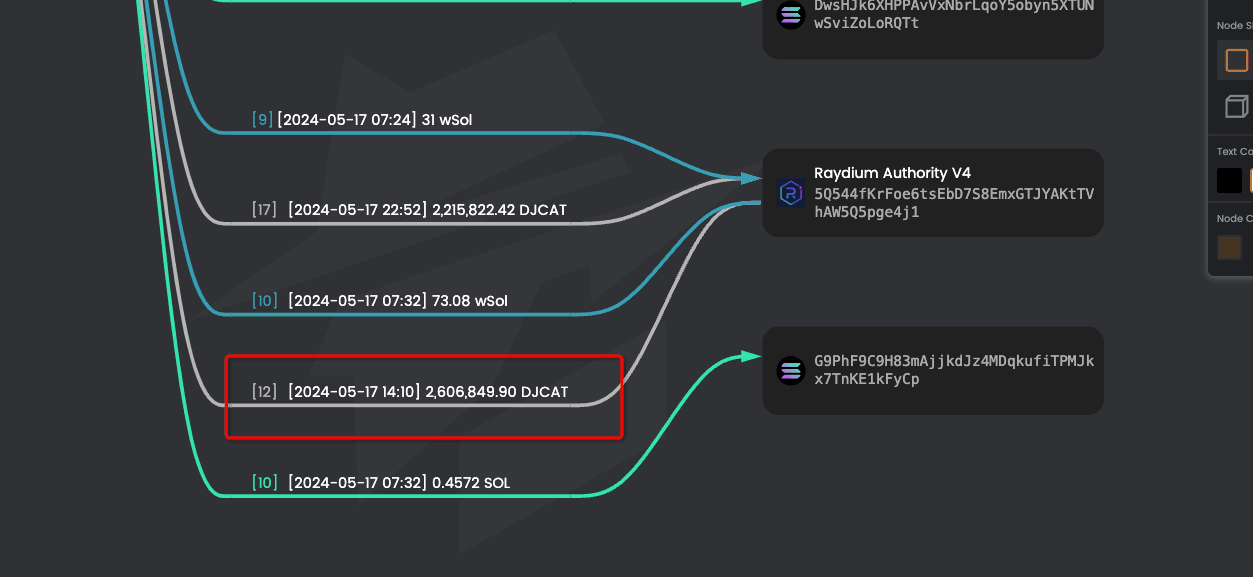 As mentioned, the edge represents aggregated token transfers. We can click the edge to view more detailed information.
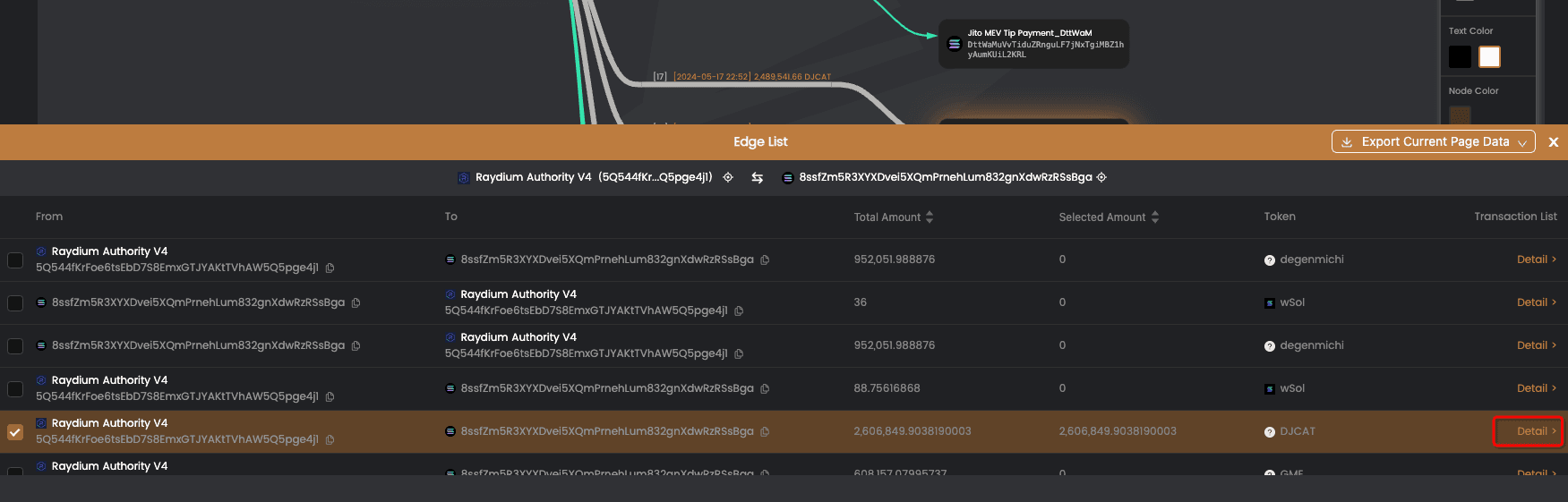 We need to know the cost at which this user acquired these DJCAT tokens. Click on the transaction to see a popup with transaction details. Then, click on "details" to view the full breakdown of the transaction.
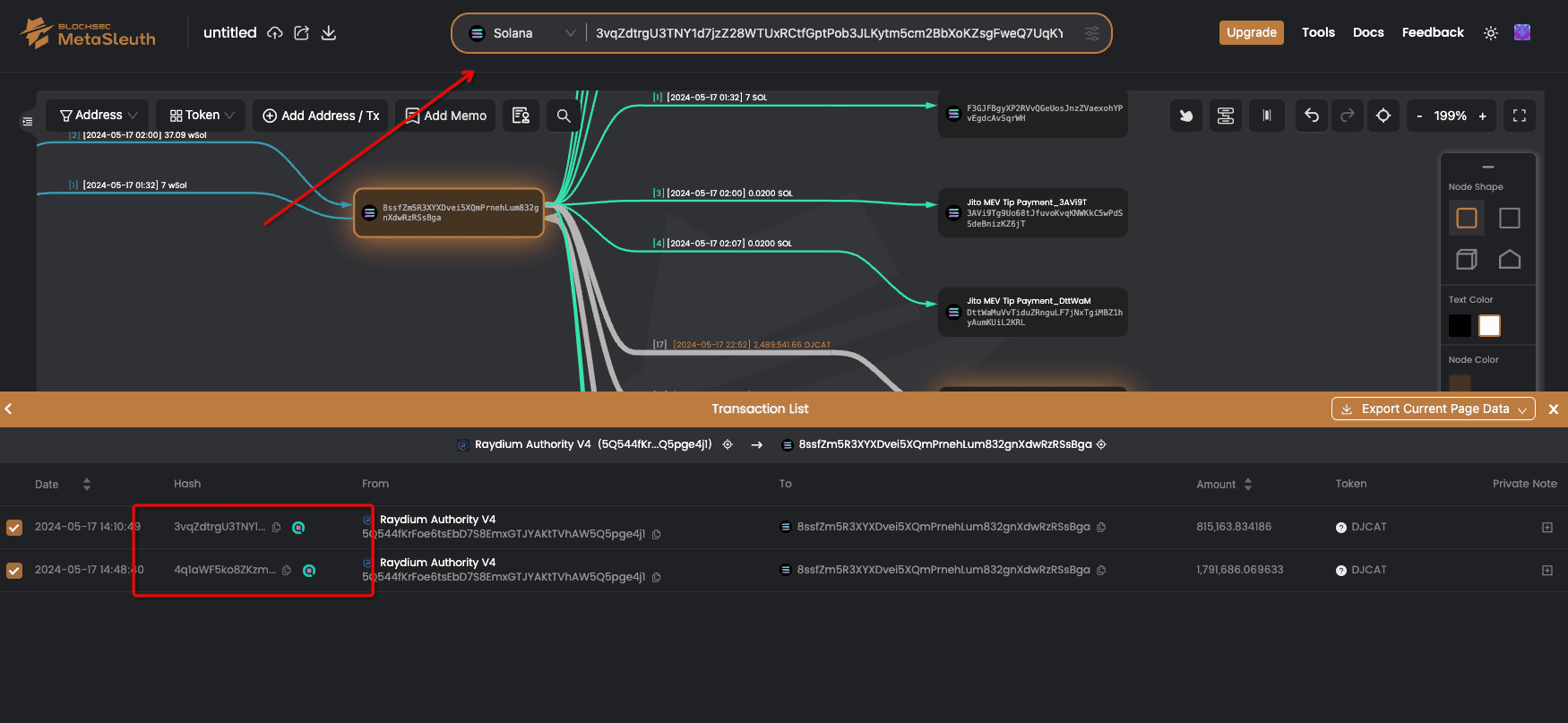 In the transaction list, we can see two transactions where 815,163.83 DJCAT and 1,791,686.07 DJCAT were sent from Raydium to 8ssfZm5R3XYXDvei5XQmPrnehLum832gnXdwRzRSsBga. The transaction hashes are as follows:
3vqZdtrgU3TNY1d7jzZ28WTUxRCtfGptPob3JLKytm5cm2BbXoKZsgFweQ7UqKYVGDKDAoMa8rYSu7FwQYznjBFy
4q1aWF5ko8ZKzmpDGyRmdZkJY1uNBgaM2gN64RptJjqQmnvjTaucRcimEpNfeEzxCBcszcmowW96ZCFCPrpqMPvj
In the transaction list, we can see two transactions where 815,163.83 DJCAT and 1,791,686.07 DJCAT were sent from Raydium to 8ssfZm5R3XYXDvei5XQmPrnehLum832gnXdwRzRSsBga. The transaction hashes are as follows:
3vqZdtrgU3TNY1d7jzZ28WTUxRCtfGptPob3JLKytm5cm2BbXoKZsgFweQ7UqKYVGDKDAoMa8rYSu7FwQYznjBFy
4q1aWF5ko8ZKzmpDGyRmdZkJY1uNBgaM2gN64RptJjqQmnvjTaucRcimEpNfeEzxCBcszcmowW96ZCFCPrpqMPvj
We now need to determine the cost of acquiring these tokens. Copy the two transaction hashes into the search box at the top.
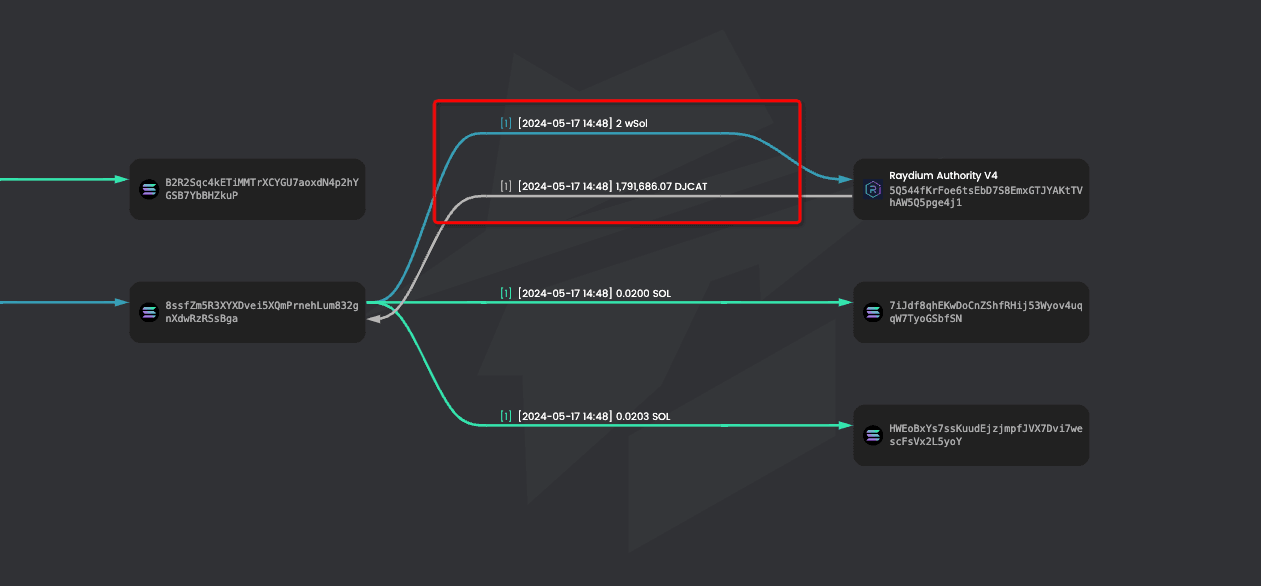
The results show that this wallet address swapped 2 wSOL for 815,163.83 DJCAT and 1,791,686.07 DJCAT on [2024-05-17 14:10] and [2024-05-17 14:48], respectively. Given the wSOL price at the time ($160), the total cost was $640.
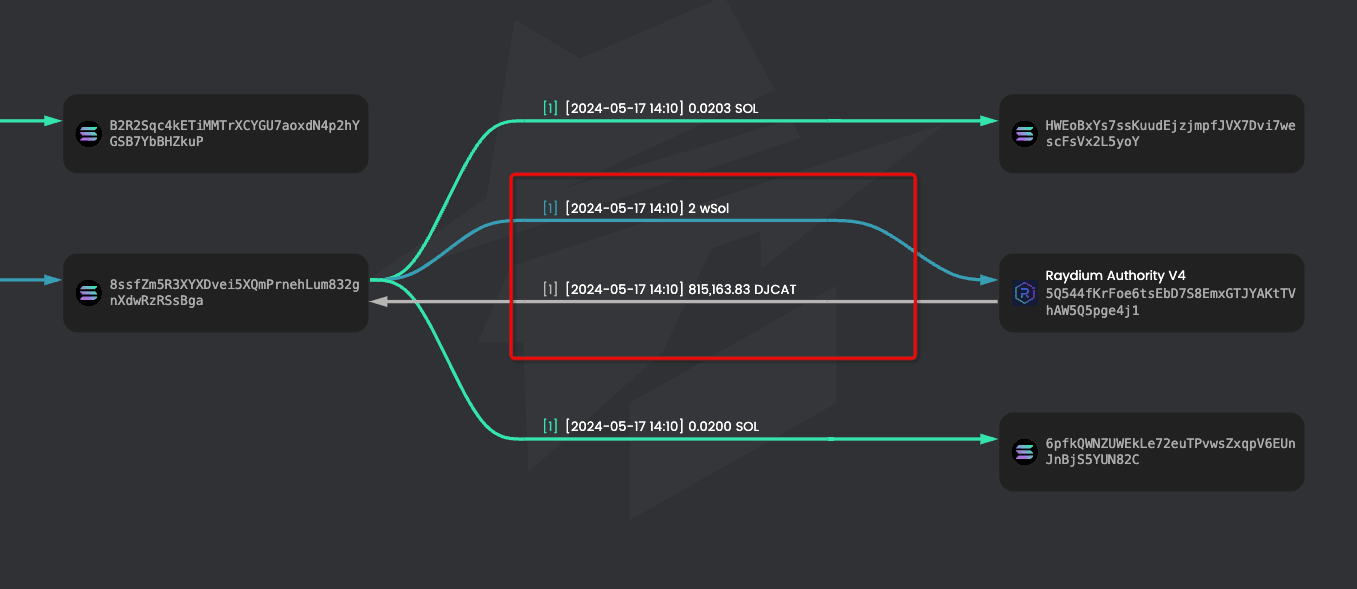
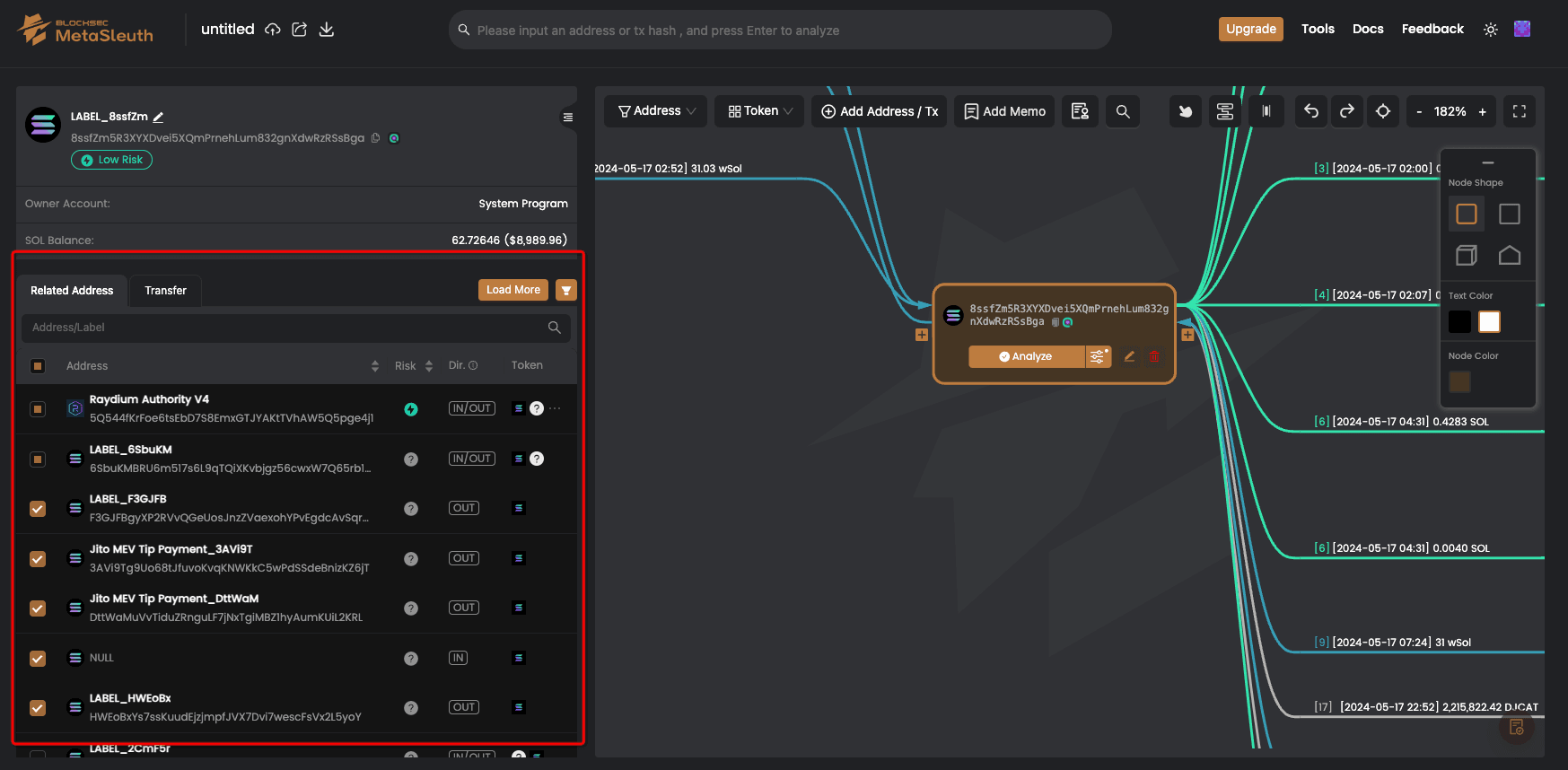
Next, we need to see what actions the address 8ssfZm5R3XYXDvei5XQmPrnehLum832gnXdwRzRSsBga took after receiving these DJCAT tokens. Click on this wallet address, and a side panel will appear on the left. We need to filter out how much DJCAT flowed out from this address.
 Click on "Transfer" and select only the transactions where DJCAT flowed out.
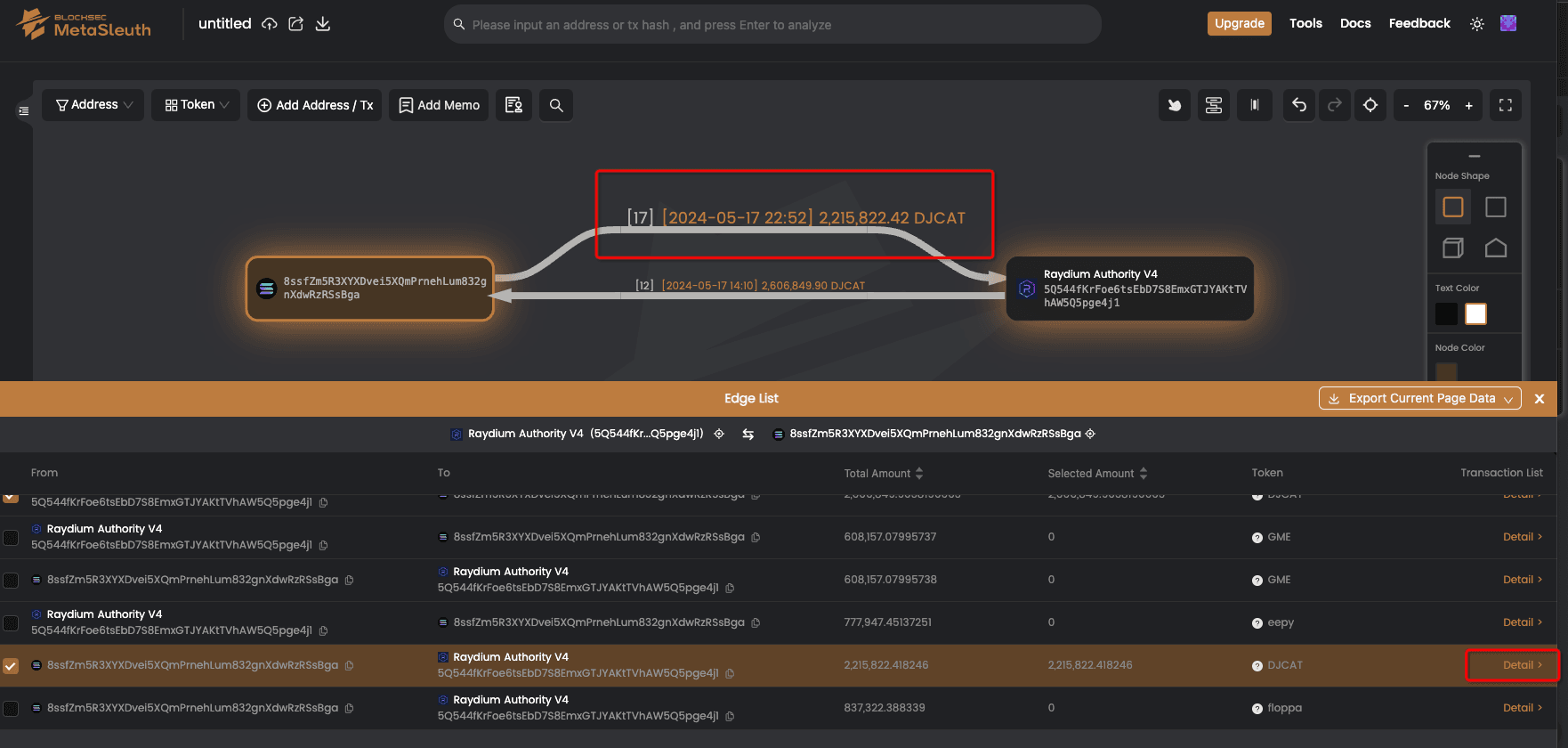
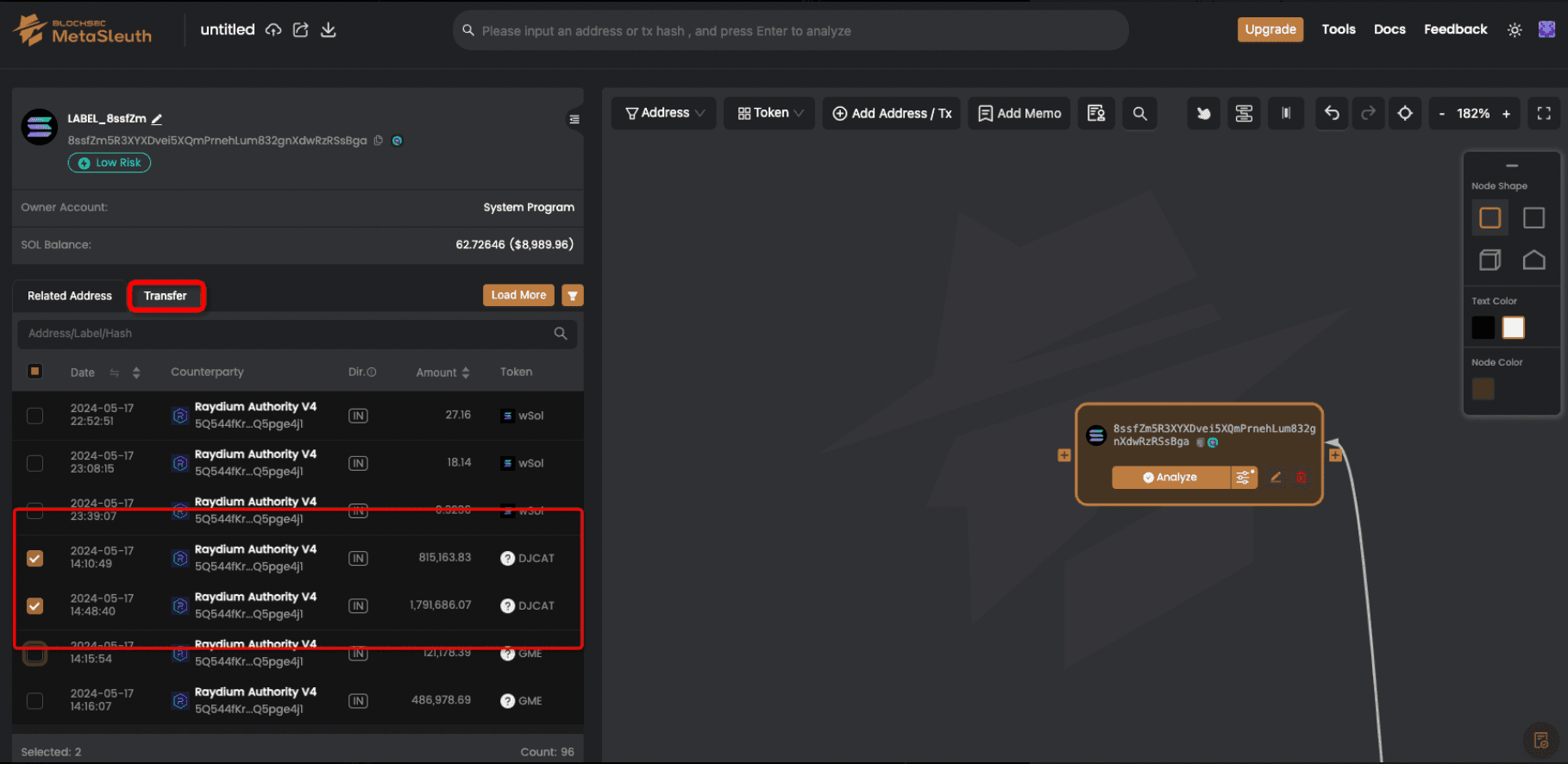 We can see that on [2024-05-17 22:52], the wallet address transferred 2,215,822.42 DJCAT to Raydium.
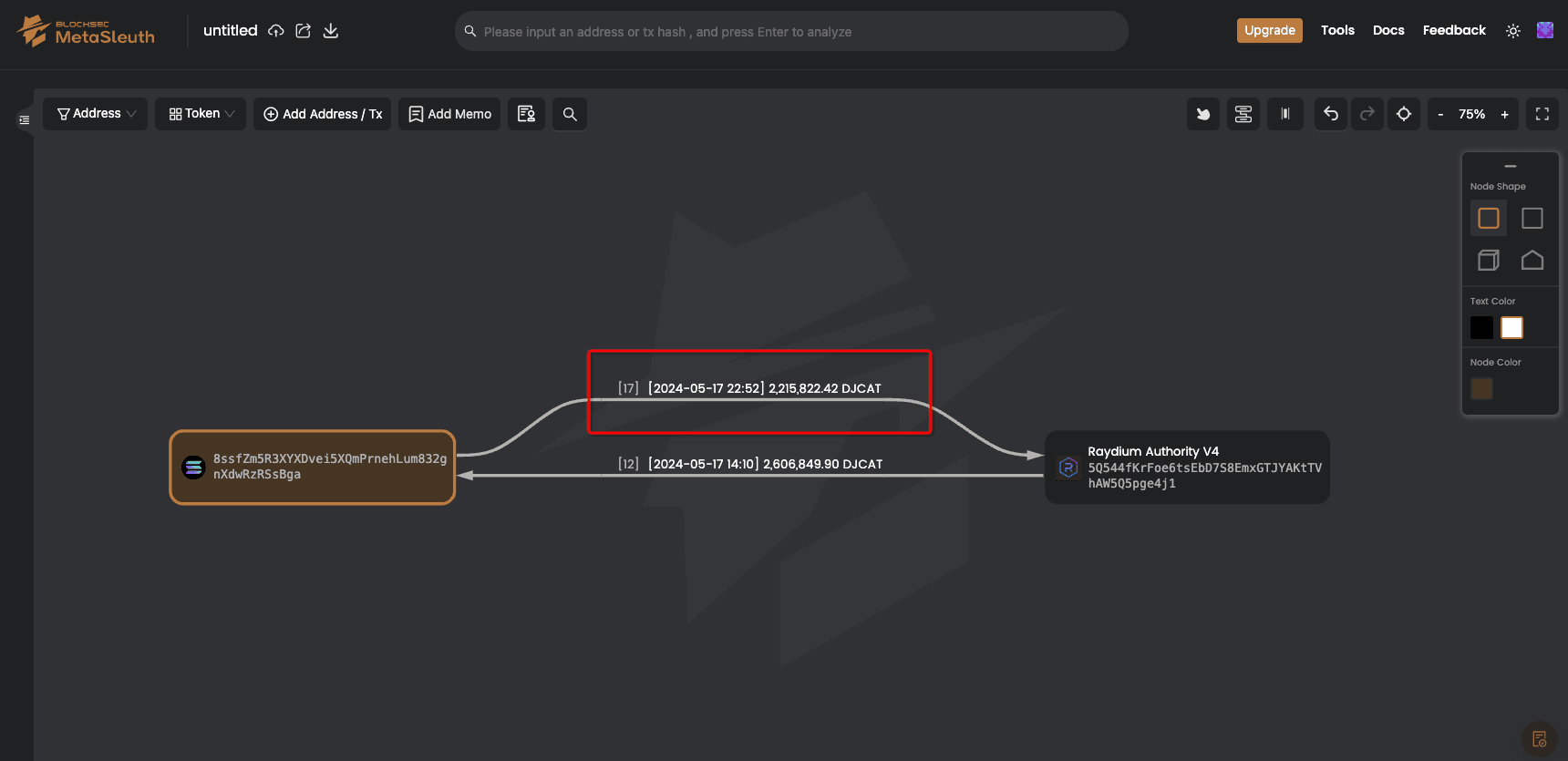 At this point, we need to find out how much wSOL these DJCAT tokens were swapped for. Click on this transaction and then on "details" to see the two related transactions.
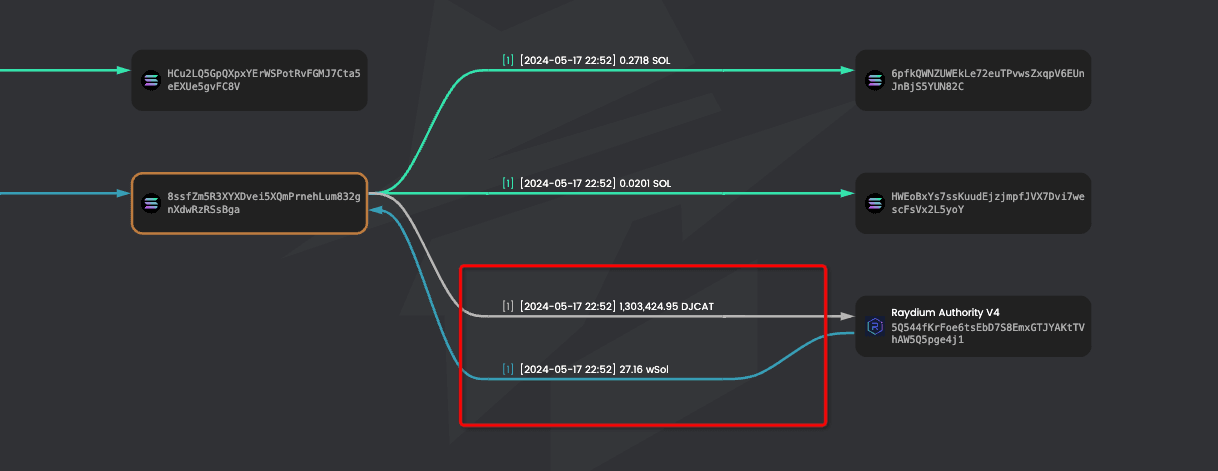
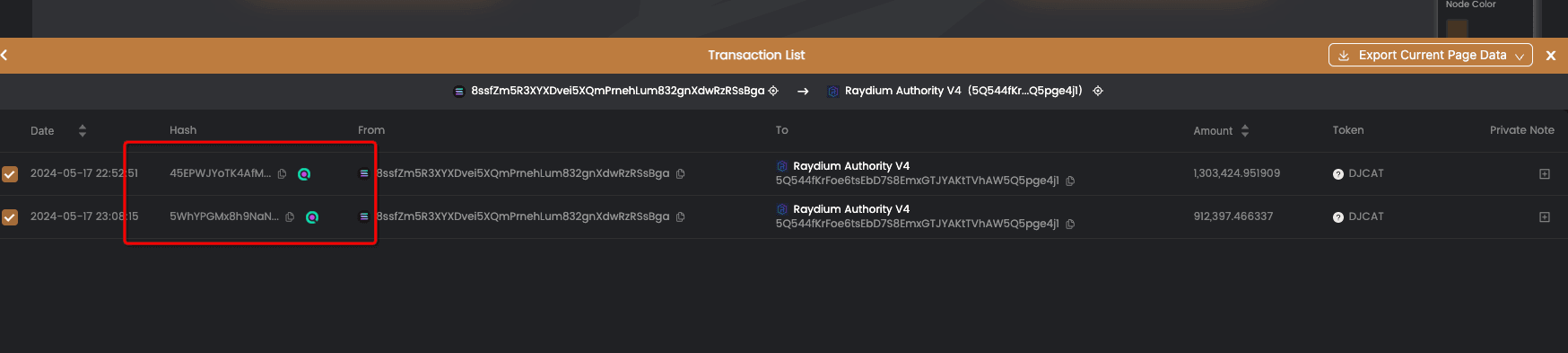 Repeat the previous actions and copy the two transaction hashes for further search. We find that the two transactions on [2024-05-17 22:52] and [2024-05-17 23:08] swapped 27.16 wSOL and 18.14 wSOL, respectively, totaling 45 wSOL.
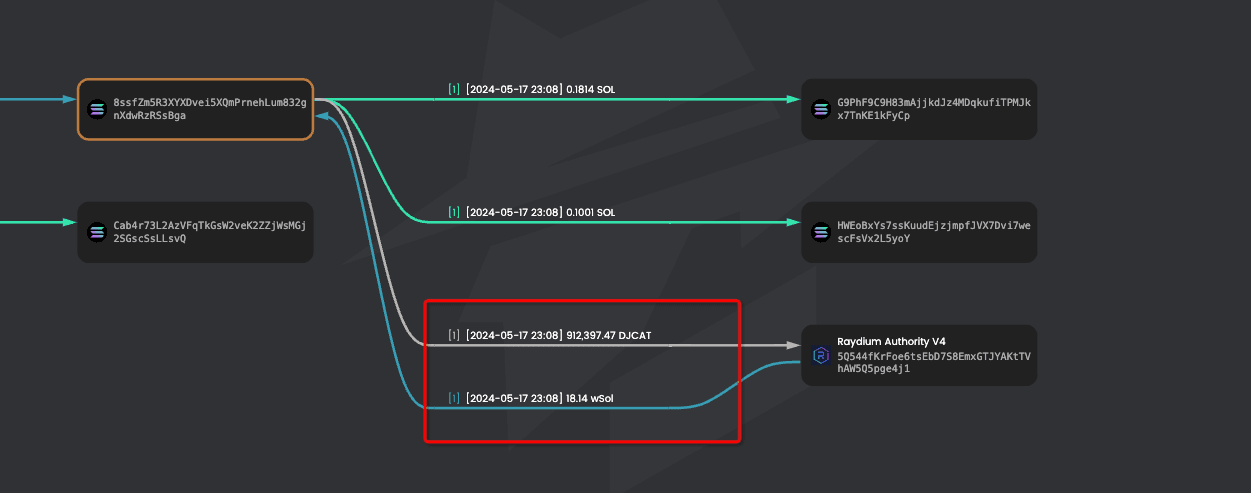 Based on the wSOL price at that time, these DJCAT tokens were worth a total of $7,470. Comparing this to the initial purchase cost of $640, the profit was 1067%.
By following these steps and techniques, you can use MetaSleuth to deeply investigate projects and wallets within the Solana ecosystem, track the investment movements of Smart Money, and make more informed investment decisions. Whether you are a novice investor or an experienced analyst, MetaSleuth is a powerful tool for exploring and understanding the Solana ecosystem.
Based on the wSOL price at that time, these DJCAT tokens were worth a total of $7,470. Comparing this to the initial purchase cost of $640, the profit was 1067%.
By following these steps and techniques, you can use MetaSleuth to deeply investigate projects and wallets within the Solana ecosystem, track the investment movements of Smart Money, and make more informed investment decisions. Whether you are a novice investor or an experienced analyst, MetaSleuth is a powerful tool for exploring and understanding the Solana ecosystem.
Subscribe and Enjoy 10% Off Discount
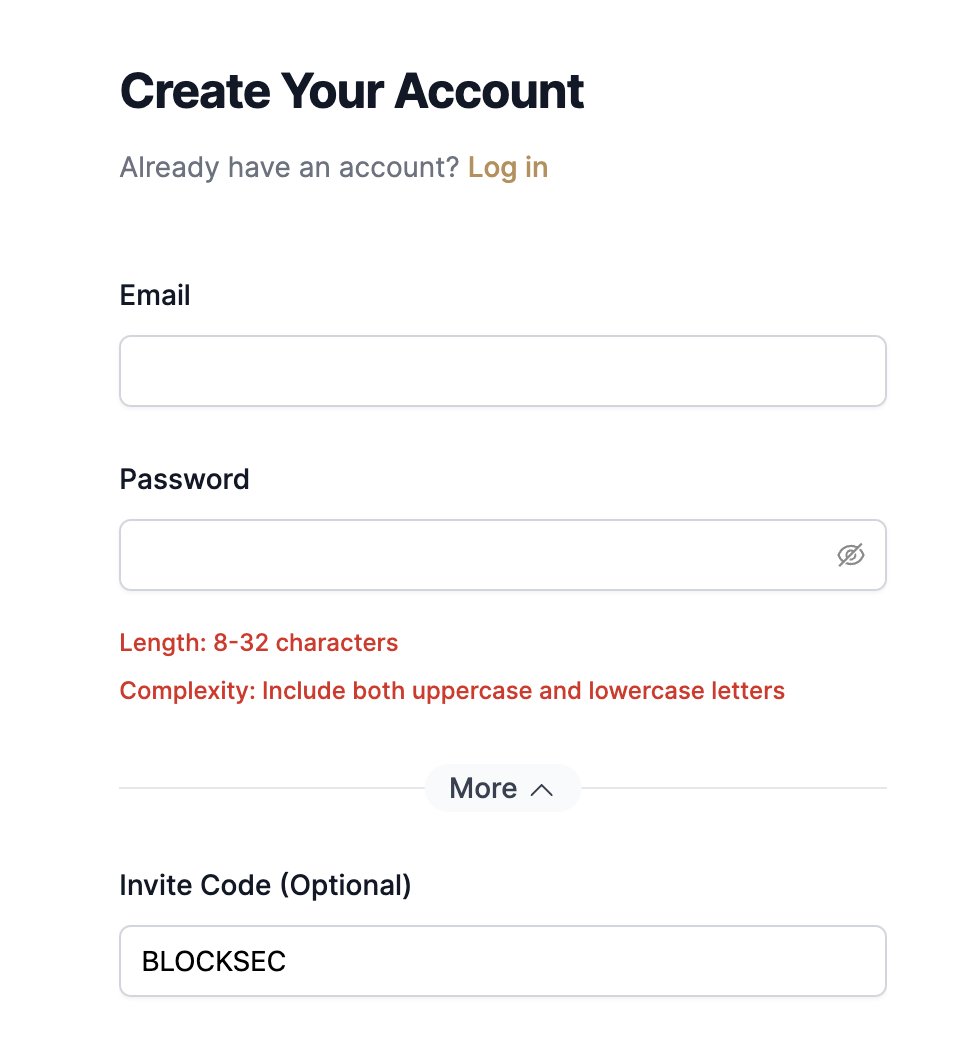
When signing up for MetaSleuth, use BLOCKSEC as the invitation code to enjoy 10% off for the subscription.
https://metasleuth.io/?invite-code=BLOCKSEC
About MetaSleuth
MetaSleuth is a comprehensive platform developed by BlockSec to assist users in effectively tracking and investigating all crypto activities. With MetaSleuth, users can easily track funds, visualize fund flows, monitor real-time fund movements, save important information, and collaborate by sharing their findings with others. Currently, we support 13 different blockchains, including Bitcoin (BTC), Ethereum (ETH), Tron (TRX), Polygon (MATIC), and more.
Website: https://metasleuth.io/
Twitter: @MetaSleuth
Telegram: https://t.me/MetaSleuthTeam