Executive Summary
Protocol compliance operations have shifted from periodic wallet checks to transaction-native workflows. Engineering and risk teams require controls capable of parsing wallet interactions, tracking multi-chain asset movements, identifying illicit fund paths during execution, and structuring alert data into regulator-facing evidence formats—all without introducing latency into protocol operations.
A crypto compliance platform deployed for decentralized finance must process risk parameters outside the scope of traditional account-based monitoring. In the on-chain environment, users execute logic via non-custodial wallets, liquidity pools, bridge contracts, DEX routers, and temporary intermediary addresses. Managing this exposure requires a unified workflow where static address screening, dynamic risk evaluation, real-time transaction monitoring, and cross-chain tracking function concurrently.
For risk managers and protocol operators, the primary focus is determining which blockchain compliance architecture can sustain transaction throughput while mitigating interactions with sanctioned entities, exploit proceeds, laundering operations, and high-risk counterparties. FATF guidelines indicate virtual asset controls must align with risk-based methodologies supported by persistent transaction monitoring, while recent enforcement mandates reflect a regulatory expectation for granular, transaction-level documentation.
This document details the technical and operational benchmarks DeFi protocols require from an on-chain compliance stack, the criteria for evaluating vendor infrastructure, the common friction points in risk operations, and how Phalcon Compliance integrates address profiling, KYT monitoring, behavioral risk engines, visual fund tracing, and automated reporting formats to support protocol teams.
Core Insights
Robust DeFi risk management models integrate prevention, detection, investigation, and logging functions. A functional platform goes beyond generating alert flags; it provides investigators with context, facilitates intervention before illicit funds mingle with clean liquidity, and outputs structured logs for internal governance and external auditors.
First, risk variables in decentralized finance are highly composable. A standard token swap might route through an initiating wallet, a proxy contract, a DEX aggregator, a specialized pool, a cross-chain bridge, and a final withdrawal destination. Point-in-time checks on the initiating address consistently fail to map this interaction depth.
Second, cross-chain execution represents the baseline for current transaction monitoring. Analytical reports indicate illicit funds frequently bypass single-chain monitoring systems. Operators using bridges, mixing protocols, and rapid asset conversions actively exploit the visibility gaps between different blockchain environments.
Third, the throughput requirements place a heavy load on compliance personnel. Active protocols process thousands of state changes daily. When risk platforms generate alerts without prioritizing severity or providing context, the resulting investigation backlog becomes a secondary source of regulatory liability and operational friction.
Fourth, viable monitoring systems must minimize false positive rates. Broad parameter settings generate alert fatigue, while restrictive rules ignore established laundering typologies. Optimized engines combine entity attribution, behavioral heuristics, volume metrics, interaction frequency, and thresholds adjusted for specific regulatory jurisdictions.
Why DeFi Protocols Need a Different Compliance Stack
Decentralized protocols require monitoring infrastructure calibrated for smart-contract execution paths, rather than fiat-based customer identity records. Since exposure generates from liquidity interactions, routing choices, and multi-chain transfers, risk controls must evaluate on-chain behavior directly.
DeFi risk is transaction-native, not account-native
Conventional compliance architectures anchor their checks to verified customer identity profiles. In contrast, DeFi interactions originate from cryptographic addresses. This structural difference requires a shift in monitoring logic. A newly deployed address might receive assets from multiple intermediary sources, execute a series of contract calls, and bridge the output to a Layer-2 network within a single block. Consequently, investigators must evaluate the transaction context, historical fund sources, and behavioral markers continuously.
A functional compliance platform for decentralized environments treats every deposit, withdrawal, staking function, and cross-chain transfer as an evaluative data point. The system maps the immediate counterparty alongside the historical asset flow network. This requirement positions real-time transaction monitoring and dynamic on-chain risk scoring as necessary components of protocol governance.
Why wallet screening alone misses multi-hop exposure
Basic address screening provides baseline filtering but fails against sophisticated routing. High-risk or sanctioned entities rarely deposit assets directly from flagged addresses. The capital typically routes through mixing services, nested exchanges, OTC desks, and disposable intermediary addresses prior to protocol interaction. A superficial one-hop screening process frequently categorizes the immediate interacting wallet as low-risk, ignoring the illicit origins located further up the transaction chain.
Tracing investigations consistently document that illicit actors utilize multi-hop strategies before consolidating or swapping assets. The complexity scales in multi-chain scenarios, where exposure transfers from Ethereum mainnet to TRON, BNB Chain, or Layer-2 environments like Base and Optimism prior to interacting with the target protocol. Therefore, multi-hop capability and cross-chain tracking represent core monitoring requirements rather than optional system upgrades.
The operational gap between detecting risk and resolving it
Signal detection represents only the initial phase of the compliance workflow. Operations teams must determine whether to restrict access, increase monitoring frequency, escalate for secondary review, modify blocklists, approve known entities, or draft suspicious activity logs. In high-throughput protocol environments, relying on manual data transfer between systems introduces latency, allowing risk exposure to propagate.
A comprehensive blockchain compliance architecture connects the initial alert generation to case administration, graphical fund tracing, personnel assignment, investigation logging, and standardized reporting outputs. The platform enables risk analysts to process signals and reach documented resolutions without requiring manual exports of transaction hashes and fragmented visual evidence across disparate software tools.
Core Capabilities Every On-Chain Compliance Program Requires
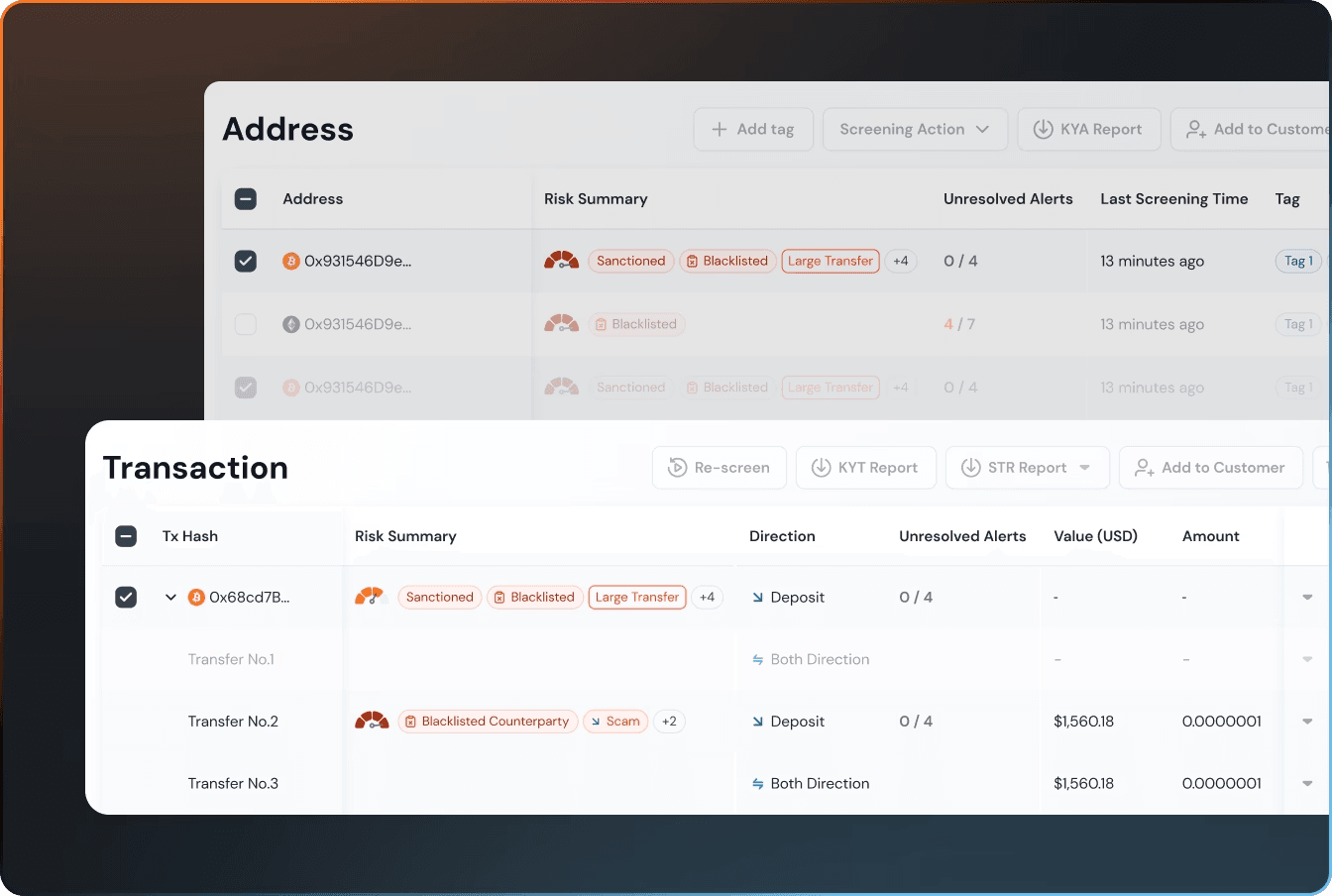
An on-chain compliance architecture requires functional integration of address attribution, continuous KYT monitoring, behavioral risk scoring, and cross-chain tracking. These functions establish a control layer designed to intercept high-risk interactions prior to liquidity contamination or regulatory inquiry.
Address intelligence: understanding who may be behind a wallet
Address intelligence maps cryptographic identifiers to documented entities, behavioral groupings, historical risk exposure, and specific laundering typologies. For decentralized protocols, this translates to determining if an interacting address maintains connections to sanctioned regimes, ransomware operators, exploit addresses, mixing protocols, or identified fraudulent networks.
Detailed address intelligence enables granular business logic. A lending market might implement stricter monitoring parameters for collateral deposits compared to governance voting functions. An automated market maker might evaluate liquidity provision using different heuristics than standard token swaps. Bridge operators typically prioritize historical source-of-funds analysis, given the rapid settlement times across distinct ecosystems.
Real-time transaction monitoring for deposits, withdrawals, swaps, and bridge flows
Know Your Transaction (KYT) functions as the persistent analysis of ongoing asset transfers. In decentralized finance, this monitoring must match the execution speed of the underlying network. Relying on batch processing or daily reviews is insufficient when illicit assets can enter a protocol, execute a token swap, and exit via a cross-chain bridge within a single confirmation cycle.
An effective KYT integration scans deposits, withdrawals, swap execution, cross-chain transfers, and irregular contract calls continuously. The system routes alerts via defined escalation paths, enabling operators to intervene. Current operational benchmarks indicate that processing latency and alert resolution throughput serve as primary evaluation criteria for risk management teams.
Risk scoring that combines entity, behavior, volume, and interaction signals
Risk assessment cannot rely on static address tags. The scoring models must adjust dynamically based on transaction execution. An address lacking an explicit negative entity tag might trigger high-risk parameters if it accepts incoming transfers from known exploit paths, executes repetitive fractional transactions, or routes substantial volume through temporary intermediary wallets.
Advanced scoring frameworks process entity attribution, transaction frequency, volume metrics, execution timing, routing complexity, and multi-chain movements concurrently. This multi-variable approach limits the reliance on rigid, single-parameter rules and facilitates more precise alert prioritization.
Cross-chain visibility across major ecosystems and L2 networks
Multi-chain execution defines standard protocol interaction. Protocol users route capital through bridges and Layer-2 infrastructure to optimize gas expenditures, access fragmented liquidity pools, or execute cross-market arbitrage. Illicit actors leverage these exact pathways to obfuscate asset origins. Consequently, compliance infrastructure must maintain tracking continuity across Ethereum, BNB Chain, Polygon, TRON, Base, Optimism, and other active networks.
Failing to monitor cross-chain movements limits the protocol's visibility to the final execution step, discarding the historical risk context. This limitation creates documentation deficits. When evaluating cross-chain tracing solutions, the primary benchmark is whether the monitoring engine can reconstruct the asset path across distinct networks and intermediary hops within a unified graphical interface.
How to Evaluate a Crypto Compliance Platform for DeFi
Platform evaluation should prioritize network coverage, detection granularity, system latency, and parameter configurability. While vendors heavily market broad compliance capabilities, protocol teams require verifiable evidence that the infrastructure processes protocol-specific execution patterns and multi-chain environments under production loads.
Coverage: chains, tokens, bridges, contracts, and labeled entities
Monitoring coverage extends beyond the total number of supported blockchains. The evaluation criteria include token standard support, bridge contract parsing, smart contract attribution, entity clustering accuracy, and the historical depth of the transaction database. Infrastructure supporting multiple chains but lacking specific bridge parsing logic frequently misses active risk vectors.
Evaluation teams should verify the update frequency of entity tags, the methodology used to validate clustering algorithms, the depth of bridge pathway mapping, and whether Layer-2 environments receive the granular indexing required for production-level transaction monitoring.
Detection depth: multi-hop tracing, typology rules, and AI behavior analysis
The granularity of detection defines the platform's ability to intercept obscured risk. Multi-hop tracing maps the historical route of incoming assets. Typology engines flag established execution patterns, including layering sequences, asset splitting, peeling chain structures, wash trading indicators, and interaction with obfuscation services. Behavioral models utilizing machine learning identify anomalous execution patterns that bypass static parameter checks.
Optimized detection typically merges deterministic rules with adaptive behavioral analytics. Deterministic parameters ensure strict enforcement of known limits. Machine learning models provide pattern recognition at scale. Operating concurrently, these detection methods provide risk managers with a solid foundation for intervention.
Speed: alert latency, transaction throughput, and escalation channels
Processing speed functions as a hard constraint because decentralized execution settles definitively. A viable platform must process high transaction volumes with minimal alert generation latency, while pushing notifications through stable channels. In high-throughput protocols, monitoring delays of several minutes frequently result in unmitigated exposure as assets move through liquidity pools and aggregator routers.
Engineering teams must conduct load testing using real-world transaction data during the vendor selection phase. The evaluation should measure the temporal gap between block finality and alert generation, the efficiency of the case assignment logic, and the stability of the webhook integrations, messaging API connections, and email routing systems.
Configurability: jurisdiction-specific rules and protocol-specific risk thresholds
While decentralized protocols maintain global accessibility, the specific risk tolerances and regulatory obligations differ based on corporate jurisdiction, asset classification, operational structure, and internal governance parameters. Configurable rule engines allow risk managers to customize thresholds for large-volume transfers, specific geographic interaction markers, and distinct contract routing paths.
Extensive configurability directly addresses the false-positive problem. Universal, non-adjustable parameters flag benign transaction volume, whereas highly customized thresholds ensure that the alert queue reflects the protocol's specific risk exposure model.
The Compliance Workflow: From Alert to Investigation to Report
An effective operational workflow converts raw detection signals into structured, documented resolutions. The optimal platforms consolidate continuous monitoring, asset tracing, case administration, access control management, and report generation into a singular sequential process.
Step 1: Triage high-risk wallets and transactions before exposure spreads
The triage phase segments incoming alerts based on assigned severity, capital exposure, entity risk tags, matching typologies, and execution timing. Alerts indicating interaction with sanctioned entities, identified exploit proceeds, or immediate bridge transfers require processing priority over standard operational anomalies.
The platform must provide filtering mechanisms that suppress low-confidence signals while highlighting active execution risks. The effectiveness of this filtering relies heavily on the accuracy of the underlying contextual intelligence and risk scoring models.
Step 2: Trace funds visually to identify counterparties and source of funds
Graphical tracing interfaces allow analysts to parse complex execution sequences efficiently. Rather than analyzing raw transaction hashes via block explorers, investigators analyze visual representations of asset flows across specific wallets, protocol contracts, and network bridges. This visual formatting accelerates source-of-funds determinations and clarifies internal reporting.
These visual structures serve as primary evidence during external audits and regulatory inquiries. A detailed node-graph illustrates the analytical rationale behind a specific intervention, documenting the identified exposure limits and the specific counterparties involved in the execution chain.
Step 3: Assign cases, manage blacklists and whitelists, and document decisions
Risk mitigation requires structured team coordination. Generated alerts mandate assignment to specific analysts, proper escalation routing, and resolution logging. Access controls, including blocklists and approved entity registries, require strict governance, periodic reviews, and comprehensive audit trails for every modification.
Standardizing this progression eliminates operational inconsistency. Furthermore, it provides technical oversight committees with the metrics required to verify that the compliance personnel can sustain the analytical pace required by the protocol's transaction volume.
Step 4: Generate STR or SAR-ready records for auditors and regulators
Upon verifying illicit execution, operations teams frequently need to output documentation formatted for Suspicious Transaction Reports (STR) or Suspicious Activity Reports (SAR), contingent on the specific regulatory framework. The software infrastructure must archive transaction hashes, relevant wallet identifiers, behavioral risk tags, analyst notations, final resolutions, and the supporting visual graphs.
While automated data formatting does not bypass the need for legal review, it standardizes the evidence collection phase and minimizes manual data entry. This standardization is mandatory when regulatory bodies request the submission of transaction-level execution logs.
Common Failure Points in DeFi Compliance Operations
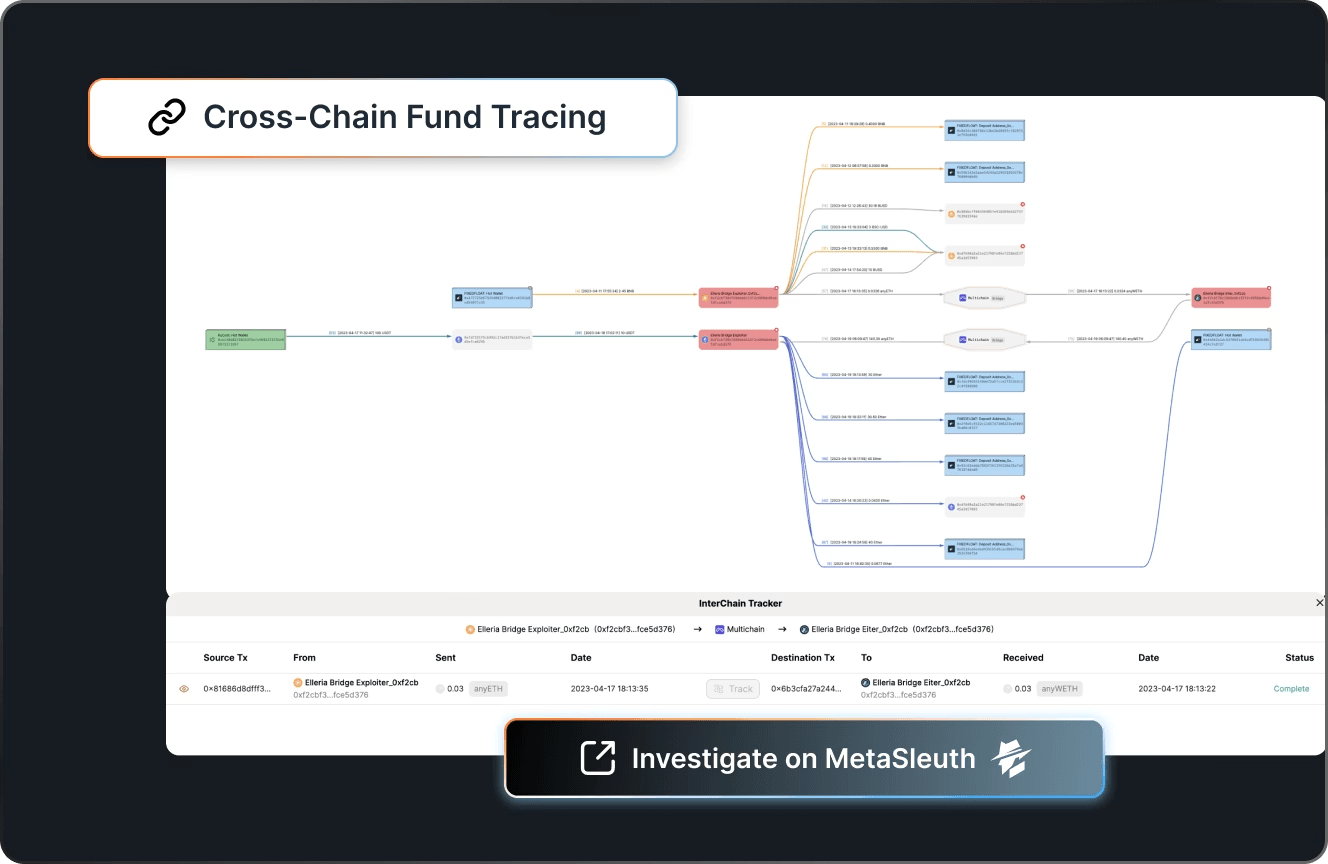
Operational breakdowns in risk management rarely stem from a lack of alert generation. They typically originate from fragmented datasets, rigid parameter rules, manual processing bottlenecks, and missing documentation when operators must justify their intervention logic to external reviewers.
Too many false positives from static screening rules
Inflexible parameter settings generate extensive alert queues lacking execution context. Treating minor, multi-hop indirect exposure with the same severity as direct interaction consumes analytical bandwidth. Conversely, overly permissive thresholds allow identified risk to execute cleanly. Minimizing false positives necessitates dynamic scoring methodologies, detailed entity clustering, behavioral heuristics, and rule sets customized to the protocol's architecture.
No unified view across chains, entities, and intermediary addresses
Operating disparate analytical tools yields fragmented assessments. Monitoring Ethereum state changes in one interface, TRON execution in another, and cross-chain bridge paths in a third prevents investigators from mapping the complete asset trajectory.
This fragmentation exacerbates response latency during active incidents. When exploiters route capital rapidly across distinct network environments, risk teams require integrated, cross-chain analytical visibility rather than isolated data dashboards.
Manual investigations that cannot keep pace with protocol activity
Manual data parsing functions adequately in low-throughput environments but collapses under the load of active decentralized protocols. Exporting transaction hashes to local spreadsheets, manually drawing relationship graphs, and drafting resolution logs outside the monitoring environment introduces severe latency and evidentiary inconsistencies.
System automation is not designed to replace analytical judgment. Its primary function is the elimination of manual data formatting, allowing personnel to allocate their bandwidth to evaluating actual risk parameters and executing timely interventions.
Evidence gaps when regulators request transaction-level documentation
Regulatory agencies, independent auditors, and technical oversight committees consistently require precise operational logs. Risk teams must document the detection vector, the analytical process, the personnel involved, the final intervention choice, and the technical evidence supporting that choice.
If this evidence remains distributed across internal messaging platforms, local files, isolated screenshots, and disconnected software instances, the protocol operators face significant friction when required to demonstrate the functional efficacy of their control systems.
Where Phalcon Compliance Fits for On-Chain Protocol Teams
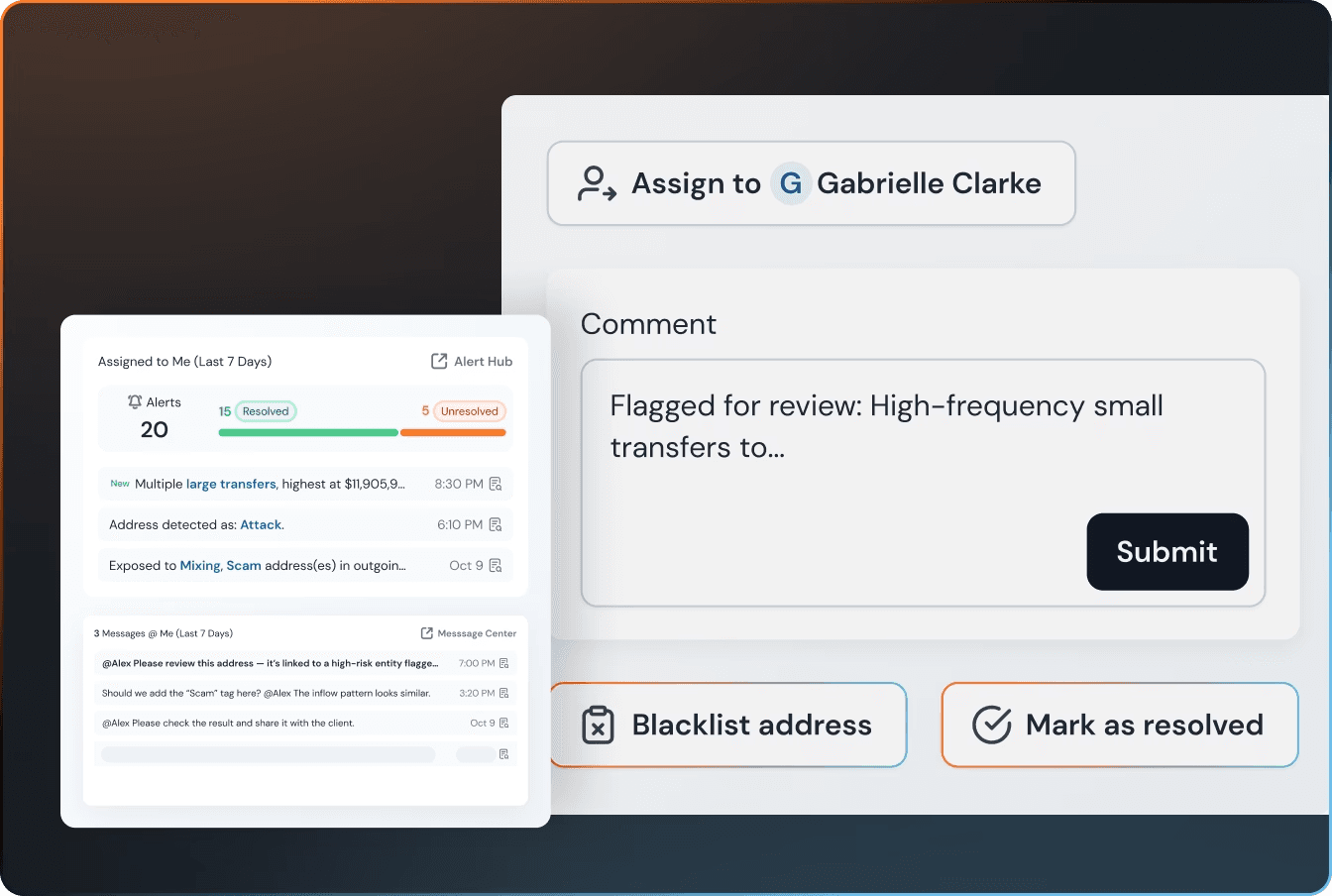
Phalcon Compliance provides protocol operators with a high-speed, verifiable, and structurally complete on-chain monitoring infrastructure. The platform consolidates address profiling, continuous KYT monitoring, behavioral risk detection, visual fund mapping, workflow administration, and standardized log generation into a single operational interface.
KYA deep address profiling with unlimited-hop and cross-chain tracing
Phalcon Compliance executes Know Your Address (KYA) protocols through comprehensive wallet profiling. The infrastructure provides unlimited-hop transaction tracing and multi-chain mapping across primary public networks, including Ethereum, BNB Chain, Polygon, TRON, Base, and Optimism. This architecture enables investigators to determine historical asset origins, current execution trajectories, and the specific entity groupings controlling complex intermediary routing.
KYT real-time monitoring with millisecond-level response and multi-channel alerts
The platform integrates real-time KYT processing, engineered to deliver millisecond-level analytical responses for high-throughput protocol execution. The system pushes alerts through seven distinct operational channels, providing risk teams with the latency reduction required to intercept flagged deposits, irregular token swaps, anomalous bridge transfers, and unexpected contract interactions.
AI-powered risk engine with 200+ signals and 17 regulatory-aligned rule engines
The detection framework merges behavioral machine learning analytics with over 200 distinct execution signals. The system deploys 17 pre-configured, regulatory-aligned rule sets covering entity attribution limits, interaction anomalies, transfer frequency spikes, volume thresholds, and intermediary address routing. Risk managers can customize these parameters based on specific jurisdictional mandates and technical structures, increasing detection accuracy while maintaining comprehensive execution coverage.
Integrated investigations, team collaboration, and one-click compliance reporting
Phalcon Compliance embeds professional on-chain tracing tools via MetaSleuth, allowing analysts to visually map asset paths and extract relationship logic. The system facilitates case assignment, intervention workflows, access control list administration, and automated generation of structured STR or SAR-ready documentation logs. This integration ensures the risk management function operates at the speed of the underlying network while generating verifiable audit trails.
FAQ: Crypto Compliance Platform Questions for DeFi Teams
Protocol operators frequently question the feasibility of implementing robust compliance without degrading system performance. Resolving this friction requires infrastructure that specifically supports continuous KYT, multi-chain asset tracing, configurable parameter models, structured investigation tracking, and automated log generation.
What is a crypto compliance platform in a DeFi context?
In a decentralized architecture, it represents an infrastructure layer that indexes on-chain state changes, calculates specific wallet and execution risk metrics, tracks multi-chain asset routing, facilitates analyst investigations, coordinates internal risk workflows, and outputs structured documentation for internal governance or external audit requirements.
How is KYT different from wallet screening?
Address screening evaluates the risk status of a specific cryptographic identifier at a static point in time. KYT (Know Your Transaction) functions as persistent, continuous analysis of the actual execution logic, scanning deposits, withdrawals, swaps, cross-chain transfers, and specific contract calls. This persistent analysis aligns with the dynamic nature of decentralized networks.
What risk signals should DeFi protocols monitor in real time?
Monitoring models must target exposure to sanctioned addresses, established exploit proceeds, mixing protocol interactions, identified fraudulent clusters, high-risk centralized exchange routing, rapid fractional splitting sequences, irregular high-frequency transfers, volume anomalies, repetitive intermediary staging, abnormal bridge utilization, and irregular smart contract state modifications.
Can on-chain compliance support multiple jurisdictions and reporting standards?
Yes, provided the underlying infrastructure allows for customizable parameter rules, jurisdiction-specific volume thresholds, comprehensive audit logging, and adaptable report formatting. However, internal risk personnel must continuously calibrate these technical configurations to ensure alignment with current local regulatory obligations.
How can protocols reduce false positives without missing serious risk?
Operators must deploy multi-variable assessment models that process entity attribution, behavioral heuristics, transfer volume, historical interaction logs, and multi-chain routing concurrently. Implementing highly configurable thresholds and maintaining an active analyst feedback loop ensures the detection accuracy improves iteratively over time.
Conclusion
Integrating verifiable compliance controls has shifted from an operational edge-case to a fundamental protocol requirement. Engineering teams must deploy infrastructure capable of parsing smart-contract execution paths, multi-chain routing sequences, and generating transaction-level evidence logs, thereby enabling risk analysts to intervene promptly and document their logic securely.
Deploying a crypto compliance platform for decentralized environments requires functionality beyond tagging isolated addresses. The architecture must synchronize address profiling, continuous KYT, dynamic risk scoring, cross-chain asset tracing, case administration workflows, and data logging into a cohesive system. This integrated framework minimizes exposure to illicit capital, enforces internal governance standards, and establishes baseline responses for increasing regulatory scrutiny.
Phalcon Compliance addresses these precise requirements by uniting KYA profiling algorithms, real-time KYT evaluation, behavioral risk engines, MetaSleuth tracing analytics, internal workflow coordination, and automated evidence reporting. For active protocol teams, this infrastructure translates into faster, more accurate risk interventions that match the execution speed of the on-chain markets.