Executive Summary
Centralized exchanges entering 2026 require a blockchain compliance platform capable of translating on-chain risk indicators into actionable operational routing for deposits, withdrawals, and incident response. The baseline shifts toward real-time transaction monitoring, deterministic on-chain risk scoring, multi-chain entity attribution, and integrated case management.
For compliance officers at centralized exchanges, the risk profile has transitioned. Problematic fund flows bypass isolated single-chain transfers, instead routing through cross-chain bridges, decentralized mixers, stablecoin smart contracts, and nested fiat off-ramps. Industry analytics indicate illicit transaction volumes reached $24.2 billion in 2023, heavily weighted toward sanctioned entity interactions[1]. The operational mandate is no longer mass transaction blocking, but rather processing verification at higher speeds with verifiable deterministic evidence.
Consequently, a functional blockchain compliance platform in 2026 requires real-time transaction monitoring, programmable screening thresholds, cross-chain attribution, and API integration with the broader exchange risk infrastructure.
Evaluating vendor capabilities involves establishing technical baselines for exchange operations. This evaluation process details specific system requirements, vendor testing methodologies, and the application of BlockSec within compliance architectures that combine security incident intelligence with standard regulatory reporting workflows.
Core Insights
Mature exchange compliance architectures in 2026 utilize blockchain intelligence as a primary control mechanism. The system must restrict asset settlement during active alerts, maintain verifiable evidence post-review, and output standardized documentation for internal audits, regulatory inquiries, and law enforcement requests.
Five technical requirements dictate system viability. First, static address blocklists fail when operators rotate infrastructure across distinct networks within minutes. Second, high false-positive rates degrade platform utility by congesting withdrawal queues and reducing analyst output. Third, monitoring infrastructure must cover stablecoin contracts, Layer 2 state channels, and cross-chain messaging protocols. Fourth, the integrity of an investigation relies on evidence continuity, requiring immutable logs of transaction graphs and escalation decisions. Fifth, the technical boundary between security operations and compliance dissolves when processing funds originating from localized smart contract exploits or phishing infrastructure.
Regulatory frameworks reinforce these technical standards. The Financial Action Task Force mandates virtual asset service providers deploy risk-calibrated monitoring and persistent sanctions enforcement[2]. During routine audits, compliance teams are required to demonstrate tool utilization rates, decision consistency, and transaction-level justification rather than mere software procurement.
What CEX Compliance Teams Must Solve in 2026
Exchange compliance units are shifting from localized retrospective reviews to automated risk orchestration. The platform infrastructure must coordinate rapid deposit verification, withdrawal gating, sanctions filtering, and evidence archiving while maintaining data synchronization across fraud, security, and legal departments.
From basic AML monitoring to exchange-wide risk orchestration
Standard AML procedures rely heavily on retrospective batch processing and customer profile updates. Crypto asset platforms require parallel transaction-level execution. A deposit originating from a known exploit contract requires a deterministic ledger credit delay. Withdrawals targeting newly identified scam infrastructure require immediate step-up authentication. Internal treasury movements executed post-incident require coordinated security documentation and compliance logging.
The functionality of an alert depends on its contextual density and execution latency. A production-ready blockchain compliance platform processes on-chain risk scores, fiat transaction history, asset classification, jurisdictional requirements, and behavioral baselines into a unified routing decision.
Why real-time deposit and withdrawal decisions matter more than static reports
Retrospective reporting satisfies periodic governance requirements but fails to halt high-risk asset settlement. For exchanges processing high transactions per second, minute-level latency introduces severe exposure. A 0.5% manual review queue in a high-throughput environment strains operational capacity. Financial crime compliance studies report false-positive rates exceeding 90% in poorly optimized configurations[3]. Exchange infrastructure cannot absorb this friction when retail users expect instant withdrawal execution.
Real-time transaction monitoring algorithms must handle pre-credit filtering, pre-withdrawal routing, internal sweep verification, and hot wallet monitoring. Each distinct flow demands specific API timeout limits, fallback logic, and escalation triggers.
Key risk scenarios: sanctions exposure, mixers, bridges, scams, hacks, and nested services
High-priority detection logic for centralized exchanges includes strict liability sanctions screening, zero-knowledge mixer interactions, multi-hop bridge layering, verified scam clusters, exploit liquidation routes, and nested broker accounts. System configurations should apply distinct risk weights to these events. A direct OFAC-sanctioned address interaction requires different API hold parameters, approval hierarchies, and reporting documentation compared to a five-hop exposure to a low-confidence phishing cluster.
Must-Have Feature 1: Real-Time Transaction Monitoring and KYT
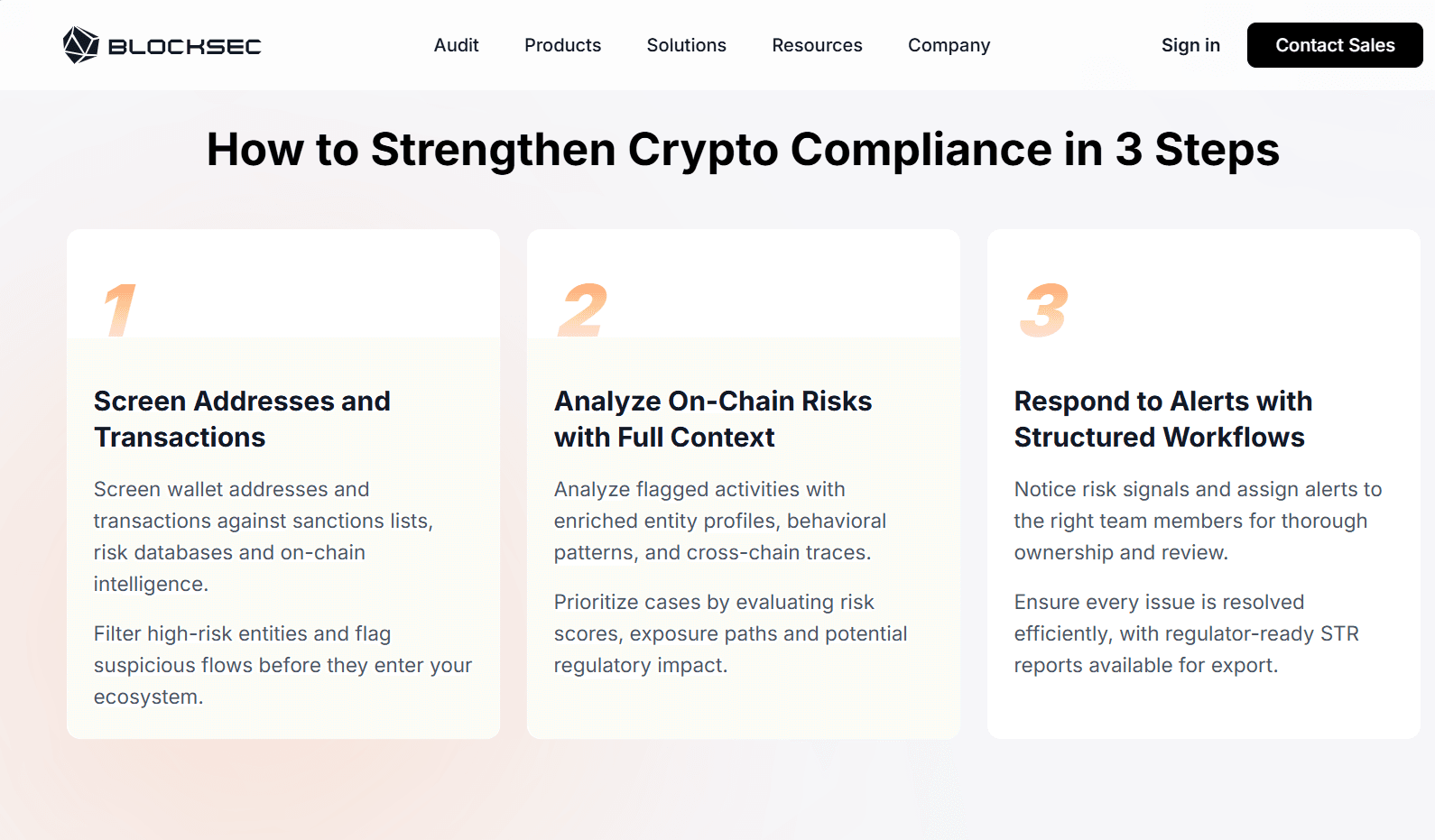
Real-time KYT processes parse blockchain state changes into operational routing directives prior to final settlement. Centralized exchanges require low-latency screening logic applied across deposits, withdrawals, treasury movements, and localized smart contract interactions, utilizing tunable risk scoring matrices.
Risk scoring for deposits, withdrawals, internal transfers, and hot wallet movements
A functional compliance architecture scores both inbound and outbound asset flows. Unmonitored withdrawals introduce sanctions liability, immediate financial loss, and severe regulatory penalties. Internal wallet sweeps and treasury consolidation routines require monitoring, as compromised internal infrastructure initiates immediate compliance reporting obligations.
Risk calculation algorithms evaluate direct interaction, distance-based indirect exposure, chronological decay of the risk event, transfer volume, specific asset properties, heuristic clustering confidence, and deviation from behavioral baselines. A single-hop transfer from a sanctioned entity dictates a higher severity weighting than an aged, low-value transfer linked to a generalized high-risk category.
Configurable alert rules by asset, chain, jurisdiction, and customer segment
Exchange compliance units managing global liquidity require distinct rule sets for localized jurisdictions, specific fiat-backed stablecoins, zero-knowledge protocols, and institutional sub-accounts. Programmable rule engines enable compliance officers to adjust risk weighting parameters without requiring engineering resources to deploy code updates for individual exceptions.
The baseline rule library incorporates sanctions filtering, mixer proximity metrics, known exploit outputs, ransomware operator addresses, verified darknet infrastructure, bridge transit history, and anomalous smart contract interactions. Deployment pipelines require sandbox environments to backtest modified threshold parameters against historical ledger data prior to production deployment.
Low-latency screening that supports high-volume trading and withdrawal flows
API response latency dictates operational viability. Sub-optimal query times trigger withdrawal timeouts, leading to manual bypasses by customer support units. Insufficient network depth allows problematic funds to clear prior to intervention. Baseline standards for top-tier exchanges demand millisecond-level response times for standard queries and near-instant logic execution for identified high-risk events.
The platform architecture must demonstrate API stability under load, query queue redundancy, failover mechanisms, and precise SLA adherence. System outputs must clearly demarcate auto-clear, auto-block, manual review, and severe escalation directives.
Must-Have Feature 2: Multi-Chain Coverage and Entity Intelligence
Network operators route assets across disparate ledger environments. Multi-chain entity intelligence requires indexing standardized addresses, proxy contracts, cross-chain messaging bridges, stablecoin ledgers, and Layer 2 rollups, supported by continuous attribution updates to maintain accurate detection logic.
Coverage beyond Bitcoin and Ethereum: stablecoins, L2s, bridges, and emerging chains
Indexing native UTXO and EVM transactions constitutes a baseline, not a complete solution. Fiat-backed stablecoins manage the majority of centralized exchange liquidity and cross-border settlement. Layer 2 rollups alter expected gas patterns and address generation behaviors. Cross-chain bridges complicate tracing by modifying the asset contract standard while maintaining the economic linkage of the initial deposit.
The Financial Action Task Force documents that malicious actors target technical inconsistencies between networks and fragmented jurisdictional oversight[2]. This operational reality manifests in daily exchange processing. Funds originating on a specific ledger frequently complete settlement on an entirely distinct network following bridge transitions or token swap events.
Entity attribution for exchanges, darknet markets, mixers, fraud rings, and sanctioned addresses
Raw address indexing provides minimal utility without deterministic entity attribution. Compliance platforms must map addresses to identified custodians, unregulated exchanges, sanctioned entities, zero-knowledge protocols, phishing distributors, exploit operators, and localized OTC brokers.
The validity of attribution relies on primary source verification, algorithmic clustering precision, ledger timestamp proximity, and transparent cryptographic evidence. A tagged address lacking contextual data introduces operational liability. Reviewing analysts require access to the initial classification reasoning, historical update logs, cluster associations, and the exact distance of the inferred exposure.
Continuous updating to reduce blind spots as attackers move across ecosystems
Malicious operators cycle deposit addresses, deploy temporary proxy contracts, exploit bridge vulnerabilities, and distribute assets across fragmented liquidity pools. Intelligence databases require continuous API updates rather than scheduled batch refreshes. The latency between an on-chain event and the database update directly dictates the window during which unrecognized assets clear internal exchange controls.
Vendor evaluations must audit the process for indicator ingestion, heuristic validation, version control, and client-side database distribution. The system architecture must lock historical address classifications to allow investigative units to reconstruct the exact data state visible during the initial processing decision.
Must-Have Feature 3: Investigation, Case Management, and Audit Trails

Triggered alerts require structured conversion into documented investigations. The case management module handles evidence preservation, analyst assignment, multi-hop graph mapping, justification logging, and immutable audit trailing to support internal quality assurance and external regulatory examinations.
Turning alerts into defensible cases with evidence, notes, ownership, and escalation paths
An alert generation initiates a standardized logging procedure. The operational case file aggregates the transaction hash, related historical transfers, applied entity tags, precise exposure routing, operator annotations, user profile metrics, resolution logic, server timestamps, hierarchical approvals, and internal routing history. Standardized structures ensure audit consistency across shifts.
Access control matrices define the operational hierarchy. Level-one personnel process standard threshold alerts, while confirmed OFAC hits, recognized exploit addresses, and high-volume institutional holds route directly to designated compliance directors. Granular ownership tracking prevents parallel processing and ensures severe flags receive mandatory resolution.
Graph analysis for tracing fund flows across wallets, contracts, bridges, and services
Graph database interfaces enable analysts to map asset trajectories across standard addresses, decentralized exchange pools, bridge contracts, and mixing services. This module resolves complex routing where initial deposits are fragmented into micro-transactions. The interface serves a functional requirement: establishing original source parameters, intermediate routing hops, final destination addresses, and the exact technical exposure logged by the exchange.
During active smart contract exploits, identified assets traverse networks rapidly following public disclosure. Security personnel isolate the initial attacker infrastructure, while compliance units monitor corresponding exchange deposit routing. Utilizing a unified graph interface synchronizes the technical response across separate departments.
Regulator-ready audit logs for internal reviews, law enforcement requests, and external exams
System audit logs capture distinct user IDs associated with viewing, modifying, authorizing, escalating, or archiving specific files. The architecture records the precise rule set version and entity database state active at the millisecond of the decision. Regulatory examiners review the validity of a clearance based exclusively on the data accessible at the time of execution, not subsequent intelligence updates.
Preserving verifiable system logs minimizes subsequent compliance remediation expenses. Standardized reporting formats enable management to track operational metrics, including alert resolution latency, individual operator output, escalation ratios, unmitigated exposure values, and documented policy overrides.
Must-Have Feature 4: Policy Automation, Reporting, and Integration
Policy automation translates written compliance directives into standardized API execution. The platform links sanctions logic, local risk parameters, behavioral anomaly detection, withdrawal gating, security event tracking, internal support ticketing, and localized data storage without requiring manual data transfers between interfaces.
Automated controls for sanctions screening, risk appetite, and suspicious activity review
Programmatic automation ensures standard execution of internal directives. A primary sanctioned address interaction executes a hard API block and immediate director escalation. A secondary interaction with a known mixing pool generates a standard analyst queue ticket. Low-value, multi-hop exposure to a generalized risk category logs the interaction without interrupting the settlement process.
Behavioral review processes rely on pattern recognition algorithms. The system aggregates linked transaction flags, identifies repetitive localized behaviors, and constructs entity-level risk profiles. This clustering limits redundant manual reviews and directs operational resources toward events exhibiting severe deviation from expected baselines.
API integration with KYC, fraud, withdrawal approval, SIEM, ticketing, and data warehouse systems
Standalone compliance interfaces introduce execution latency. The infrastructure requires direct API links with identity verification vendors, localized fraud detection models, withdrawal execution layers, Security Information and Event Management (SIEM) networks, task routing platforms, and long-term storage clusters. Technical procurement focuses on API schema documentation, measured endpoint uptime, and defined rate limits.
Synchronization with security operations provides immediate technical utility. On-chain exploit markers, localized phishing signatures, anomalous contract calls, and irregular treasury transfers trigger simultaneous security and compliance protocols. Shared data pipelines accelerate the internal mitigation response and improve the accuracy of subsequent regulatory filings.
Dashboards and exports for board reporting, jurisdictional compliance, and operational KPIs
Management interfaces aggregate high-level metrics: total high-risk volume, confirmed sanctions blocks, pending case queues, total alert generation, false-positive ratios, operational bandwidth, approved policy overrides, and specific ledger risk distributions. Compliance directors utilize standardized data exports to format mandatory jurisdictional filings and support external audit requirements.
Effective dashboard configurations separate execution metrics from systemic risk parameters. Review personnel operate within active queues and granular case files. Risk directors monitor overall exposure vectors, API execution latency, and department resource allocation. Executive committees track long-term risk trajectories and structural compliance liabilities.
How to Evaluate a Blockchain Compliance Platform Vendor
Procurement processes prioritize data accuracy, systems integration, and institutional reliability. Centralized exchanges run isolated proof-of-concept tests covering API latency, address classification freshness, false-positive mitigation, role-based access controls, and the vendor's capacity to process localized high-throughput workloads.
Data quality: accuracy, freshness, attribution depth, and false-positive control
Database integrity determines operational output. Technical audits evaluate address clustering methodologies, update propagation latency, source data validation, and cryptographic evidence availability. Engineering teams execute load testing utilizing historical exchange transfers, documented security incidents, and previously archived internal case files to measure detection accuracy.
False-positive ratios dictate analyst bandwidth. Highly sensitive thresholds generate excessive alerts, exhausting internal resources and delaying retail settlement. Production-grade systems provide granular threshold adjustments, transparent heuristic weighting, and segmented logic applications based on specific ledgers, asset types, fiat jurisdictions, and user tier classifications.
Operational fit: alert tuning, analyst productivity, SLA, scalability, and permissions
System stability requires validation under maximum network load. Test parameters cover API response degradation, queue prioritization logic, interface render times, bulk processing capabilities, case reassignment functionality, and multi-tier access matrices. Procurement teams verify the architecture's ability to handle retail transaction volumes and maintain stability during high-frequency security events.
Service Level Agreements mandate specific metrics for endpoint uptime, technical support response latency, emergency database updates, and joint incident analysis. Transaction monitoring infrastructure acts as a critical path dependency once integrated into the primary deposit and withdrawal execution layers.
Trust signals: enterprise adoption, regulator credibility, and investigative track record
Institutional track records mitigate deployment risk. Procurement units review enterprise integration history, confirmed public-sector contracts, verified incident analysis capabilities, and historical performance during severe network exploits. Standard procurement protocols demand technical references, validated use cases, and documentation of system resilience.
Documented industry metrics track the continuous modification of on-chain laundering techniques, ranging from retail scams and localized ransomware to state-sponsored exploit routing[1]. Infrastructure vendors lacking the capacity to distribute rapid intelligence updates during active, high-profile network incidents introduce severe latency into exchange compliance responses.
Where BlockSec Fits for Exchange-Grade Compliance

BlockSec operates at the intersection of security incident intelligence and structured compliance logging. Its deployment across major Web3 infrastructure providers and public-sector units supports exchange operations requiring deterministic tracking, rapid incident parsing, and coordinated compliance routing under stringent operational limits.
Why security intelligence and compliance workflows need to converge for CEX risk control
Operational risk bypasses strict departmental boundaries. A localized protocol exploit frequently routes liquidated assets directly to exchange deposit addresses. Dedicated phishing infrastructure generates retail victim deposits and subsequent outbound transfers to known mixing pools. Internal hot wallet anomalies initiate simultaneous engineering lockdowns and regulatory disclosure procedures.
BlockSec’s foundation in security incident analysis directly impacts compliance utility. The capacity to correlate attack vectors, on-chain ledger mapping, definitive address attribution, and standardized case logging accelerates internal processing and hardens evidence formatting. This reduces overall exposure windows while standardizing data flow between engineering and regulatory units.
Enterprise validation: 500+ global clients across Web3 leaders and public-sector institutions
Based on internal deployment metrics, BlockSec infrastructure supports over 500 global clients, encompassing primary Web3 network operators and major regulatory bodies. Public deployments include Coinbase, Bybit, Cobo, MetaMask, the United Nations, the Hong Kong Securities and Futures Commission, the FBI, and PwC.
For exchange compliance directors, this deployment scale validates system stability, institutional data handling, and practical investigative capacity. Architecture deployed by high-volume enterprises and primary investigative agencies demonstrates the necessary baseline for processing critical alerts, managing cross-departmental incident data, and outputting verifiable compliance records.
Relevant trust footprint: Coinbase, Bybit, Cobo, MetaMask, UN, Hong Kong SFC, FBI, and PwC
Specific institutional deployments highlight functional utility. Integrations with Coinbase and Bybit indicate capacity for exchange-level throughput and API stability. Usage by Cobo and MetaMask demonstrates compatibility with foundational wallet infrastructure. Contracts with the UN, Hong Kong SFC, FBI, and PwC validate the data precision required for formal regulatory audits and federal investigations.
System evaluation for BlockSec mirrors standard procurement: auditing data precision, API limits, interface utility, and SLA commitments. However, the integration of deep security intelligence with standard compliance routing provides centralized exchanges with a hardened technical baseline when upgrading operational infrastructure for 2026.
FAQ: Blockchain Compliance Platform Selection for CEXs
Procurement teams evaluating transaction monitoring platforms frequently query the technical differentiation from legacy AML software, specific API requirements for low-latency routing, tuning parameters to manage alert queues, baseline evidence retention standards, and the technical indicators signaling a necessary infrastructure upgrade.
What is the difference between a blockchain compliance platform and a generic AML tool?
Standard AML software processes localized fiat profiles, batch logic, and retrospective case files. A dedicated blockchain platform integrates on-chain node data, cryptographic address clustering, network exposure graphing, unified entity databases, and ledger-specific risk matrices. This tracks the asset transfer mechanics directly, rather than relying exclusively on isolated user identity data.
Which features are essential for crypto exchange transaction monitoring?
Baseline technical requirements mandate millisecond-latency deposit and withdrawal filtering, deterministic KYT, automated OFAC exposure blocking, multi-hop mixer and bridge analytics, continuous threat intelligence updates, programmable API thresholds, multi-chain data ingestion, unified case logs, and unalterable audit trails.
How should a CEX reduce false positives without missing high-risk flows?
Engineering teams optimize alerts by adjusting variables based on specific ledgers, asset contract types, jurisdictional boundaries, multi-hop exposure distance, transaction volume, user KYC tier, and tagged entity classifications. Sandboxed backtesting, routine database pruning, and strict analyst feedback loops ensure the queue prioritizes functional risk over generalized network noise.
What evidence should compliance teams keep for regulators and law enforcement?
Standardized case archives must contain the exact transaction hash, complete address routing, active entity classifications at the time of execution, database source tags, exported graph visualizations, timestamped operator notes, contextual fiat data, specific logic rules applied, hierarchical approval signatures, and complete API escalation logs.
When should an exchange replace or upgrade its current compliance stack?
Infrastructure replacement becomes mandatory when legacy systems trigger API timeouts, fail to parse multi-chain asset routing, output unmanageable alert queues, lack immutable case logs, or operate in isolation from security endpoints. Reliance on manual data exports, delayed bridge visibility, and slow indicator updates during public networks exploits signal critical system failure.
Conclusion
In 2026, exchange compliance architecture must execute automated routing decisions, generate verifiable audit records, and synchronize data pipelines across security and regulatory departments. Competitive platforms standardizing real-time screening, cross-chain attribution, immutable logging, and enterprise API integration establish the operational baseline.
Exchange risk management operates beyond scheduled fiat profile reviews. The infrastructure dictates continuous node-level transaction monitoring, programmable asset logic, deterministic entity mapping, and automated queue management built to sustain high retail throughput and strict regulatory audits. Optimized architectures limit exposure gaps, mitigate manual queue friction, and output standardized documentation.
BlockSec provides specialized utility by aligning security intelligence ingestion with compliance decision logic. Supported by deployments across 500+ global entities, including Coinbase, Bybit, Cobo, MetaMask, the UN, Hong Kong SFC, FBI, and PwC, BlockSec delivers the requisite data precision and API stability for centralized exchanges upgrading their compliance infrastructure for 2026.