2025 marks a turning point for crypto. For years, blockchain regulations were a blurred area, but with Europe’s MiCA laws and stricter US enforcement, the "Wild West" era is over.
This creates a "compliance gap." While your legal team knows the rules on paper, your product team may struggle to enforce them on the blockchain in real-time. Compliance isn't just paperwork anymore, it has become a technology challenge. You can't rely on slow manual checks, you need instant, reliable, and direct advice to act on.
We developed Phalcon Compliance to be the infrastructure layer that bridges this gap, turning legal mandates into a few simple clicks.
What You Need to Know About Blockchain Regulations in 2025
Crypto payments are now regulated with the level of precision once reserved for traditional finance. The focus of enforcement has shifted from offering optional guidance to demanding concrete proof of compliance. To operate legally, payment providers must now navigate a complex web of specific laws that demand transparency and accountability across borders.
The European Standard (MiCA)
MiCA, the EU’s Markets in Crypto-Assets Regulation, took full effect on 30 December 2024 and applies across 27 EU member states plus three EEA countries. It aims to stop regulatory fragmentation and arbitrage by setting a single framework for issuers and Crypto-Asset Service Providers (CASPs).
Under MiCA, regulated assets are strictly classified into categories like E-Money Tokens (EMTs), Asset-Referenced Tokens (ARTs), and utility tokens (UT). Each category comes with mandatory licenses and strict duties regarding capital reserves, consumer protection, and governance. Notably, fully decentralized assets (like many NFTs) generally remain outside this specific framework.
 For payment companies, working with authorized partners is now a strict legal requirement, not a choice. Stablecoin issuers must be fully licensed within the EU, collaborating with an unapproved issuer is considered a compliance violation. MiCA also bans market manipulation and insider trading, requiring providers to actively monitor for suspicious activity. Furthermore, the EU is building a unified AML/CFT regime through AMLA and AMLR, which points to closer supervision of CASPs, stricter AML protocols, and practical readiness to restrict or freeze funds when required.
The US Landscape
The United States takes a highly aggressive but fragmented approach, where regulations are split between multiple federal and state agencies. Unlike the EU's single rulebook, the U.S. system is a patchwork.
At the federal level, agencies like the SEC (Securities and Exchange Commission) and CFTC (Commodity Futures Trading Commission) often overlap in their authority, creating tension over who regulates what. Meanwhile, all companies must follow federal AML laws (under the Bank Secrecy Act), which require reporting suspicious user activity to FinCEN. For stablecoins, the expectation is moving toward "bank-grade" safety, meaning issuers must prove they have full cash reserves and undergo regular audits.
In addition to federal rules, state-level licensing creates significant barriers to entry. To operate nationally, a firm often needs licenses in nearly 50 different states. New York’s "BitLicense" is the most famous example, setting extremely high standards for cybersecurity and consumer protection. Finally, OFAC sanctions compliance is the strictest line in the sand, with the U.S. government maintaining a list of blocked persons and wallet addresses. Processing a transaction for anyone on this list is strictly prohibited, and companies are held liable even if the violation was accidental.
Global Enforcement: Following FATF Guidelines
The Financial Action Task Force (FATF) sets the global standards that crypto businesses must follow to prevent money laundering and financial crime. These guidelines serve as the primary rulebook for how companies monitor transactions and identify their users. Instead of just checking a single transfer, FATF expects businesses to understand the entire risk profile of their customers. This means a company must be able to show exactly who is sending funds and prove that the transaction is legitimate before it is ever processed.
To meet these standards, companies must perform constant risk checks on every wallet and user they interact with. This includes flagging "high-risk" situations, such as transactions involving Politically Exposed Persons (PEPs) or users located in restricted countries. The guidelines also require businesses to watch for tools designed to hide ownership, such as mixers or other privacy-focused technologies. By following these global rules, a business ensures it has the clear, organized evidence needed whenever a regulator asks for proof of its compliance efforts.
For a detailed guide on how you can stay compliant, refer to our Crypto Payment Compliant Handbook.
What Happens When Regulation Compliance Fails
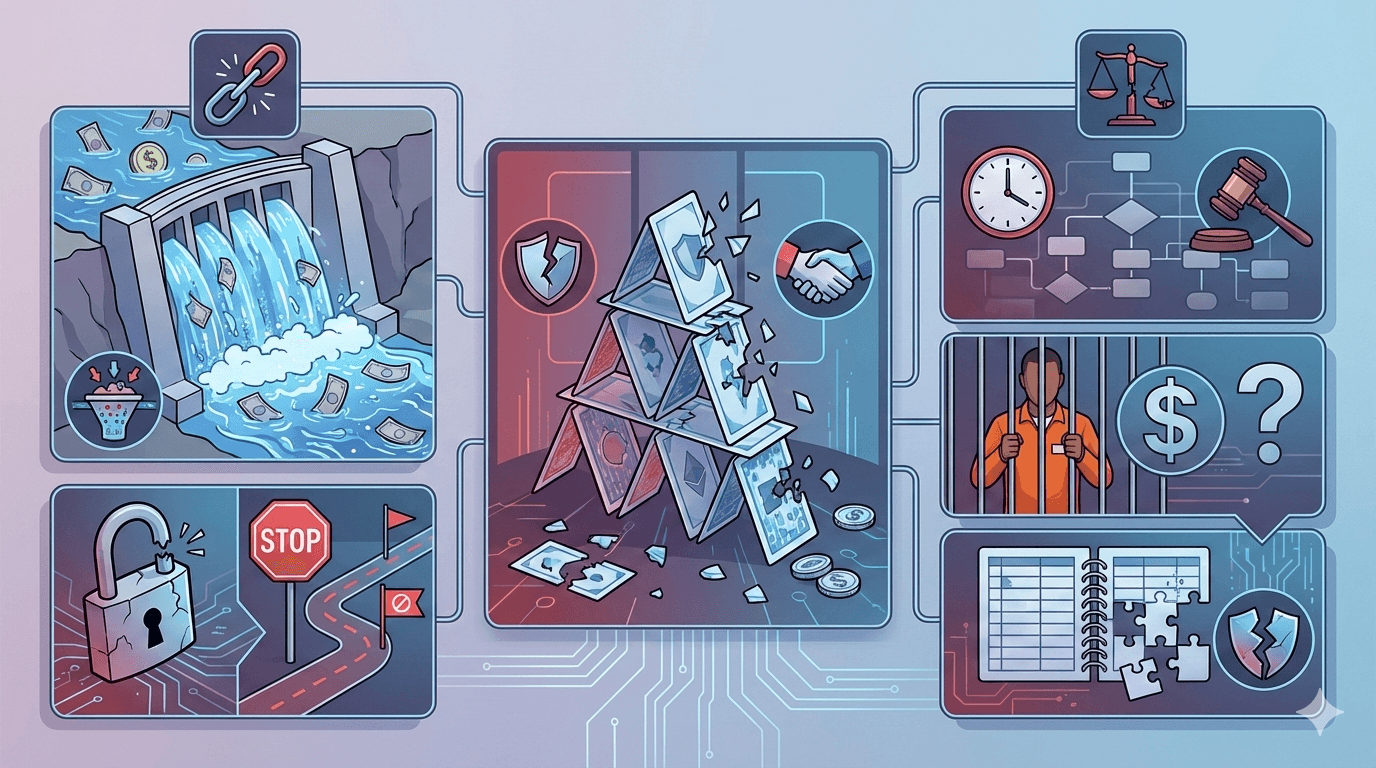
Enforcement under blockchain regulations tends to follow a few repeatable patterns. These cases taught us valuable lessons: controls that work at speed, decisions backed by evidence, and records that are ready on demand.
AML Monitoring Failures
When AML programs and suspicious-activity reporting can’t keep up with volume, regulators treat it as a system risk. Binance is the clearest example. In November 2023, the U.S. DOJ announced a guilty plea tied to Bank Secrecy Act violations and a $4.3B resolution, paired with remediation and monitoring requirements. Bittrex also faced parallel Treasury actions tied to AML and SAR failures, reinforcing that “manual catch-up” is not a sustainable defense.
Overlooked Sanctions Enforcement
Interacting with sanctioned entities is extremely dangerous because regulators apply "strict liability," meaning even accidental errors can be financially devastating. For platforms processing high volumes, these fines can quickly reach billions. In severe cases, willful violations can lead to 20 years in prison for executives.
BitPay paid over $500,000 for processing just $129,000 in transactions from sanctioned regions because it failed to use the IP data it already possessed. Bittrex faced an even heavier $53M combined penalty for similar gaps. Regulators no longer accept manual "catch-up" efforts, they demand measures taken that can identify and block prohibited paths the moment a transaction begins.
Control Breakdowns and Systemic Fallout
A breakdown in internal governance is often a death sentence for a business, leading to an overnight loss of trust and total market exit. The collapse of FTX remains the ultimate warning, resulting in a 25-year prison sentence for its founder and the loss of $8 billion in customer funds. Beyond the fraud, the lack of auditable records made recovery nearly impossible.
The lesson for blockchain regulations is practical. Segregation of assets, conflict controls, and auditable risk decisions are what keep partners, rails, and markets open.
What is Important About Blockchain Regulatory Compliance
Blockchain regulations are no longer advices on paper, they now shape the business. The real enforcement cases show the hard edge of blockchain regulations. The softer edge is just as decisive. Today, the quality of your compliance measures directly impacts how fast you can onboard users and how easily you can move liquidity.
A solid grasp of blockchain regulations is an approach for crypto firms to maintain essential ties with the broader financial world. Most Web3 platforms still depend on banks, payment processors, and stablecoin rails to operate at scale. These partners do not tolerate uncertainty.
This reality turns blockchain regulatory compliance into a must-have for business growth. Teams that downplay this often discover the cost too late. It's either losing payment access or being shut out of the entire jurisdiction. In today’s market, regulatory readiness is what keeps a business credible and able to scale globally.
The cost of mistakes is also rising as regulators' increasing focus on crypto payments, exchanges, and Web3 platforms. Weak controls lead to investigations that can damage a brand's reputation for years, while strong, built-in compliance builds the trust necessary to attract high-quality users and investors. By treating these rules as part of the daily operation rather than a barrier, businesses can turn regulatory hurdles into a competitive advantage.
Why Traditional Solutions Fail in Blockchain
Mismatch Between Human Schedules and Crypto Speed
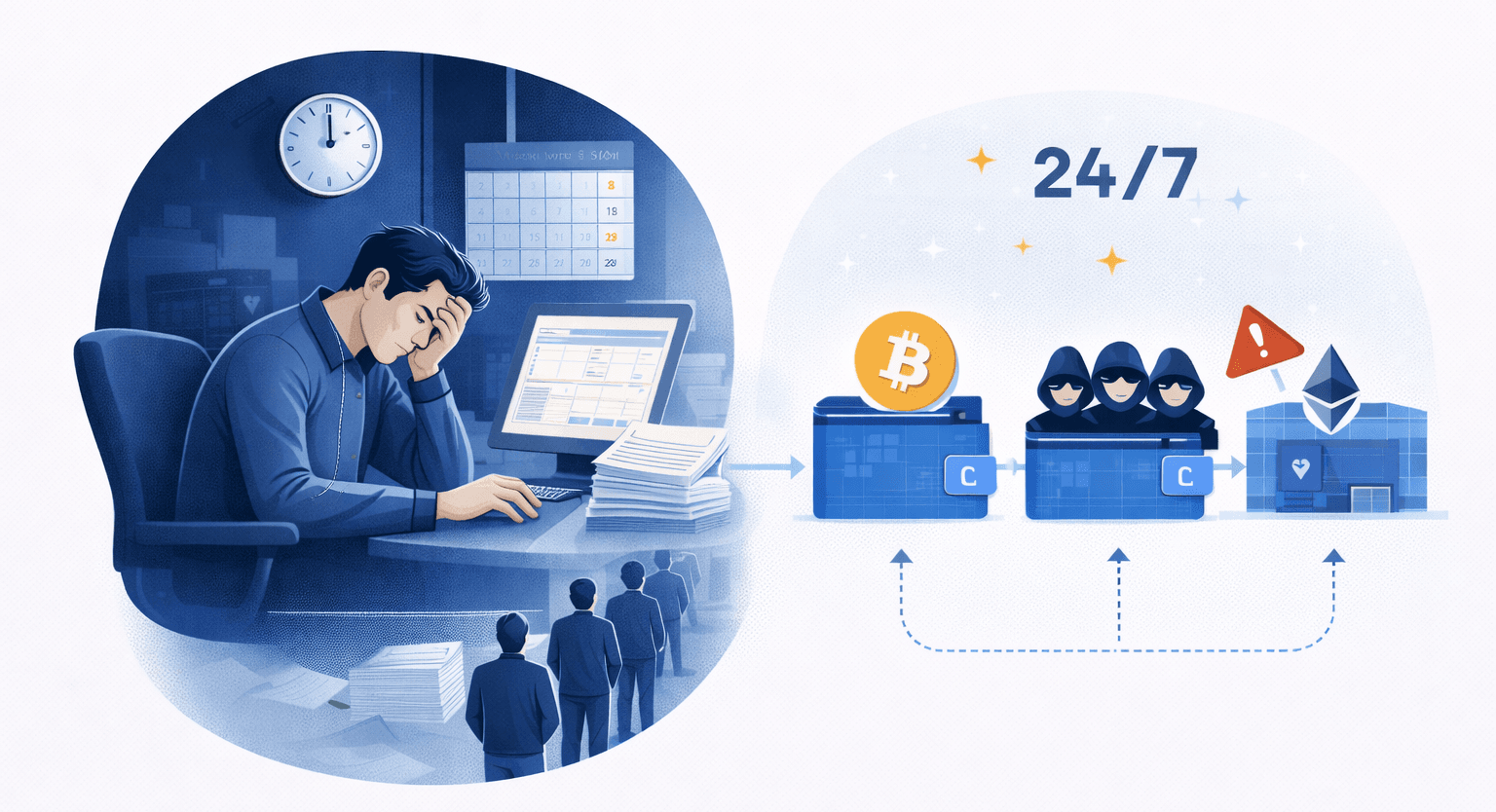
The biggest operational failure comes from trying to force human work schedules onto 24/7 blockchain activity. While banks and audit firms shut down at 5 PM, blockchains process billions of dollars all day and night. When a company relies on manual reviews, alerts pile up while the team sleeps. This forces a bad choice the next morning: either delay customer withdrawals for days to clear the backlog, or rush through the work and make mistakes. Humans simply cannot process this much high-speed data around the clock without burning out or missing details.
Inadequacy of Static Auditing
Traditional ways of checking records fail in crypto because they look at old snapshots instead of live data. In normal banking, checking records at the end of the month is standard, but on the blockchain, risk changes by the minute. For example, a wallet that looks "safe" on a list at 8:00 AM might receive stolen funds at 8:05 AM. If a compliance officer relies on a daily report, they are making decisions based on expired information. You cannot stop crime happening now by looking at a picture from yesterday.
The "Multi-Hop" Tracing Challenge
Manual checks struggle to satisfy regulators because risk often hides several steps away from the direct sender. Rules now require companies to know the true source of funds, not just who sent the payment. Bad actors move money through many different wallets and "bridges" to hide the link to the crime. Tracing these paths by hand is slow and easy to mess up. A team might approve a transfer that looks clean on the surface, only to realize later it held hidden exposure from a hack three steps back.
The Need for Automation
Ultimately, relying on manual work for blockchain compliance is a dangerous strategy that will eventually fail. The gap between the speed of crypto and the limits of human focus creates risks that regulators will no longer accept. To keep the business safe and open, operations must stop reacting with manual fixes and switch to automated systems that can run as fast and as long as the blockchain itself.
Achieve Blockchain Compliance in a Unified Platform
Blockchain regulations keep shifting across markets, while on-chain risk changes by the minute. Phalcon Compliance turns that moving target into a stable daily routine by bringing screening, evidence, reporting, and team handoffs into one workspace. Instead of spreading decisions across spreadsheets, chat threads, and screenshots, your team works from a single source of truth that stays current as new threats and enforcement expectations emerge.
Auto-Updated Blocklists and Risk Labels
The first requirement of blockchain compliance is freshness. A wallet can look clean today and become toxic tomorrow. Phalcon Compliance maintains auto-updated blocklists and risk labels so screening reflects live exposure, not a stale database. This reduces false confidence from “safe lists,” keeps alerts aligned with evolving risk, and helps teams apply consistent decisions even as threat patterns shift.
One-Click STR and SAR Reporting
Finding risk is only half the job. Regulators and partners expect a clear report with evidence, fast. Phalcon Compliance generates STR and SAR outputs in one click, compiling the transaction hash, risk rationale, and fund-flow context into a regulator-ready audit trail. That removes manual assembly work and shortens the path from detection to disclosure.
Built for Cross-Team Work
Compliance often involves multiple people across regions, and cases can pass between teams as they develop. Phalcon Compliance supports smooth sharing and clear handoffs, so a review does not start over when responsibility changes. Evidence remains linked to each decision, the investigation context stays easy to follow, and reporting stays consistent. This keeps the workflow stable at scale and reduces errors caused by miscommunication.
The latest version of Phalcon Compliance was released last month. Read the full article to learn more about its new features.
Regulation Compliance is a Business Advantage
Treating blockchain regulations as just another checklist item is a mistake. They are now the primary filter determining which platforms will survive to attract serious institutional capital. We have explored how the complex regulatory landscape and the severe operational dangers of relying on slow, manual checks create massive risks for growing businesses. Without speed and accurate data, staying compliant in this environment is nearly impossible.
Phalcon Compliance transforms this significant challenge into a manageable daily operation by providing the necessary speed, real-time data, and automated reporting tools needed to thrive. Instead of allowing regulatory uncertainty to hinder your progress, your business can use proven compliance rails to build trust and scale faster.
Don't let regulatory uncertainty slow down your growth. Audit your current risk exposure with Phalcon Compliance today. Start now to join our reward program, limited time only!

FAQ
- Why is 2025 a turning point for blockchain regulations?
The "Wild West" era has ended. New laws like Europe’s MiCA and stricter U.S. enforcement now require real-time technical proof of compliance rather than just simple paperwork.
- What is the "compliance gap"?
It is the mismatch between a legal team knowing the rules and a product team being unable to enforce them on-chain. This happens when companies rely on slow manual checks for high-speed transactions.
- How does Phalcon solve the "stale data" problem?
Phalcon uses auto-updated blocklists and live risk labels. This ensures screening reflects current on-chain exposure instead of relying on a database that might be outdated by the time you use it.
- What is the "multi-hop" challenge?
Risk often hides several steps away from the direct sender. Bad actors move funds through multiple wallets and bridges to hide links to a crime, making manual tracing slow and prone to errors.
- What is the risk of using manual compliance teams?
Blockchains run 24/7, but human teams do not. This creates backlogs that force a choice between delaying customer withdrawals or rushing through reviews and missing critical red flags.
- How does automated compliance help business growth?
It builds essential trust with banks and institutional partners. Strong compliance makes it easier to move liquidity, onboard users, and scale globally without facing sudden legal shutdowns.