On Nov 08, 2022, we detected that some attacks successfully drained assets from pools that are built on top of Sushi’s official KashiPairMediumRiskV1 contract(or some contracts that fork from it). After investigation, we found that the root cause is due to a logic bug that causes the miscalculation of the token prices.
We immediately contacted Sushi's security team, and they confirmed our findings. The good thing was that they were taking action to protect some valuable but vulnerable pools from being attacked. Besides, they also provided procedures to compensate those that lost funds from the exploit. As such, we now believe it is safe to disclose the details about the vulnerability and the attacks. In this report, we'd like to provide a detailed analysis.
Vulnerability Analysis
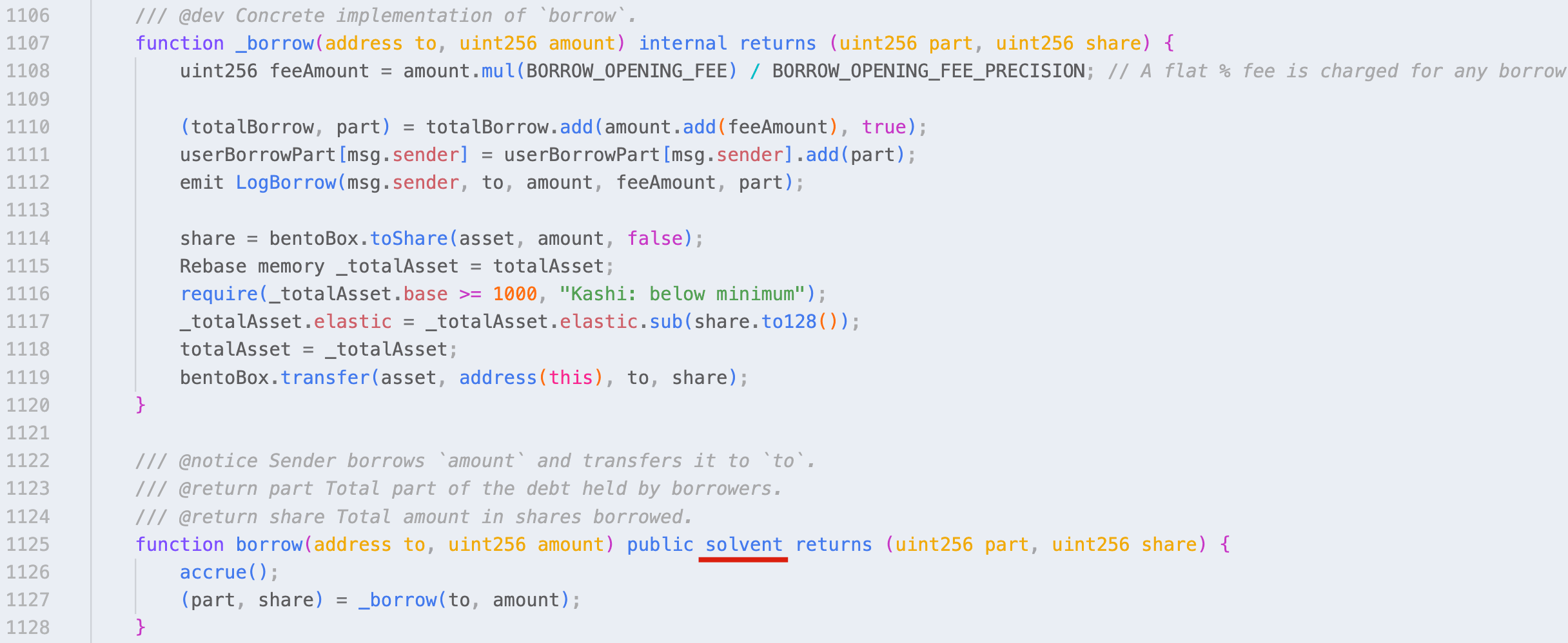
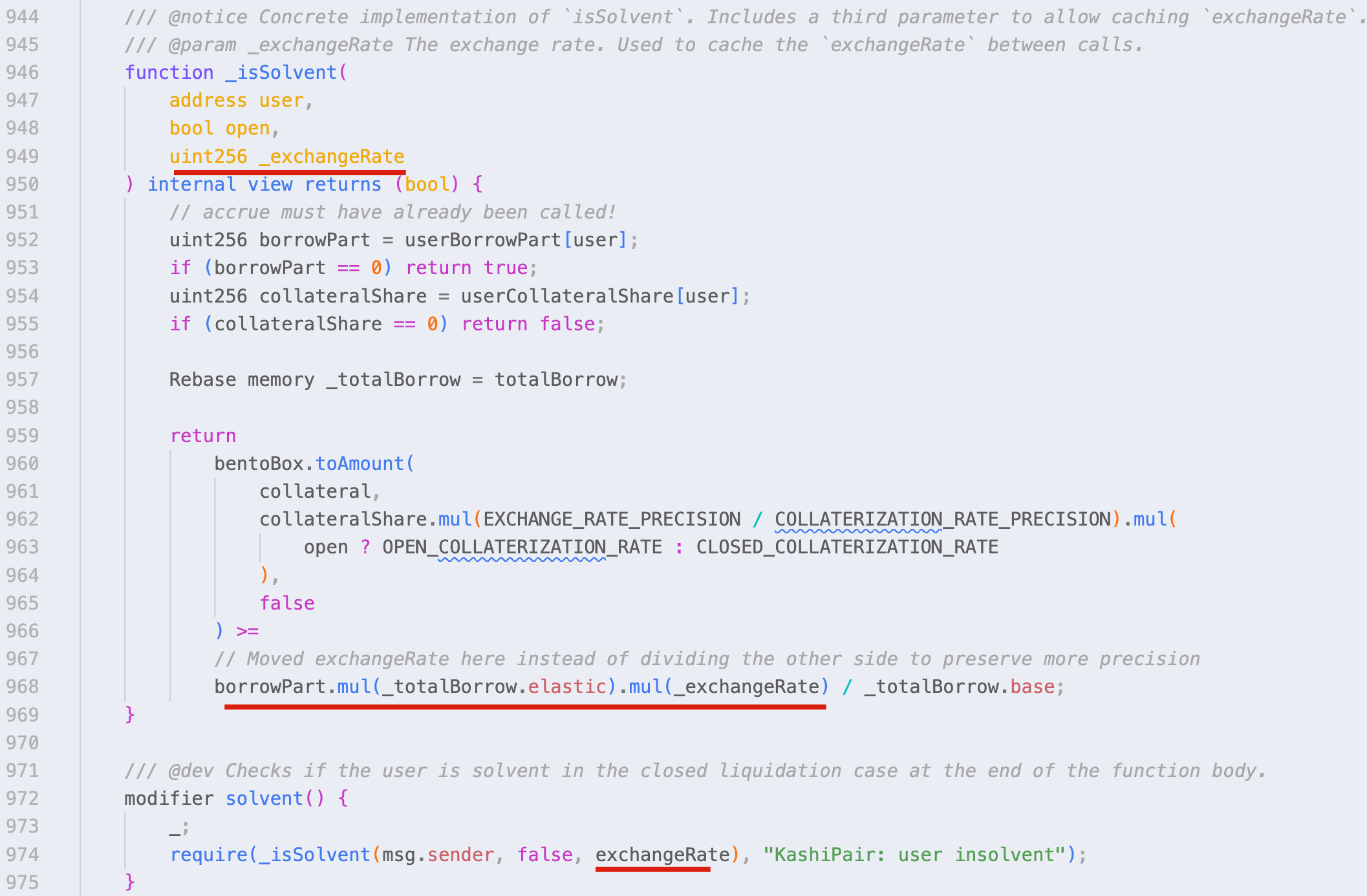
After anaylzing the source code of the KashiPairMediumRiskV1 contract, we conclude that this bug lies in the borrow function, which uses the outdated exchangeRate to verify the borrow share in the solvent modifier. Specifically, the verification will be performed based on the current value of exchangeRate in the _isSolvent function.
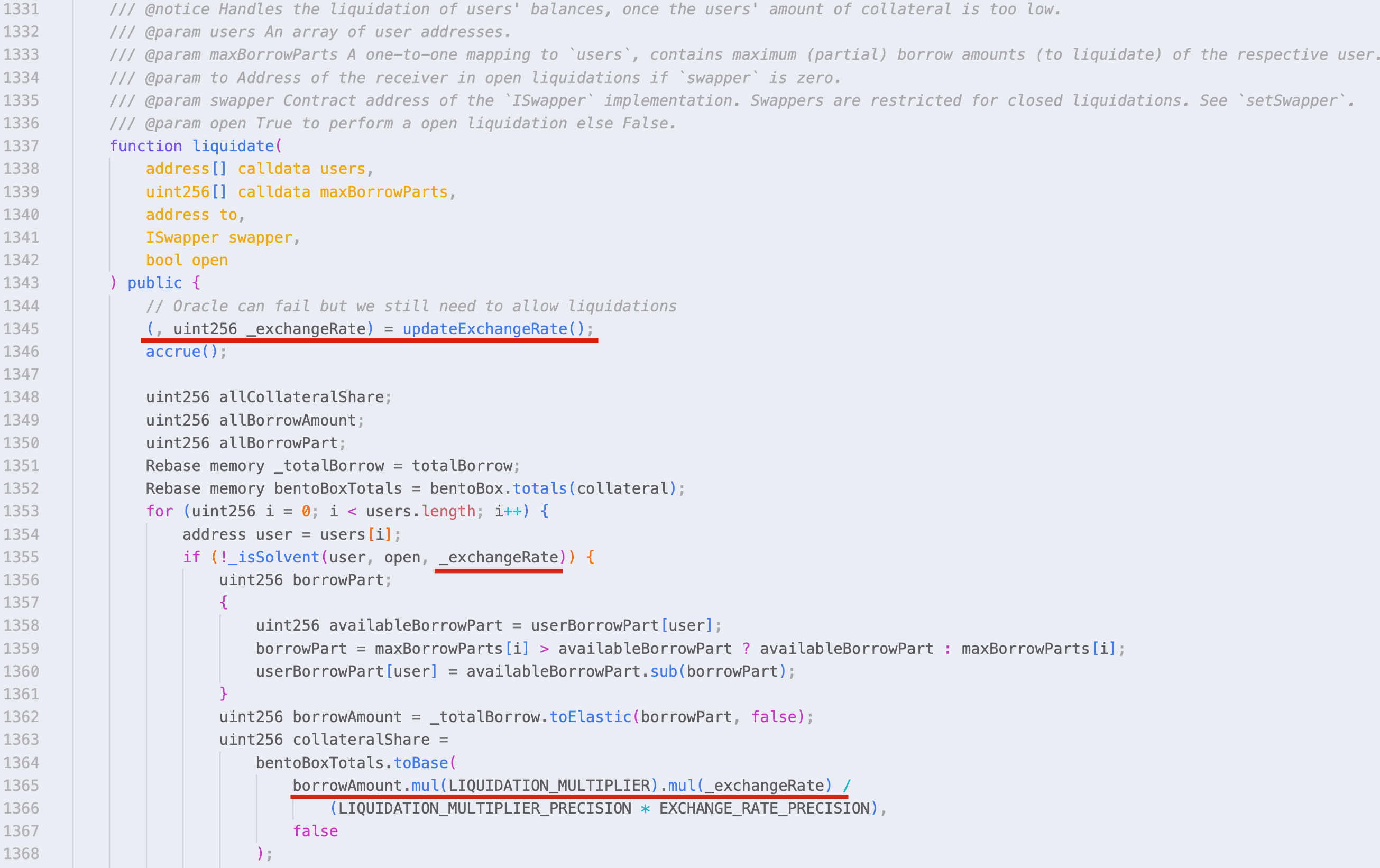
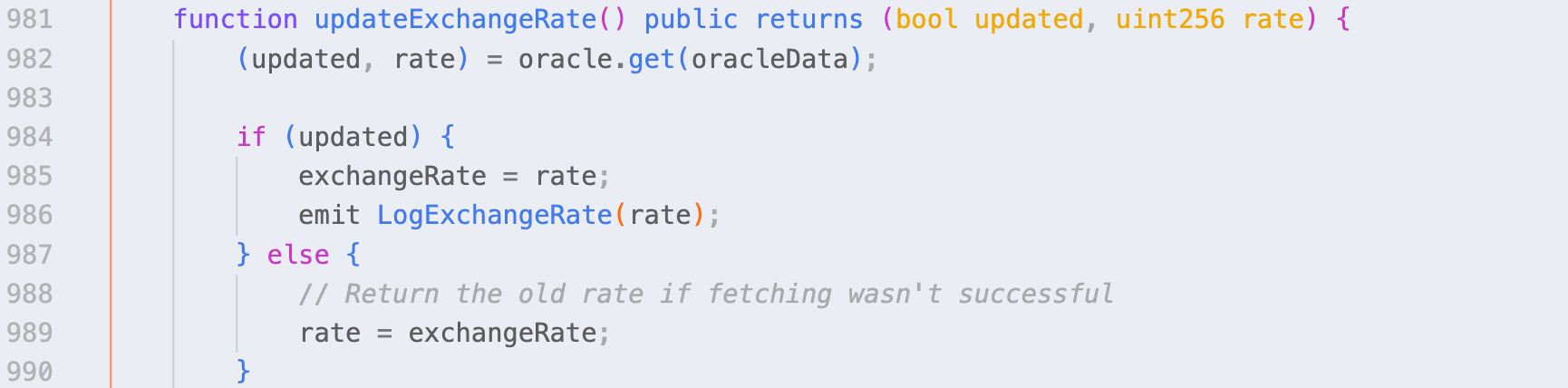
While in the liquidate function, the updateExchangeRate function is invoked at the very beginning. Hence the verfication and calculation will be performed based on the updated value.
Obviously, this bug could be exploited to lead to a (huge) price difference.
Attack Analysis
We observed two attacks:
- 0xcf8f242ea83100b6d43e659f7f53a698d304fc6ac2ca6fe79e3e07ee05fefe58: the victim uses the KashiPairMediumRiskV1 contract, and the loss is around 9,466 USDC.
- 0x3d163bfbec5686d428a6d43e45e2626a220cc4fcfac7620c620b82c1f2537c78: the victim is a strategy contract uses CauldronMediumRiskV1 (the fork of KashiPairMediumRiskV1), and the loss is around 110,911 MIM.
Note that, the first attack transaction was launched by a bot which front-runs the original attack transaction: 0x7a845d8d2af7919f5b9e22dd5571305cb5347d17986a8402715c1463d515fc18, and the original attacker address is 0xb7ea0f0f8c6df7a61bf024db21bbe85ac5688005.
Here we take the first attack transaction as an example, which consists of the following steps:
- Borrowing a flashloan of 40,900 BADGER and 121,904 USDC from
Balancer. - Depositing 40,900 BADGER and 113,599 USDC to
BentoBox. - Invoking the
addCollateralfunction of kmBADGER/USDC-LINK to deposit 40,900,000,000,000,000,000,000 shares of BADGER. - Invoking the
addAssetfunction of kmBADGER/USDC-LINK to deposit 112,529,000,000 shares of USDC. - Invoking the
borrowfunction to borrow 120,755,095,093 shares of USDC. - Invoking the
UpdateExchangeRatefunction. - Invoking the
liquidatefunction to liquidate itself. - Withdraw 40,899 BADGER and 123,006 USDC from
BentoBox. - Repaying the flashloan and obtaining a profit of about 9466 USDC.
Note that step 6 is not necessary, because the
borrowfunction will invoke theUpdateExchangeRatefunction.
The key steps are as follows:
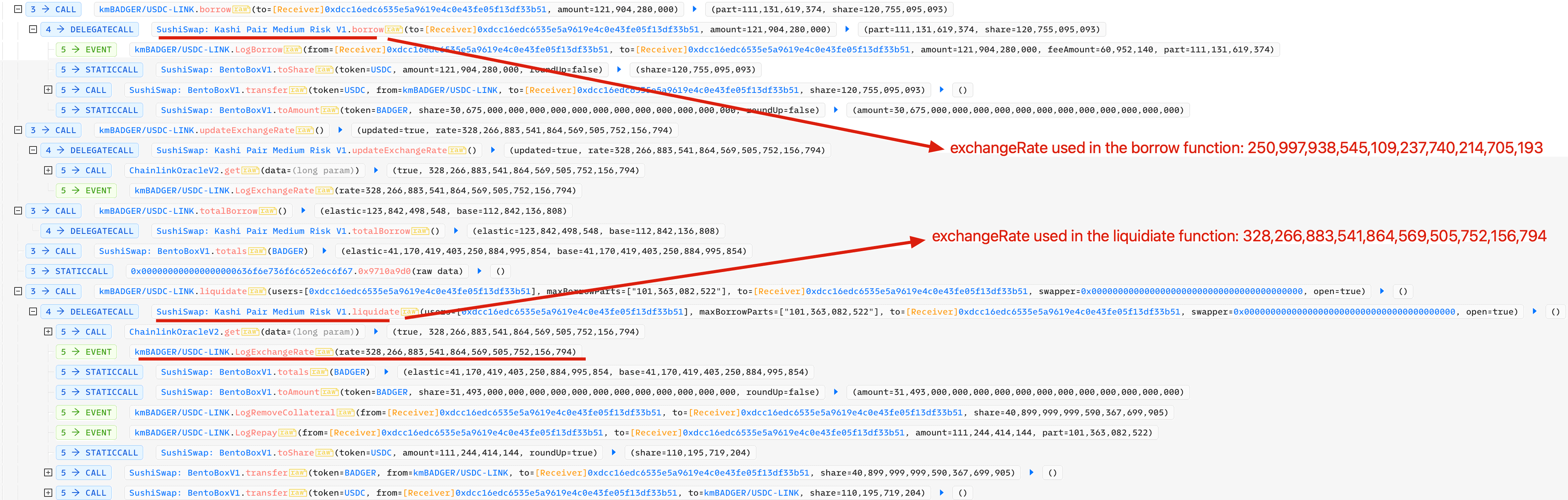 It is not difficult to figure that the value of
 exchangeRate used in the borrow function deviates from the value used in the liquidate function:
- In the
borrowfunction: 250,997,938,545,109,237,740,214,705,193 - In the
liquidatefunction: 328,266,883,541,864,569,505,752,156,794
The Impact
There are dozens of pools (on both Ethereum and BSC) that might be affected by this bug. A temporary method to mitigate this issue is to reduce or eliminate the deviation by invoking the UpdateExchangeRate function occasionally (or periodically). This method has already been adopted by many affected projects and the corresponding transactions can be observed in the wild.
Takeaway
Making a DeFi project secure is not an easy job. Besides the code audit, we think the community should take a proactive method to monitor the project status, and block the attack before it even takes place.
About BlockSec
BlockSec is a pioneering blockchain security company established in 2021 by a group of globally distinguished security experts. The company is committed to enhancing security and usability for the emerging Web3 world in order to facilitate its mass adoption. To this end, BlockSec provides smart contract and EVM chain security auditing services, the Phalcon platform for security development and blocking threats proactively, the MetaSleuth platform for fund tracking and investigation, and MetaDock extension for web3 builders surfing efficiently in the crypto world.
To date, the company has served over 300 esteemed clients such as MetaMask, Uniswap Foundation, Compound, Forta, and PancakeSwap, and received tens of millions of US dollars in two rounds of financing from preeminent investors, including Matrix Partners, Vitalbridge Capital, and Fenbushi Capital.
Official website: https://blocksec.com/
Official Twitter account: https://twitter.com/BlockSecTeam