When “SafeMint” Becomes Unsafe: Lessons from the HypeBears Security Incident

When “SafeMint” Becomes Unsafe: Lessons from the HypeBears Security Incident

On the morning of Feb 3rd (+8 timezone), our system reported an attack transaction 0xfa97c3476aa8aeac662dae0cc3f0d3da48472ff4e7c55d0e305901ec37a2f704 towards the HypeBears NFT contract. After the investigation, we found it's a re-entrancy attack caused by the _safeMint function of ERC721.

The root cause

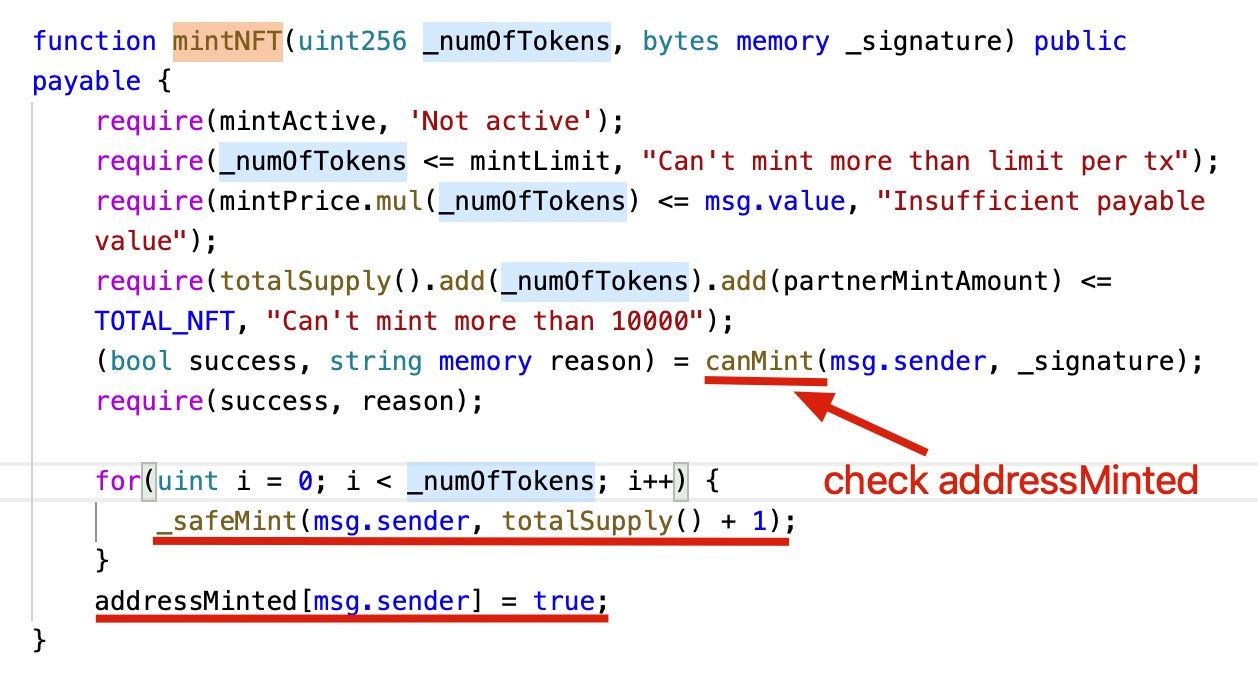
The project has a limitation of the NTFs that an account can mint. Basically, it has a map addressMinted that logs whether an account has minted the NTFs.

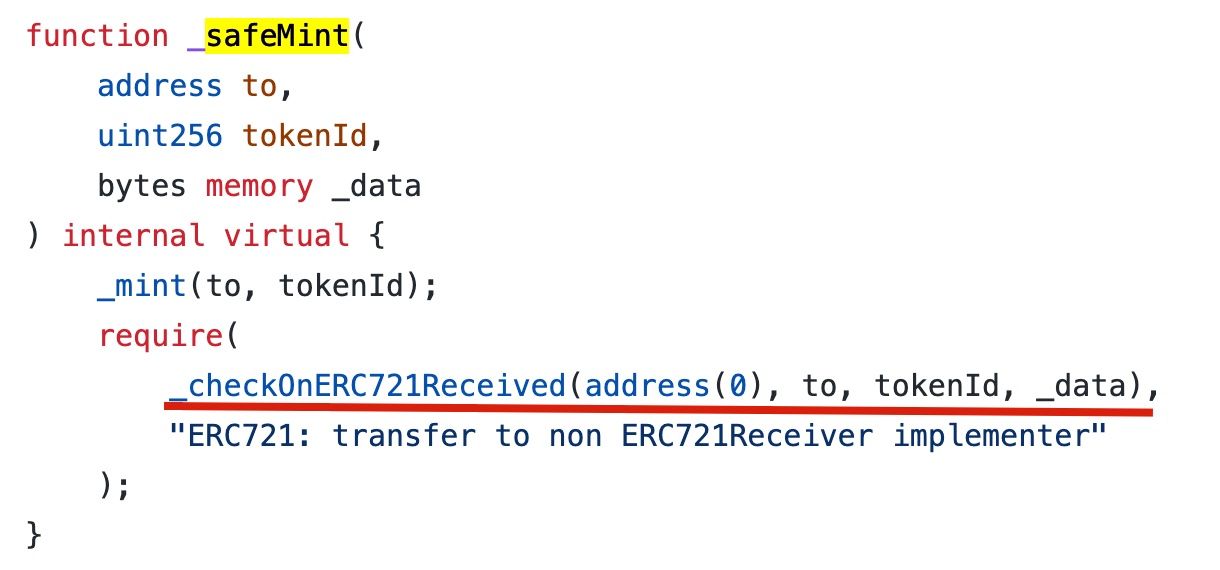
When minting NFTs, the code uses _safeMint function of the OZ reference implementation. This function is safe because it checks whether the receiver can receive ERC721 tokens. The can prevent the case that a NFT will be minted to a contract that cannot handle ERC721 tokens. According to the document:

If to refers to a smart contract, it must implement IERC721Receiver.onERC721Received, which is called upon a safe transfer. The following code shows the OZ implementation of _safeMint function.

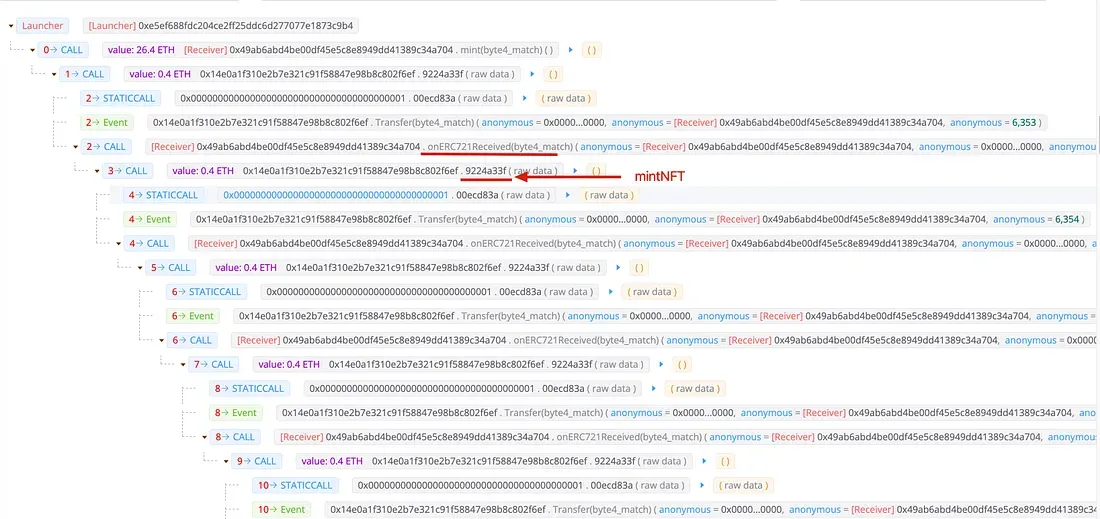
However, this external function call creates a security loophole. Specifically, the attacker can perform a reentrant call inside the onERC721Received callback. For instance, in the vulnerable HypeBears contract, the attacker can invoke the mintNFT function again in the onERC721Received callback (since 1addressMinted` has not been updated.)
The attack

The following screenshot shows the attack transaction.
Lessons

The risk called by SafeMint has been discussed by security researchers link1 link2. However, we can still see the vulnerable code and the attack in the wild. As shown in the safeTransfer in QBridge security incident, using a safe function does not guarantee a safe contract 😃.
Sign up for the latest updates
Weekly Web3 Security Incident Roundup | Feb 9 – Feb 15, 2026

Weekly Web3 Security Incident Roundup | Feb 9 – Feb 15, 2026

During the week of February 9 to February 15, 2026, three blockchain security incidents were reported with total losses of ~$657K. All incidents occurred on the BNB Smart Chain and involved flawed business logic in DeFi token contracts. The primary causes included an unchecked balance withdrawal from an intermediary contract that allowed donation-based inflation of a liquidity addition targeted by a sandwich attack, a post-swap deflationary clawback that returned sold tokens to the caller while draining pool reserves to create a repeatable price-manipulation primitive, and a token transfer override that burned tokens directly from a Uniswap V2 pair's balance and force-synced reserves within the same transaction to artificially inflate the token price.

Top 10 "Awesome" Security Incidents in 2025

Top 10 "Awesome" Security Incidents in 2025

To help the community learn from what happened, BlockSec selected ten incidents that stood out most this year. These cases were chosen not only for the scale of loss, but also for the distinct techniques involved, the unexpected twists in execution, and the new or underexplored attack surfaces they revealed.

#10 Panoptic Incident: XOR Linearity Breaks the Position Fingerprint Scheme

#10 Panoptic Incident: XOR Linearity Breaks the Position Fingerprint Scheme

On August 29, 2025, Panoptic disclosed a Cantina bounty finding and confirmed that, with support from Cantina and Seal911, it executed a rescue operation on August 25 to secure roughly $400K in funds. The issue stemmed from a flaw in Panoptic’s position fingerprint calculation algorithm, which could have enabled incorrect position identification and downstream fund risk.