Back to Blog

How did BlockSec Save $5M Worth of Crypto Assets in Successful ParaSpace Attack Blocking

Phalcon
March 17, 2023

On 2023–03–17 05:48:59 (UTC), BlockSec successfully blocked an attack attempt on ParaSpace (a top NFT lending protocol) and protected crypto assets worth $5M.
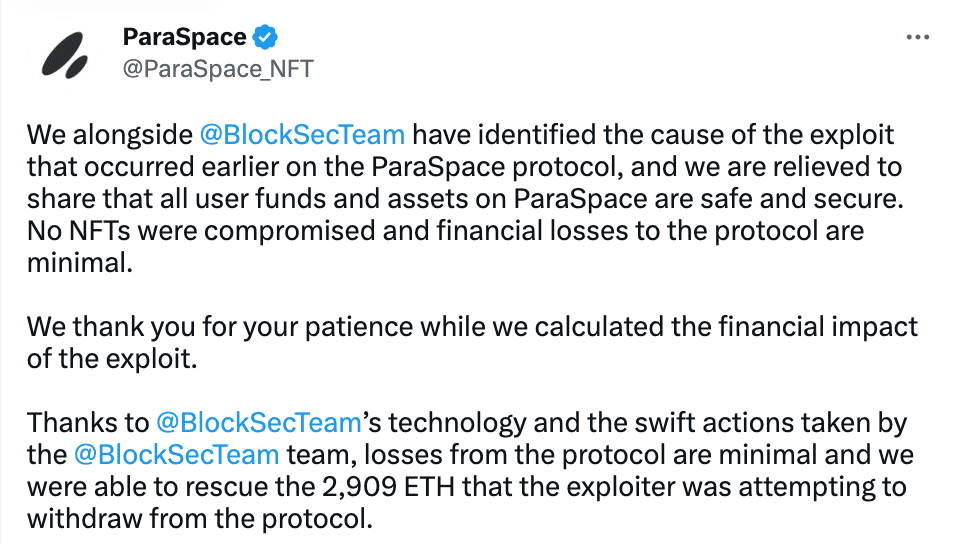
As mentioned in the previous blog, we always believe a more proactive threat prevention solution can help to defend against the threats. We have deployed such a system internally in 2022. As of this writing, our system successfully blocked multiple attacks and saved around 14 million USD users’ assets.

See our perspective on proactive threat prevention in this article.

The feasibility and practice of our solution have been widely recognized by the community, and we have collaborated with some top-notch partners in the community. For example, we are working with Compound to develop a risk prevention system for Compound V3 smart contracts.

We always try to build blockchain security infrastructure for the Web3 community, including Phalcon Explorer (a transaction analysis tool for Web3 developers and security researchers), MetaDock (a security toolbox for Web3 users), and MetaSleuth (a fund tracing tool for Web3 users).
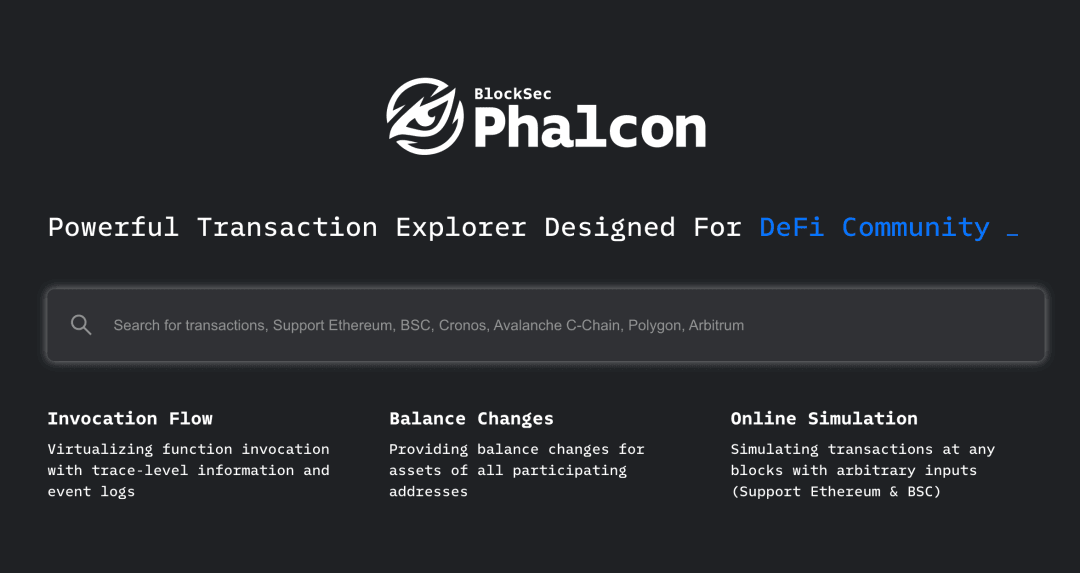

Phalcon Explorer
Phalcon Explorer
MetaDock
MetaDock
MetaSleuth
MetaSleuth

Learn more about BlockSec: Website | Document | Twitter | Medium | TG Group

Sign up for the latest updates
Tracing $1.6B in TRON USDT: Inside the VerilyHK Ponzi Infrastructure
Case Studies

Tracing $1.6B in TRON USDT: Inside the VerilyHK Ponzi Infrastructure

An on-chain investigation into VerilyHK, a fraudulent platform that moved $1.6B in TRON USDT through a multi-layered fund-routing infrastructure of rotating wallets, paired payout channels, and exchange exit funnels, with traced connections to the FinCEN-sanctioned Huione Group.

Weekly Web3 Security Incident Roundup | Mar 30 – Apr 5, 2026
Security Insights

Weekly Web3 Security Incident Roundup | Mar 30 – Apr 5, 2026

This BlockSec weekly security report covers nine DeFi attack incidents detected between March 30 and April 5, 2026, across Solana, BNB Chain, Arbitrum, and Polygon, with total estimated losses of approximately $287M. The week was dominated by the $285.3M Drift Protocol exploit on Solana, where attackers combined multisig signer social engineering with Solana's durable nonce mechanism to bypass a zero-timelock 2-of-5 Security Council, alongside notable incidents including a $950K flash loan TWAP manipulation against the LML staking protocol, a $359K Silo Finance vault inflation via an external `wstUSR` market donation exploiting a depegged-asset oracle and `totalAssets()` accounting flaw, and an EIP-7702 delegated-code access control failure. The report provides detailed vulnerability analysis and attack transaction breakdowns for each incident, covering flawed business logic, access control, price manipulation, phishing, and misconfiguration attack types.

Drift Protocol Incident: Multisig Governance Compromise via Durable Nonce Exploitation
Security Insights

Drift Protocol Incident: Multisig Governance Compromise via Durable Nonce Exploitation

On April 1, 2026 (UTC), Drift Protocol on Solana suffered a $285.3M loss after an attacker exploited Solana's durable nonce mechanism to delay the execution of phished multisig approvals, ultimately transferring administrative control of the protocol's 2-of-5 Squads governance with zero timelock. With full admin privileges, the attacker created a malicious collateral market (CVT), inflated its oracle price, relaxed withdrawal protections, and drained USDC, JLP, SOL, cbBTC, and other assets through 31 rapid withdrawals in approximately 12 minutes. This incident highlights how durable nonce-based delayed execution can decouple signer intent from on-chain execution, bypassing the temporal assumptions that multisig security implicitly relies on.